
Close Menu
    Facebook X (Twitter) Instagram
    SciTechDaily
    • Biology
    • Chemistry
    • Earth
    • Health
    • Physics
    • Science
    • Space
    • Technology
    Facebook X (Twitter) Pinterest YouTube RSS
    SciTechDaily
    Home»Space»New Spitzer Image: A Space Spider Watches Over Young Stars
    Space

    New Spitzer Image: A Space Spider Watches Over Young Stars

    By Elizabeth Landau, Jet Propulsion LaboratoryApril 14, 2016No Comments2 Mins Read
    Facebook Twitter Pinterest Telegram LinkedIn WhatsApp Email Reddit
    Share
    Facebook Twitter LinkedIn Pinterest Telegram Email Reddit
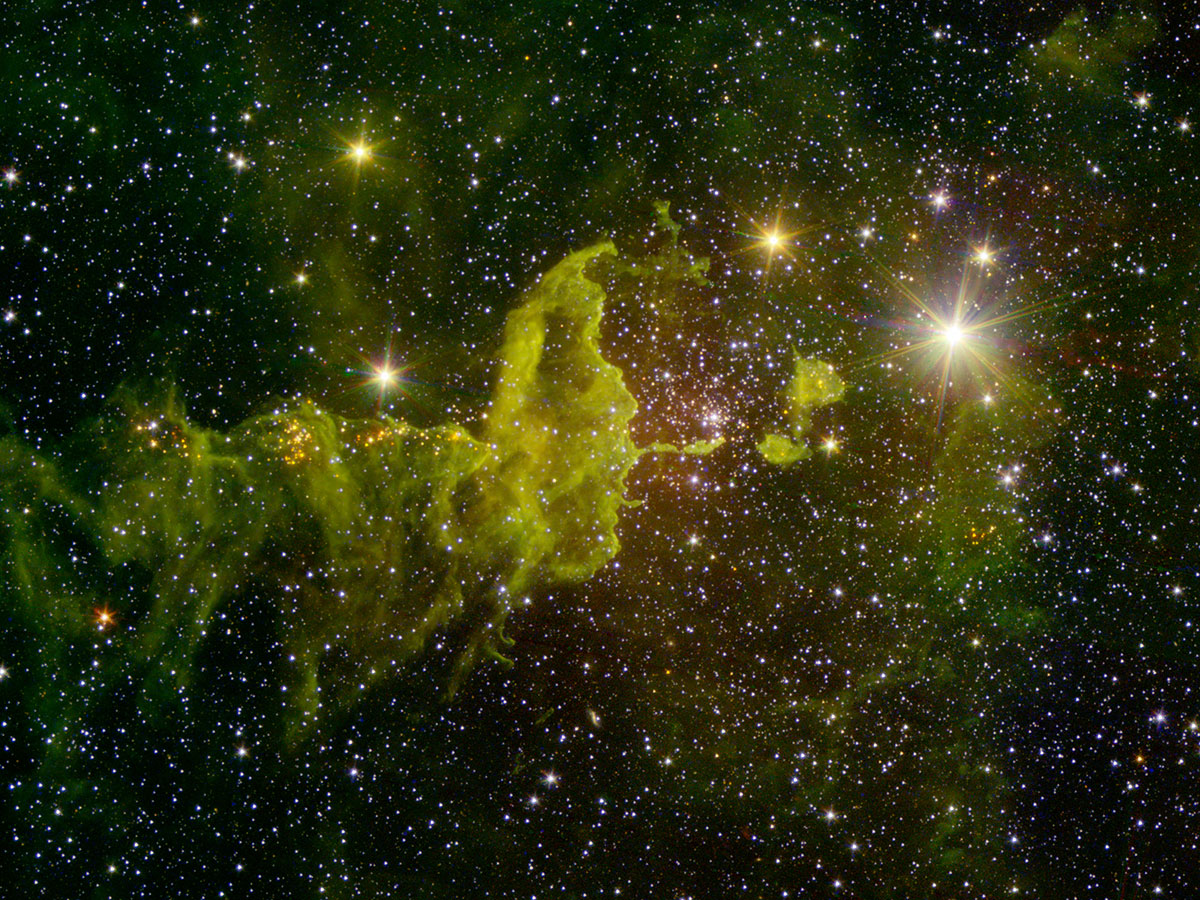
    Spitzer Views the Spider Nebula
    Nebula IC 417, the Spider, is located about 10,000 light-years from Earth in the constellation Auriga

    This new infrared image from NASA’s Spitzer Space Telescope and the Two Micron All Sky Survey shows IC 417, which is about 10,000 light-years away.

    A nebula known as “the Spider” glows fluorescent green in an infrared image from NASA’s Spitzer Space Telescope and the Two Micron All Sky Survey (2MASS). The Spider, officially named IC 417, lies near a much smaller object called NGC 1931, not pictured in the image. Together, the two are called “The Spider and the Fly” nebulae. Nebulae are clouds of interstellar gas and dust where stars can form.

    The Spider, located about 10,000 light-years from Earth in the constellation Auriga, is clearly a site of star formation. It resides in the outer part of the Milky Way, almost exactly in the opposite direction from the galactic center. A group of students, teachers, and scientists focused their attention on this region as part of the NASA/IPAC Teacher Archive Research Program (NITARP) in 2015. They worked on identifying new stars in this area.

    One of the largest clusters of young stars in the Spider can be seen easily in the image. Toward the right of the center, against the black background of space, you can see a bright group of stars called “Stock 8.” The light from this cluster carves out a bowl in the nearby dust clouds, seen in the image as green fluff. Along the sinuous tail in the center, and to the left, the groupings of red point sources clumped in the green are also young stars.

    In the image, infrared wavelengths, which are invisible to the unaided eye, have been assigned visible colors. Light with a wavelength of 1.2 microns, detected by 2MASS, is shown in blue. The Spitzer wavelengths of 3.6 and 4.5 microns are green and red, respectively.

    Spitzer data used to create the image were obtained during the space telescope’s “warm mission” phase, following its depletion of coolant in mid-2009. Due to its design, Spitzer remains cold enough to operate efficiently at two channels of infrared light. It is now in its 12th year of operation since launch.

    The 2MASS mission was a joint effort between the California Institute of Technology, Pasadena; the University of Massachusetts, Amherst; and NASA’s Jet Propulsion Laboratory, Pasadena, California.

    Never miss a breakthrough: Join the SciTechDaily newsletter.
    Follow us on Google and Google News.

    Astronomy NASA Popular Spitzer Space Telescope
    Share. Facebook Twitter Pinterest LinkedIn Email Reddit

    Related Articles

    NASA Discovers Pair of Super-Earths With 1,000-Mile-Deep Oceans

    Incredibly Sharp Webb Space Telescope Test Images Hint at New Possibilities for Science

    Scores of Baby Stars Revealed in the Orion Constellation

    Godzilla Nebula: A “Monster” Star-Forming Region Spied by NASA’s Spitzer Space Telescope

    Hidden Supernova: Stars Are Exploding in Dusty Galaxies – We Just Can’t Always See Them

    New Worlds in a River of Young Stars Discovered by NASA’s Transiting Exoplanet Survey Satellite

    3D Map of Cosmic Neighborhood Created With Help From Worldwide Network of Citizen Scientists

    First Possible “Survivor” Planet Discovered by NASA Next to a Stellar Cinder

    NASA’s Spitzer Spies a Massive Star Factory – 2 Quadrillion Miles Across

    Leave A Reply Cancel Reply

    • Facebook
    • Twitter
    • Pinterest
    • YouTube

    Don't Miss a Discovery

    Subscribe for the Latest in Science & Tech!

    Trending News

    Tea or Coffee? Your Daily Choice Could Affect Osteoporosis Risk

    Vitamin C May Fight Cancer in a Surprising Way

    Hidden Earthquake Threat: Oregon’s Fault May Be Closer to the Surface Than Scientists Thought

    Scientists Discover Hidden Sleep Switch That Boosts Brainpower, Builds Muscle, and Burns Fat

    Ancient Mega-Floods Once Ripped Across Mars and Left This Giant Scar

    Scientists Discover Cheap, Natural Remedy for High Blood Pressure

    Earth’s Upper Atmosphere Is Cooling Fast and Scientists Finally Know Why

    32,000 Olympic Pools of Magma Nearly Erupted Beneath Atlantic Island

    Follow SciTechDaily
    • Facebook
    • Twitter
    • YouTube
    • Pinterest
    • Newsletter
    • RSS
    SciTech News
    • Biology News
    • Chemistry News
    • Earth News
    • Health News
    • Physics News
    • Science News
    • Space News
    • Technology News
    Recent Posts
    • Ancient Roman Gold Mines Discovered in Spain’s Pyrenees
    • Ancient DNA Reveals How Farming Spread and Nearly Broke a Civilization
    • 146,000-Year-Old Discovery Rewrites the Story of Human Creativity
    • The Type of Alcohol You Drink Could Affect How Long You Live
    • 19-Year Study Reveals the Surprising Truth About Sitting and Dementia
    Copyright © 1998 - 2026 SciTechDaily. All Rights Reserved.
    • Science News
    • About
    • Contact
    • Editorial Board
    • Privacy Policy
    • Terms of Use

    Type above and press Enter to search. Press Esc to cancel.