

Close Menu
    Facebook X (Twitter) Instagram
    SciTechDaily
    • Biology
    • Chemistry
    • Earth
    • Health
    • Physics
    • Science
    • Space
    • Technology
    Facebook X (Twitter) Pinterest YouTube RSS
    SciTechDaily
    Home»Chemistry»New Sports Sensors Could Help Prevent Bad Referee Calls
    Chemistry

    New Sports Sensors Could Help Prevent Bad Referee Calls

    By American Chemical SocietyMarch 14, 2023No Comments3 Mins Read
    Facebook Twitter Pinterest Telegram LinkedIn WhatsApp Email Reddit
    Share
    Facebook Twitter LinkedIn Pinterest Telegram Email Reddit
    Bad Call Football Referee
    According to the researchers, the work could also pave a way for exploring other applications for nanogenerators in sports.

    Hybrid nanogenerators now enable real-time tracking of punches and cricket hits, offering precise data for performance analysis and improved officiating in sports.

    If you tuned in to the latest Super Bowl, you saw firsthand the crucial role that a referee’s decisions play in determining the outcome of the game. Slow-motion replays and close-watching eyes help, but a new sensor technology could soon provide a more reliable tool for officials. According to a recent study published in ACS Applied Nano Materials, researchers have created a hybrid nanogenerator sensor that is self-powered and could improve the accuracy of calls and enhance the training process for boxers and cricket players.

    The widespread availability of sensors and their increasing simplicity have opened up new possibilities in the world of sports. These sensors can provide in-depth insights for referees, coaches, and players, but for this to be practical, they must be compact, self-sustaining, and cost-effective.

    Two technologies well suited for this are triboelectric nanogenerators (TENGs) and piezoelectric nanogenerators (PENGs). Both work by converting mechanical energy into electric energy, albeit in different ways.
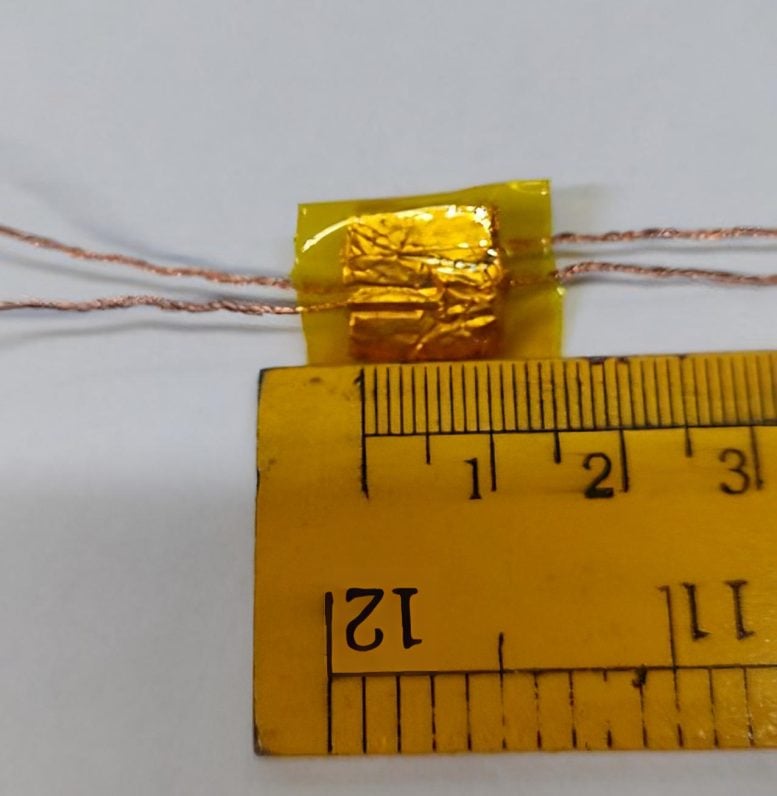
    Hybrid Nanogenerator Powered Sensor
    A hybrid nanogenerator-powered sensor, shown above a ruler, could help improve performance and gameplay in boxing and cricket. Credit: ACS Applied Nano Materials, 2023, DOI: 10.1021/acsanm.2c04731

    When combined into one hybrid nanogenerator, their individual shortcomings can be mitigated, but these devices have so far failed to find many practical applications. So, Nishat Kumar Das, Om Priya Nanda, and Sushmee Badhulika from the Indian Institute of Technology wanted to create a sensor powered by a hybrid nanogenerator that could be used to monitor real-life performance in boxing and cricket.

    Hybrid Nanogenerator Sensor

    To manufacture their sensor, the researchers created nanofibers from lithium-modified zinc titanium oxide. These were layered with copper, a special kind of tape, and other films with certain characteristics to create either a TENG or PENG. The PENG was mounted to a cricket bat and the stumps of a wicket — used similarly to the bases in American baseball. If the ball contacted the sensors, it produced a voltage that could be used to determine a call.

    When used during practice, it provided data corresponding to the accuracy and power of the swing, with a response time of around 0.02 seconds. Then, they combined this PENG with a TENG to make a hybrid nanogenerator, four of which were then mounted to different parts of a punching bag. The devices distinguished between the six different types of punches used in boxing, as well as the speed of each, giving a player and their coach information about their style. The researchers say that this work could pave a way for exploring other applications for nanogenerators in sports.

    Reference: “Piezo/Triboelectric Nanogenerator from Lithium-Modified Zinc Titanium Oxide Nanofibers to Monitor Contact in Sports” by Nishat Kumar Das, Om Priya Nanda and Sushmee Badhulika, 2 February 2023, ACS Applied Nano Materials.
    DOI: 10.1021/acsanm.2c04731

    The study was funded by the Defense Research Development Organization (DRDO).

    Never miss a breakthrough: Join the SciTechDaily newsletter.
    Follow us on Google and Google News.

    American Chemical Society Nanomaterials Nanotechnology Sensor
    Share. Facebook Twitter Pinterest LinkedIn Email Reddit

    Related Articles

    Cancer Breathalyzer: Nanotech Breath Test for Cancer Could Save Lives

    COVID-19 or Flu? New Nano-Sensor Delivers Answers in Just 10 Seconds

    Researchers Have Developed a Fully Automated Analyzer That Could Help Detect Signs of Extraterrestrial Life

    Machinery of Photosynthesis Supercharges Solar Energy to Hydrogen Fuel Conversion

    Diagnostic Biosensor Detects SARS-CoV-2 From Nasopharyngeal Swab in Less Than a Minute

    Using Fish Scales to Make Wearable Electronics More Sustainable

    Using an Engineered Nanomaterial and Sunlight to Decontaminate Pesticide-Polluted Water

    Human Cells Made Magnetic With Engineered Protein Crystals

    Gold Nanorods Shaped as Starfruit Deliver Impressive Results

    Leave A Reply Cancel Reply

    • Facebook
    • Twitter
    • Pinterest
    • YouTube

    Don't Miss a Discovery

    Subscribe for the Latest in Science & Tech!

    Trending News

    Millions Take These IBS Drugs, But a New Study Finds Serious Risks

    Scientists Unlock Hidden Secrets of 2,300-Year-Old Mummies Using Cutting-Edge CT Scanner

    Bread Might Be Making You Gain Weight Even Without Eating More Calories

    Scientists Discover Massive Magma Reservoir Beneath Tuscany

    Europe’s Most Active Volcano Just Got Stranger – Here’s Why Scientists Are Rethinking It

    Alzheimer’s Symptoms May Start Outside the Brain, Study Finds

    Millions Take This Popular Supplement – Scientists Discover a Concerning Link to Heart Failure

    The Universe Is Expanding Too Fast and Scientists Can’t Explain Why

    Follow SciTechDaily
    • Facebook
    • Twitter
    • YouTube
    • Pinterest
    • Newsletter
    • RSS
    SciTech News
    • Biology News
    • Chemistry News
    • Earth News
    • Health News
    • Physics News
    • Science News
    • Space News
    • Technology News
    Recent Posts
    • U.S. Waste Holds $5.7 Billion Worth of Crop Nutrients
    • Scientists Say a Hidden Structure May Exist Inside Earth’s Core
    • Doctors Surprised by the Power of a Simple Drug Against Colon Cancer
    • Why Popular Diabetes Drugs Like Ozempic Don’t Work for Everyone: The “Genetic Glitch”
    • Scientists Create Improved Insulin Cells That Reverse Diabetes in Mice
    Copyright © 1998 - 2026 SciTechDaily. All Rights Reserved.
    • Science News
    • About
    • Contact
    • Editorial Board
    • Privacy Policy
    • Terms of Use

    Type above and press Enter to search. Press Esc to cancel.