
Close Menu
    Facebook X (Twitter) Instagram
    SciTechDaily
    • Biology
    • Chemistry
    • Earth
    • Health
    • Physics
    • Science
    • Space
    • Technology
    Facebook X (Twitter) Pinterest YouTube RSS
    SciTechDaily
    Home»Technology»New Stretchable Light-Emitting Devices Can Be Applied to Human Skin
    Technology

    New Stretchable Light-Emitting Devices Can Be Applied to Human Skin

    By American Chemical SocietyNovember 3, 2019No Comments2 Mins Read
    Facebook Twitter Pinterest Telegram LinkedIn WhatsApp Email Reddit
    Share
    Facebook Twitter LinkedIn Pinterest Telegram Email Reddit
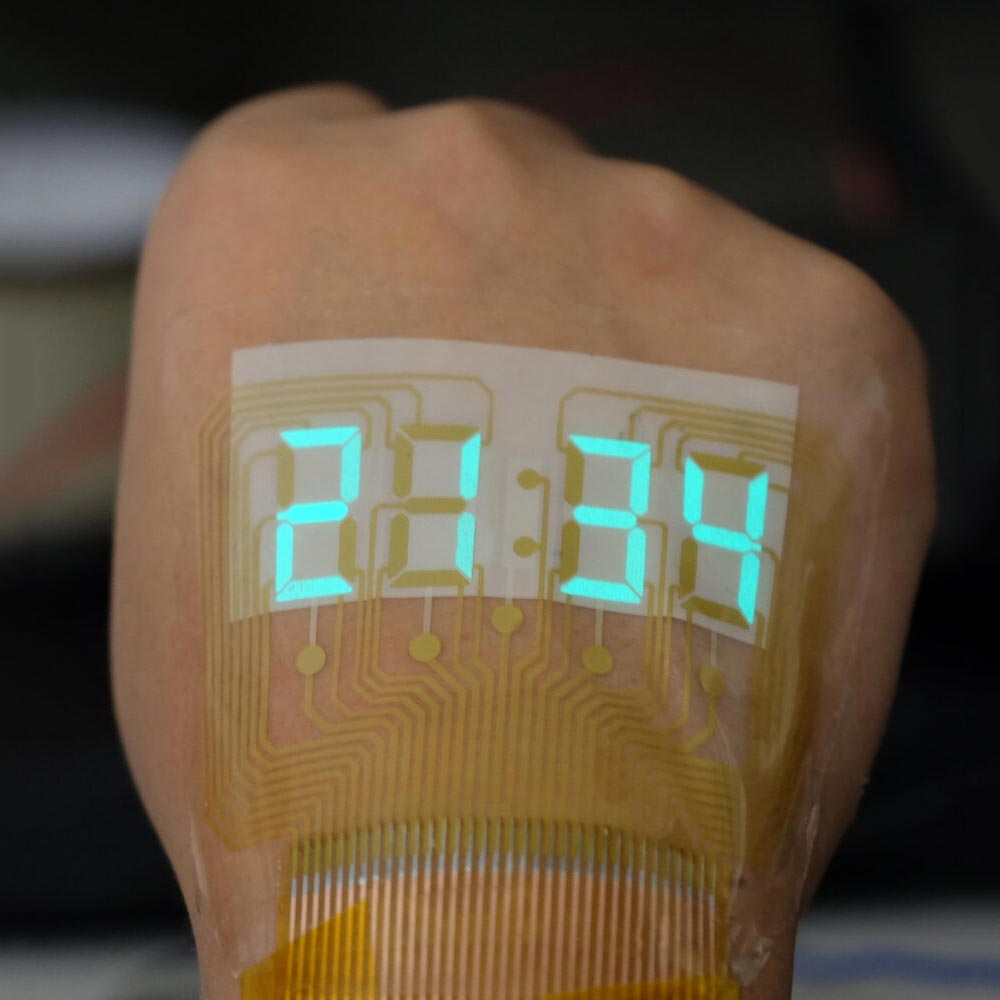
    Stretchable Stopwatch Lights up Human Skin
    A stretchable light-emitting device becomes an epidermal stopwatch. Credit: Adapted from ACS Materials Letters 2019, DOI: 10.1021/acsmaterialslett.9b00376.

    Imagine a runner who doesn’t need to carry a stopwatch or cell phone to check her time: She could just gaze at the glowing stopwatch display on the back of her hand. Such human-machine interfaces are no longer science fiction, but they still have a way to go before becoming mainstream. Now, researchers reporting in ACS Materials Letters have developed a stretchable light-emitting device that operates at low voltages and is safe for human skin.

    Recently, scientists have developed stretchable light-emitting devices called alternating-current electroluminescent (ACEL) displays that can be stuck on skin or other surfaces like a temporary tattoo. However, the displays require relatively high voltages to achieve sufficient brightness, which could create safety concerns. So, Desheng Kong and colleagues wanted to develop an ACEL that could operate at lower voltages and thus be safer for human skin.

    To make their device, the researchers sandwiched an electroluminescent layer, made of light-emitting microparticles dispersed in a stretchable dielectric material, between two flexible silver nanowire electrodes. The device contained a new type of dielectric material, in the form of ceramic nanoparticles embedded in a rubbery polymer, that increased the brightness compared with existing ACEL displays. They used this material to make a four-digit stopwatch display, which they mounted onto a volunteer’s hand. At low voltages, the stretchable display was sufficiently bright to be seen under indoor lighting. The bright stretchable display could find a broad range of applications in smart wearables, soft robotics, and human-machine interfaces, the researchers say.

    ###

    Reference: “Stretchable High-Permittivity Nanocomposites for Epidermal Alternating-Current Electroluminescent Displays” by Yunlei Zhou, Chaoshan Zhao, Jiachen Wang, Yanzhen Li, Chenxin Li, Hangyu Zhu, Shuxuan Feng, Shitai Cao and Desheng Kong, 4 October 2019, ACS Materials Letters.
    DOI: 10.1021/acsmaterialslett.9b00376

    The authors acknowledge funding from the National Key Research and Development Program of China, the National Natural Science Foundation of China, and Fundamental Research Funds for the Central Universities.

    Never miss a breakthrough: Join the SciTechDaily newsletter.
    Follow us on Google and Google News.

    American Chemical Society Biotechnology Robotics
    Share. Facebook Twitter Pinterest LinkedIn Email Reddit

    Related Articles

    Swarms of Microrobots Quickly Clean Up Radioactive Waste [Video]

    Fast-Acting Elastic Energy Robots Inspired by Chameleon’s Tongue Strike [Video]

    Army Research Into Artificial Muscle Nanomotors for More Effective Robots on the Future Battlefield

    Mosquito Eye Inspires Artificial Compound Lens That Could Lead to New Vision Systems [Video]

    Soft, Flexible Artificial Skin Produces a Realistic Sense of Touch [Video]

    Microscopic Biohybrid Robots Propelled by Muscles & Nerves Built by Researchers

    Robotic Thread Magnetically Steered Through the Brain’s Blood Vessels [Video]

    New Biosensor Can Monitor Glucose Levels From Contact Lenses

    Scientists Develop Electric Propulsion Technology for Nanorobots

    Leave A Reply Cancel Reply

    • Facebook
    • Twitter
    • Pinterest
    • YouTube

    Don't Miss a Discovery

    Subscribe for the Latest in Science & Tech!

    Trending News

    Largest-Ever Study Finds Medicinal Cannabis Ineffective for Anxiety, Depression, PTSD

    250-Million-Year-Old Egg Solves One of Evolution’s Biggest Mysteries

    Living With Roommates Might Be Changing Your Gut Microbiome Without You Knowing

    Century-Old Cleaning Chemical Linked to 500% Increased Risk of Parkinson’s Disease

    What if Your Memories Never Happened? Physicists Take a New Look at the Boltzmann Brain Paradox

    One of the Universe’s Largest Stars May Be Getting Ready To Explode

    Scientists Discover Enzyme That Could Supercharge Ozempic-Like Weight Loss Drugs

    Popular Sweetener Linked to DNA Damage – “It’s Something You Should Not Be Eating”

    Follow SciTechDaily
    • Facebook
    • Twitter
    • YouTube
    • Pinterest
    • Newsletter
    • RSS
    SciTech News
    • Biology News
    • Chemistry News
    • Earth News
    • Health News
    • Physics News
    • Science News
    • Space News
    • Technology News
    Recent Posts
    • Scientists Discover Coral Reefs Are Teeming With Previously Unknown Life
    • Scientists Find Way to Reverse Fatty Liver Disease Without Changing Diet
    • Could Humans Regrow Limbs? New Study Reveals Promising Genetic Pathway
    • Black Hole Jets Pack Power of 10,000 Suns, Stunning New Study Reveals
    • A Cosmic Crash Turned This Nearby Galaxy Into Chaos
    Copyright © 1998 - 2026 SciTechDaily. All Rights Reserved.
    • Science News
    • About
    • Contact
    • Editorial Board
    • Privacy Policy
    • Terms of Use

    Type above and press Enter to search. Press Esc to cancel.