

A groundbreaking study identifies the most influential modifiable non-clinical risk factors for enhancing heart health.
A new study has identified 56 non-clinical risk factors associated with sudden cardiac arrest (SCA), encompassing lifestyle behaviors, physical characteristics, psychosocial influences, socioeconomic status, and environmental exposures. The findings suggest that addressing these modifiable factors could prevent up to 63% of SCA cases. Published in the Canadian Journal of Cardiology, the study provides important new evidence on the role of non-medical factors in SCA prevention.
Sudden cardiac arrest remains a major global public health concern, with severe physical and psychological consequences for individuals, as well as significant ripple effects on families, social networks, and communities.
Due to its high mortality rate and unpredictable nature, SCA is one of the leading causes of death worldwide. In Canada alone, approximately 60,000 SCA events occur each year. Developing effective strategies to reduce this burden requires a better understanding of long-term, modifiable risk factors. Despite growing awareness, critical gaps in knowledge about how to prevent SCA still exist.
Lead investigator and first author of the article Huihuan Luo, PhD, School of Public Health, Key Lab of Public Health Safety of the Ministry of Education, and NHC Key Lab of Health Technology Assessment, Fudan University, Shanghai, China, explains, “All previous studies investigating the risk factors of SCA were hypothesis-driven and focused on a limited number of candidate exposure factors grounded in prior knowledge or theoretical frameworks. We conducted an exposome-wide association study, which examines the relationship between a wide range of environmental exposures and health outcomes using UK Biobank data, followed by Mendelian randomization to assess causal relationships. The study found significant associations between various modifiable factors and SCA, with lifestyle changes being the most impactful in preventing cases.”
Significant Preventative Potential
Eliminating the worst 1/3 of all risk domains (conservative elimination), 40% of SCA cases could be prevented according to the study, rising to 63% SCA prevention if the worst 2/3 of all risk factors were eliminated (thorough elimination). Lifestyle habits appeared to contribute the most to SCA prevention, accounting for 13% and 18% of SCA cases under conservative and thorough elimination, respectively.
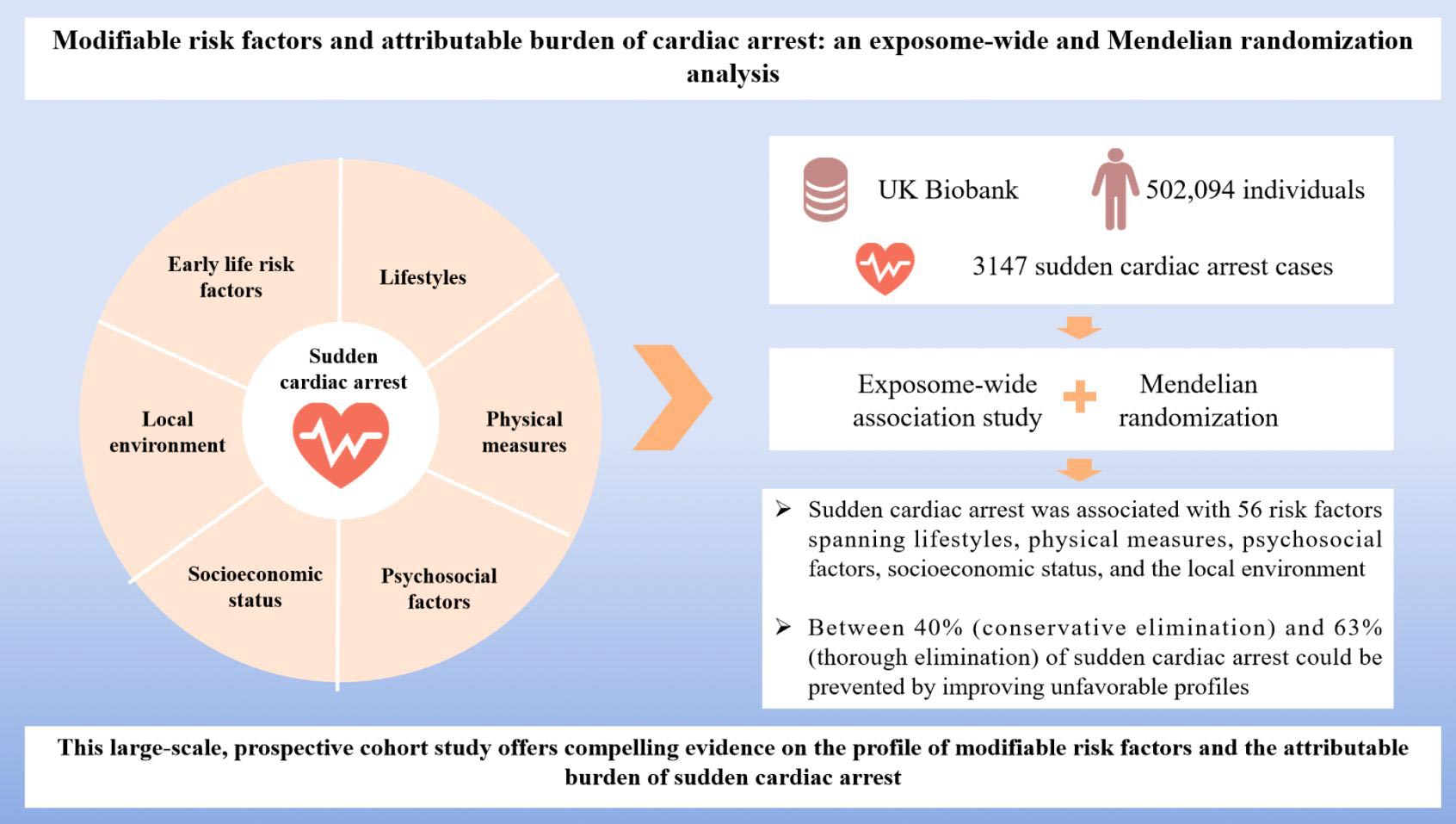
Co-investigator Renjie Chen, PhD, Department of Environmental Health, School of Public Health, Fudan University, Shanghai, China, points out, “To our knowledge, this is the first study that comprehensively investigated the associations between non-clinical modifiable risk factors and SCA incidence. We were surprised by the large proportion (40%–63%) of SCA cases that could be prevented by improving unfavorable profiles.”
Researchers found that factors such as higher consumption of champagne/white wine and increased fruit intake, along with maintaining a positive mood, weight management, blood pressure control, and improved education, may serve as important protective factors.
Rethinking Alcohol’s Role
The authors of the accompanying editorial Nicholas Grubic, MSc, Division of Epidemiology, Dalla Lana School of Public Health, University of Toronto, ON, Canada, and Dakota Gustafson, PhD, Department of Emergency Medicine and Department of Epidemiology, Faculty of Medicine, Queen’s University, Kingston, ON, Canada, say, “One of the study’s most intriguing findings is the cardioprotective effect associated with champagne and white wine consumption, questioning long-held assumptions about the specificity of red wine’s cardioprotective properties. Research on the underlying mechanisms remains unclear, but these findings reinforce the idea that the benefits of moderate alcohol consumption may be more complex than previously assumed.”
Surprisingly, computer use showed an inverse relationship with SCA risk, seemingly contradicting sedentary behavior risks. Dr. Luo explains, “While our initial analysis showed that correlation, we strongly suspect this reflects underlying socioeconomic or occupational differences between groups, not a direct protective effect from screen time. This is a common challenge in observational studies. By using advanced methods like Mendelian Randomization, we were able to dig deeper and filter out some of that ‘noise.’ The results from those more rigorous analyses didn’t show the same protective link, which strengthens our confidence in identifying the other, more clearly modifiable factors as the key targets for prevention.”
Mr. Grubic and Dr. Gustafson conclude, “To achieve dramatic reductions in the immense burden SCA places on the health system, this narrative must extend beyond acute intervention to a broader, population-wide strategy that prioritizes primary prevention. While shifting from responding to SCA to actively preventing its occurrence may seem straightforward, it is far more complex in practice. The multifactorial nature of these events – often influenced by a combination of genetic predispositions, underlying cardiovascular conditions, environmental triggers, and lifestyle factors – poses significant challenges for healthcare professionals and policymakers. Identifying modifiable factors linked to SCA is crucial for informing the development of high-quality public health messaging and interventions, especially in resource-limited environments.”
Reference: “Modifiable Risk Factors and Attributable Burden of Cardiac Arrest: An Exposome-wide and Mendelian Randomization Analysis” by Huihuan Luo, Qingli Zhang, Lu Zhou, Anni Li, Haidong Kan and Renjie Chen, 29 April 2025, Canadian Journal of Cardiology.
DOI: 10.1016/j.cjca.2025.02.027
Funding: National Key Research and Development Program of China, National Natural Science Foundation of China, Shanghai Committee of Science and Technology
Never miss a breakthrough: Join the SciTechDaily newsletter.
Follow us on Google and Google News.
1 Comment
As usual, no distinction between “nondrinkers” who chose not to drink and those compelled not to drink by their doctors (interaction with mediations and obvious health issues). This is a well recognized issue that should be addressed in all similar studies.