
New research supports the use of caffeine as a performance-enhancing aid by demonstrating that caffeine supplementation can reduce sprint time in the 100-meter dash.
In the high-stakes world of international sports, even the slightest advantage can make all the difference in an athlete’s performance. As a result, athletes often turn to training methods and performance-enhancing aids to give them a competitive edge.
Caffeine, a stimulant that affects the nervous system, is a popular choice among athletes as a performance-enhancing aid. In fact, World Athletics (formerly known as the International Association of Athletics Federations) has recognized caffeine as an ergogenic aid in a consensus statement on nutritional strategy for athletics.
However, owing to the absence of research on caffeine’s effects on sprint performance, the recommendation is reflective of evidence from other anaerobic sports rather than sprint running in athletics, like the 100-m sprint event.
A Study on Caffeine and 100-Meter Sprint Performance
To advance research, a team of researchers from Japan investigated the acute effects of caffeine supplementation on sprint running performance. This study, led by Professor Takeshi Hashimoto from Ritsumeikan University in Japan, was recently published in the Medicine & Science in Sports & Exercise journal.
According to Professor Hashimoto, “While previous studies have investigated the effects of caffeine on running activity, evidence from these studies is not conclusive enough to support the World Athletics consensus. A majority of them have looked at its effects on single sprint runs of less than 60 meters. Therefore, it was important to study the ergogenic effects of caffeine on the 100-meter sprint performance.”
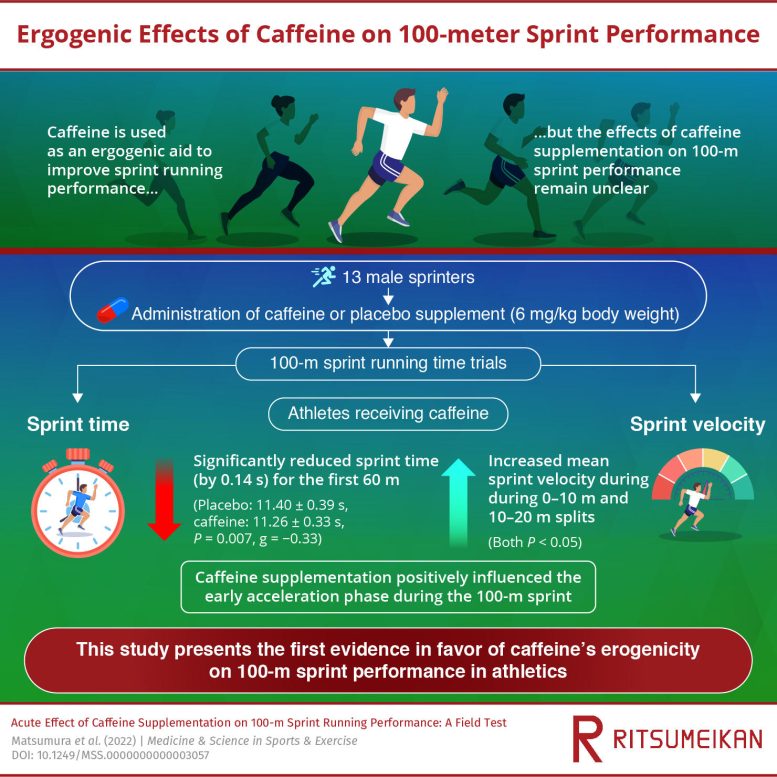
The researchers recruited 13 male collegiate sprinters for the study. In a preliminary test, the researchers determined the time it takes for each athlete to reach peak blood plasma caffeine concentration after ingesting it. Taking this into account, the athletes were called two more times for 100-meter time trials after ingesting either caffeine or placebo supplements.
As measures of performance, the researchers measured the sprint velocity and calculated the sprint time. On discounting the effects of environmental factors, the corrected sprint time was used to examine the effects of caffeine supplementation.
Caffeine’s Impact on Sprint Speed and Acceleration
The results revealed that the corrected 100-m sprint time was shortened significantly for athletes who received caffeine, with a decrease of 0.14 seconds compared to the controls. This decrease in the time was largely associated with a decrease in sprint time for the first 60 meters of the sprint.
The researchers also found that the mean sprint velocity for the 0–10 m and 10–20 m splits was significantly higher in the athletes who received caffeine. Moreover, no significant difference was seen in the sprint time for the last 40 meters of the sprint, despite the shortening of the sprint time in the first 60 meters. Together, these observations suggest that the caffeine supplementation provided more explosive acceleration to the sprinters in the early stage of the race.
In the long term, these results could translate to the enhancement of sports performance for athletes by enhancing the usage of caffeine as an ergogenic aid during sprints.
“The insights gained from this study have given us the first direct evidence of caffeine’s ergogenicity on sprint running in athletics. This also serves as evidence to directly support the recommendations for caffeine usage by World Athletics. The study thus provides one more advantage that athletes can use to inch themselves closer toward victory,” concludes Professor Hashimoto.
Determined to explore the ergogenic effects of caffeine further, Professor Hashimoto and his team intend to call to question the mechanisms behind the effects of caffeine on ballistic actions such as sprinting and jumping.
Reference: “Acute Effect of Caffeine Supplementation on 100-m Sprint Running Performance: A Field Test” by Teppei Matsumura, Keigo Tomoo, Takeshi Sugimoto, Hayato Tsukamoto, Yasushi Shinohara, Mitsuo Otsuka and Takeshi Hashimoto, 14 October 2022, Medicine & Science in Sports & Exercise.
DOI: 10.1249/MSS.0000000000003057
The study was funded by the Japanese Ministry of Education, Culture, Sports, Science, and Technology.
Never miss a breakthrough: Join the SciTechDaily newsletter.
Follow us on Google and Google News.
1 Comment
Caffeine improves everything from concentration to work and athletic performance. But caffeine IS a drug and as such shouldn’t be allowed in athletic competitions.