
Close Menu
    Facebook X (Twitter) Instagram
    SciTechDaily
    • Biology
    • Chemistry
    • Earth
    • Health
    • Physics
    • Science
    • Space
    • Technology
    Facebook X (Twitter) Pinterest YouTube RSS
    SciTechDaily
    Home»Chemistry»New Technique Allows Diapers To Be Recycled 200 Times Faster
    Chemistry

    New Technique Allows Diapers To Be Recycled 200 Times Faster

    By Karlsruhe Institute of Technology (KIT)December 14, 2023No Comments3 Mins Read
    Facebook Twitter Pinterest Telegram LinkedIn WhatsApp Email Reddit
    Share
    Facebook Twitter LinkedIn Pinterest Telegram Email Reddit
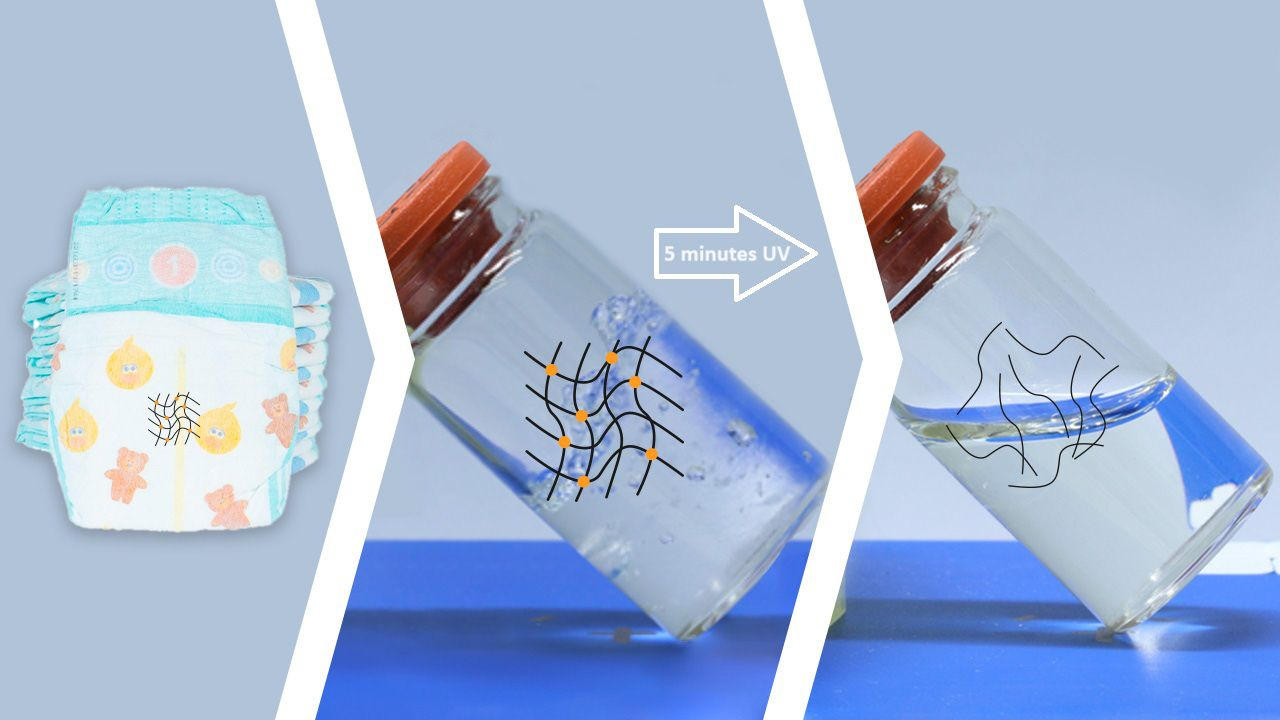
    Superabsorbers Become Liquid Under UV Light After They Have Taken Up Sufficient Water
    Superabsorbers become liquid under UV light after they have taken up sufficient water. Then, they can be reused. Credit: Ken Pekarsky, KIT

    Water and UV radiation effectively and swiftly break down the crosslinked polymers in diaper liners without the use of any chemicals. This process allows the recycled plastic molecules to be repurposed for diverse applications.

    Superabsorbent materials, like sodium polyacrylate, are key components in various hygiene and medical products, including diapers, bandages, and dressing materials. Typically, these crosslinked polymers, known for their high absorbency, are insoluble in water. Recycling them has traditionally necessitated the use of strong acids.

    At high temperatures, they do not melt, but only degrade. The acids, however, “cut” the chains stabilizing the polymers after about 16 hours at 80 degrees Celsius and, hence, enabled recycling. This process is complex and expensive, which is why superabsorbers have hardly been reused. Annually, about two million tons of them end up in the trash or are incinerated.

    Liquid in Five Minutes Instead of 16 Hours

    Researchers from the Institute of Biological and Chemical Systems, the Institute for Biological Interfaces, and the Institute for Chemical Technology and Polymer Chemistry of KIT have now found that the crosslinked sodium polyacrylate polymers degrade under UV light after the uptake of water.

    “The chains that link the polymers are broken by the light. Then, they are so loose that they swim in water and turn into liquid fibers,” Pavel Levkin, Professor at the Institute of Biological and Chemical Systems, explains. For their studies, the researchers cut out the liners from conventional diapers, wetted them with water, and exposed them to a lamp of 1000 W. After five minutes already did the solid material turned into a liquid that dropped into a collector. “This method with UV light is about 200 times faster than with acids,” Levkin says.

    The Recycled Polymers Can Be Used in Various Ways

    The team then used known processes to convert the liquid into new adhesives and dyes. “The observation that the substance is soluble and processible was of high importance. Most probably, it can be turned into many other products,” the scientist explains.

    For their tests, the researchers used clean diapers. But it is also possible to separate the superabsorbers from used diapers. “Hence, there is no reason why close-to-reality use should not be possible,” Levkin says. The recycling method can be optimized ecologically at no cost by using solar power. “We have found a promising strategy for recycling superabsorbers. This will significantly reduce environmental pollution and contribute to a more sustainable use of polymers.”

    Reference: “Diapers to Thickeners and Pressure-Sensitive Adhesives: Recycling of Superabsorbers via UV Degradation” by Shuai Li, Johannes M. Scheiger, Zhenwu Wang, Birgit Huber, Maxi Hoffmann, Manfred Wilhelm and Pavel A. Levkin, 7 September 2023, ACS Applied Materials & Interfaces.
    DOI: 10.1021/acsami.3c06999

    Never miss a breakthrough: Join the SciTechDaily newsletter.
    Follow us on Google and Google News.

    Karlsruhe Institute of Technology Materials Science Polymers
    Share. Facebook Twitter Pinterest LinkedIn Email Reddit

    Related Articles

    Incredible New Polymer Fibers Are Ultra Light and Super Strong

    Scientists Turn Plastic Waste Into Valuable Chemicals With Sunlight

    Forget ‘Super’ Glue, Scientists Develop New ‘Hyper’ Glue

    Material Synthesized That Can Increase/Decrease Volume by 100x Controlled by Electrical Signal

    US Army Synthetic Biology Research Advances Toward New Class of High-Performance Materials

    Unique Particles – With Stickiness of Gecko Feet – Formed by Harnessing Chaos

    Super Durable, Flexible, Water-Repelling Material Inspired by Porcupinefish

    Storing Secret Messages in Light-Sensitive Polymers

    MIT Researchers Develop New Strategy for Stronger Polymers

    Leave A Reply Cancel Reply

    • Facebook
    • Twitter
    • Pinterest
    • YouTube

    Don't Miss a Discovery

    Subscribe for the Latest in Science & Tech!

    Trending News

    Bone-Strengthening Discovery Could Reverse Osteoporosis

    Scientists Uncover Hidden Trigger Behind Stem Cell Aging

    Scientists Find Way to Reverse Fatty Liver Disease Without Changing Diet

    Could Humans Regrow Limbs? New Study Reveals Promising Genetic Pathway

    Scientists Reveal Eating Fruits and Vegetables May Increase Your Risk of Lung Cancer

    Scientists Reverse Brain Aging With Simple Nasal Spray

    Scientists Uncover Potential Brain Risks of Popular Fish Oil Supplements

    Scientists Discover a Surprising Way To Make Bread Healthier and More Nutritious

    Follow SciTechDaily
    • Facebook
    • Twitter
    • YouTube
    • Pinterest
    • Newsletter
    • RSS
    SciTech News
    • Biology News
    • Chemistry News
    • Earth News
    • Health News
    • Physics News
    • Science News
    • Space News
    • Technology News
    Recent Posts
    • The Neanderthal “Love Story” Isn’t What It Seems
    • Scientists Unlock Hidden Secrets of 2,300-Year-Old Mummies Using Cutting-Edge CT Scanner
    • Men vs. Women: Scientists Uncover Dramatic Differences in How the Immune System Ages
    • Eating Chili Peppers Linked to Longer Life
    • Bread Might Be Making You Gain Weight Even Without Eating More
    Copyright © 1998 - 2026 SciTechDaily. All Rights Reserved.
    • Science News
    • About
    • Contact
    • Editorial Board
    • Privacy Policy
    • Terms of Use

    Type above and press Enter to search. Press Esc to cancel.