
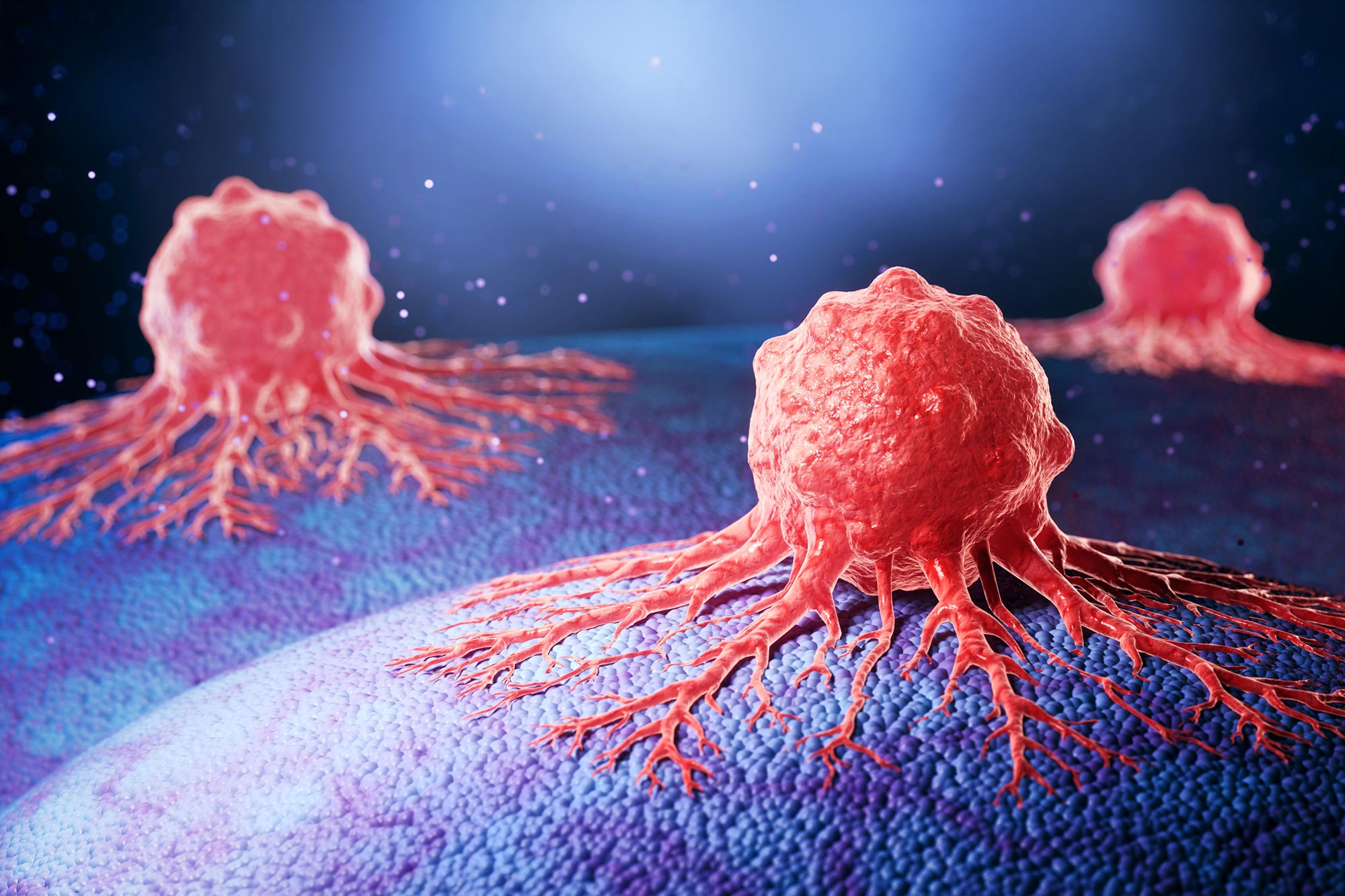
A dual-action nanomaterial uses cancer’s own chemistry to destroy tumors while leaving healthy cells unharmed.
Researchers at Oregon State University have developed a new nanomaterial that activates two chemical reactions inside cancer cells, destroying them through oxidative stress while largely sparing healthy tissue.
The study, led by Oleh and Olena Taratula and Chao Wang of the OSU College of Pharmacy, was published in Advanced Functional Materials.
Turning cancer’s chemistry against itself
The study builds on chemodynamic therapy or CDT, a developing cancer treatment strategy that takes advantage of the unusual chemical conditions inside tumors. Cancer cells typically exist in a more acidic environment than normal tissue and contain higher levels of hydrogen peroxide, creating conditions that can be exploited for targeted therapy.
Traditional CDT relies on these tumor-specific conditions to produce hydroxyl radicals. These highly reactive molecules, made up of oxygen and hydrogen with an unpaired electron, damage cells by oxidizing essential components such as lipids, proteins, and DNA.
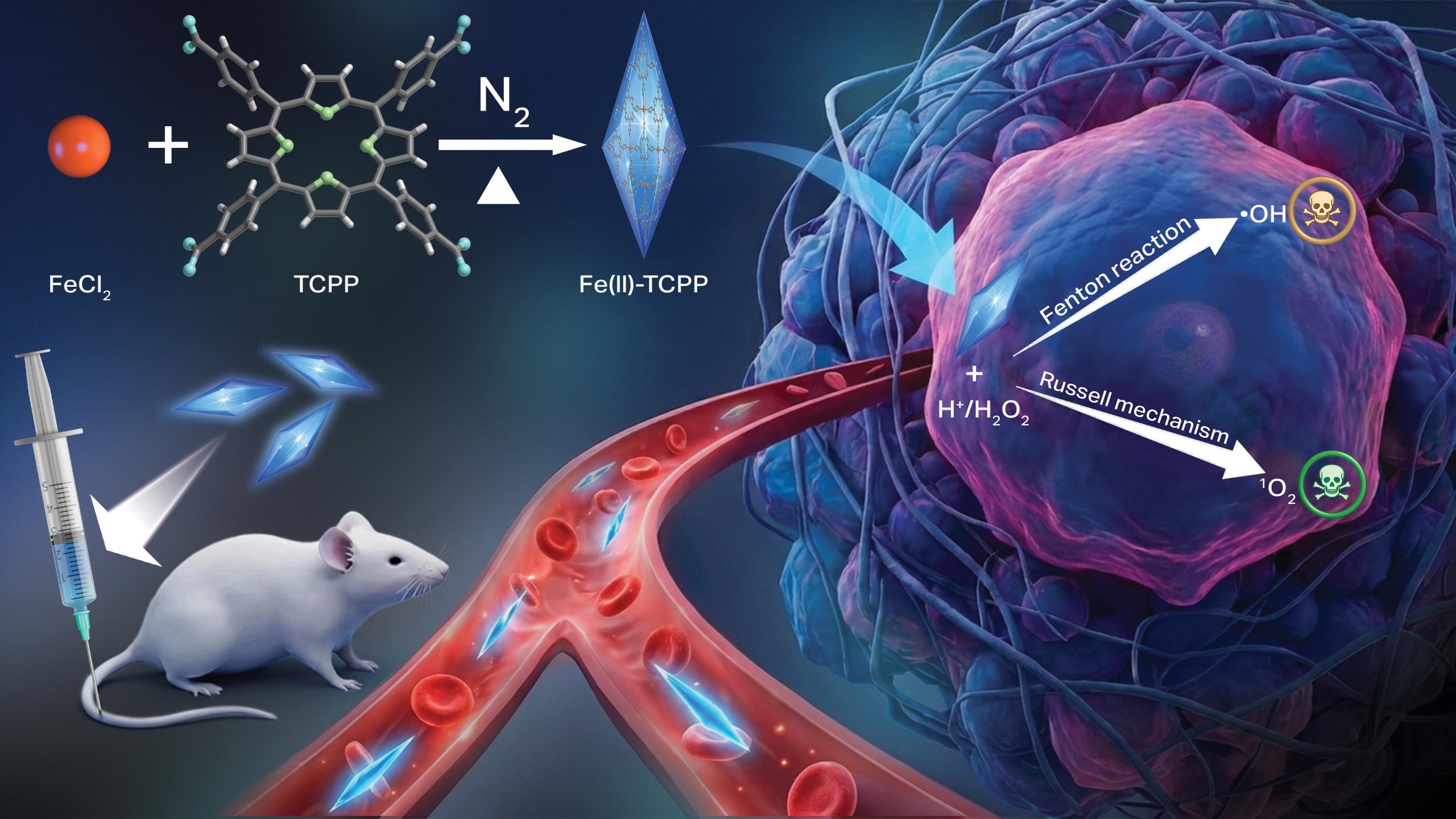
More recent CDT approaches have expanded this concept by also generating singlet oxygen, another reactive oxygen species. Singlet oxygen differs from the oxygen we breathe because it has one electron spin state instead of the three found in more stable atmospheric oxygen, making it especially reactive inside cells.
“However, existing CDT agents are limited,” Oleh Taratula said. “They efficiently generate either radical hydroxyls or singlet oxygen but not both, and they often lack sufficient catalytic activity to sustain robust reactive oxygen species production. Consequently, preclinical studies often only show partial tumor regression and not a durable therapeutic benefit.”
A nanoagent that delivers a one-two punch
In this paper, the scientists present a novel CDT nanoagent, an iron-based metal-organic framework or MOF, able to generate both compounds for more effective treatment, and with superior catalytic efficiency. The MOF showed potent toxicity in multiple cancer cell lines and negligible harm to noncancerous cells.
“When we systemically administered our nanoagent in mice bearing human breast cancer cells, it efficiently accumulated in tumors, robustly generated reactive oxygen species, and completely eradicated the cancer without adverse effects,” Olena Taratula said. “We saw total tumor regression and long-term prevention of recurrence, all without seeing any systemic toxicity.”
Before this treatment can be tested in humans, the research team plans to evaluate its therapeutic efficacy in various cancer types, including aggressive pancreatic cancer, to demonstrate its broad applicability across different malignancies.
Reference: “Structurally Engineered Ferrous Metal–Organic Framework as a Chemodynamic Therapy Nanoagent for Concurrent Hydroxyl Radical and Singlet Oxygen Generation” by Chao Wang, Kongbrailatpam Shitaljit Sharma, Yoon Tae Goo, Vladislav Grigoriev, Constanze Raitmayr, Ana Paula Mesquita Souza, Manali Parag Phawde, Olena R. Taratula and Oleh Taratula, 26 January 2026, Advanced Functional Materials.
DOI: 10.1002/adfm.202529194
Funded by the National Cancer Institute of the National Institutes of Health and the Eunice Kennedy Shriver National Institute of Child Health and Human Development.
Never miss a breakthrough: Join the SciTechDaily newsletter.
Follow us on Google and Google News.
17 Comments
Phenomenal Let’s NOT DELAY get these advancements out of the multi year testing phases and into the publics hands and sick bodies.
How can a patient join this investigative study?
They should leave that info or the oniony have that information
Thank God, my sister is starting chemo next week I wish it had come sooner. But soon this too shall be better. Thank goodness Trump wasn’t able to cease all funding for illnesses!
You are misinformed, Trump saved lives.
tRump will go down in history as responsible for the deaths of millions of people as a result of his callous elimination of aid to the world’s most needy. Spit out the Koolaid, Dan.
Buy her some ivermectin … research youtube for some info on dosing atdr john campbell channel
But doesn’t ivermectin only work if the tumor has parasites in it and not cancer from chemical exposure and stuff like cell phones etc
I’ll ask you to consider something here and it’s this: your sister may benefit significantly from the re-direction of funding towards research on cancer and cardiovascular disease – rather than, say, to fund studies on sexual behaviour, identity-based stigma experiences, and perceptions of discrimination framed as primary health determinants.
You might argue, convincing, that these are also important topics, yet it’s hard to dispute that they more properly belong to the humanities or sociology fields and *their* research, rather than siphoning off NIH-level biomedical funding – the kind that hopefully will save your sister’s life.
When we allow small special interest groups to decide on where money goes? We blur the line between science and advocacy – and that’s not something you’ll read in tomorrow’s paper, I can promise you; yet it doesn’t mean it’s not true.
Thanks for considering this. Cheers.
Need a treatment for TDS.
I’ll believe it when I see it. Probably be another 20 years before it’s in use
This is remarkable progress for the medical field. It is heartening to see such dedicated efforts to develop effective, targeted treatments for a disease as challenging as cancer. Truly great work.
Agree, there is hope
A nanoagent refers to a lightweight, highly specialized software agent or, in biomedical contexts, a nanostructured particle designed for specific, targeted actions. In computing, it represents a tiny, low-resource program for IoT security, system monitoring, or AI-driven tasks like tool calling. In medicine,
How can I take part in the trials
And this is probably last time u hear for this research
I had squamous cell carcinoma in the lymph nodes in my neck in 2019. Last 2 months my right hip bone has been killing me and even seems like it’s changing shape. Going to be tested next week for lymphoma. If that’s what it is I’d love to be a part of the trials.