
a
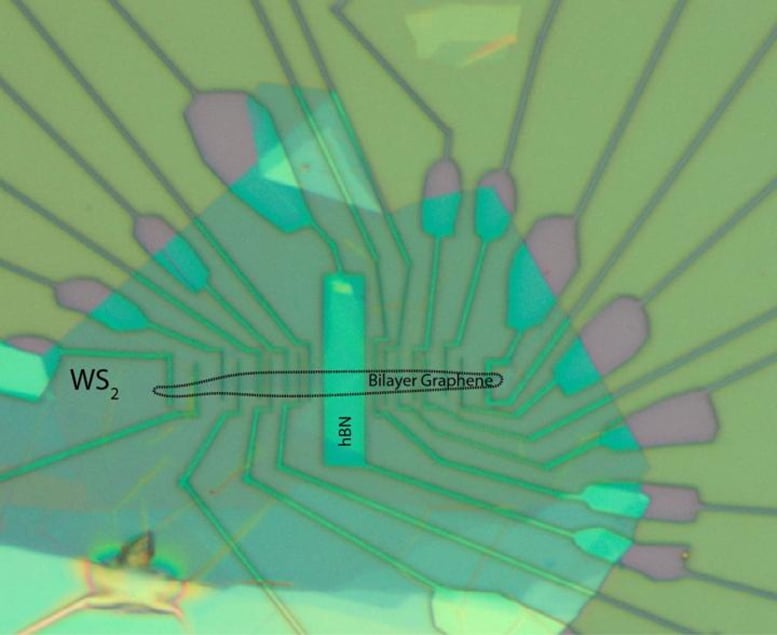
Electrons have a negative charge, but they also behave like tiny magnets. This property of electrons, called spin, can be used to transport or store information in electronic circuits. Scientists are looking for ways to create such spin-based electronics, as this is probably more energy efficient than normal electronics. University of Groningen physicist Siddhartha Omar discovered a way to transport spins over long enough distances to make such devices feasible. Furthermore, the material he used enabled him to control these spin currents.
Finding a method to turn on and off spin currents is important in order to create transistors that use electron spin rather than charge to function. Additionally, the spins should have lifetimes that are at least as long as the time it takes for these electrons to complete a circuit. University of Groningen scientists have now taken an important step forward by creating a device that meets both of these requirements, based on a double layer of graphene on top of a layer of tungsten disulfide. Their results have been published on October 16, 2019, in the journal Physics Review B.
Graphene, a two-dimensional version of carbon, is an outstanding electron spin conductor. However, manipulating spin currents in this material is tricky. Spin is a quantum mechanical feature of electrons that causes them to act like little magnets. The Physics of Nanodevices group at the University of Groningen, led by Professor Bart van Wees, is working on this problem. They have previously shown that it is possible to control spin currents if the graphene is placed on top of a layer of tungsten disulfide (another 2D material).
Double layer
‘However, this approach reduces the lifetime of the spins’, explains Siddhartha Omar, a postdoc in the Van Wees group. Tungsten is a metal, and its atoms influence the electrons passing through the graphene, dissipating the spin currents. This prompted Omar to apply a second layer of graphene to the tungsten disulfide, on the idea that electrons traveling through the upper layer would ‘feel’ less of the metal atoms’ effect.
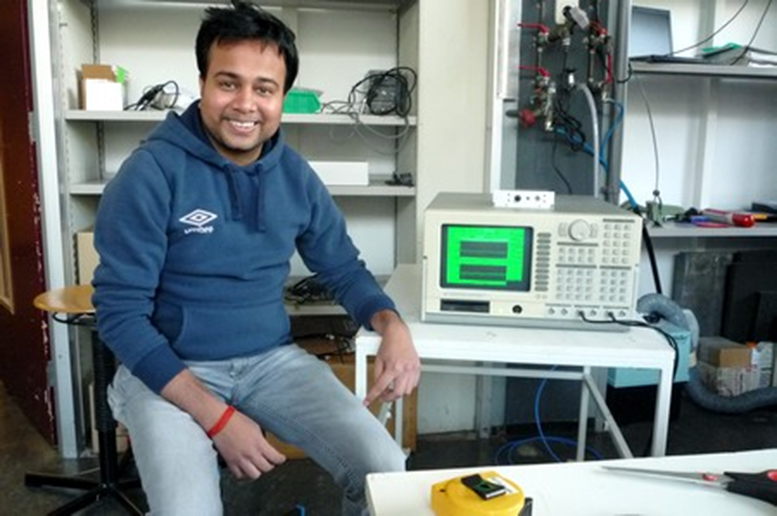
Omar also used another new technique, in which two different types of spin current are passed through the graphene. Spin is a magnetic moment with a specific orientation. In typical substances, the spins are not aligned. However, like magnets, the magnetic moment of spin currents has a favored orientation. Relative to the material through which the electrons are passing, their spins can either have an in-plane orientation or an out-of-plane orientation.
Energy level
‘We found that, as the electrons pass through the outer graphene layer, the in-plane spins are dissipated very quickly – in mere picoseconds. However, the lifetime of the out-of-plane spins is about one hundred times longer.’ This means that, even in the presence of tungsten disulfide, one component of spin currents (spins with an out-of-plane orientation) can travel far enough to be used in devices such as transistors.
The energy level of the spin currents observed by Omar caused them to pass through the upper layer of graphene. This energy level can be boosted by applying an electric field, pushing the spin currents into the lower layer. ‘Down there, the spins will feel the full effect of the metal atoms and the spin currents will quickly dissipate’, Omar explains. This ability to switch the spin current off using an electric field is important, as it could be used to ‘gate’ transistors based on this technology.
‘Unfortunately, certain technical limitations of the substrate on which we built these devices prevent us from creating electric fields that are strong enough to produce this gating effect’, says Omar. ‘However, we have shown that it is possible to send spin currents through a heterostructure made of graphene and tungsten disulfide. That is an important step towards the creation of a spin transistor.’
Reference: “Large spin-relaxation anisotropy in bilayer-graphene/WS2 heterostructures” by S. Omar, B. N. Madhushankar and B. J. van Wees, 16 October 2019, Physical Review B.
DOI: 10.1103/PhysRevB.100.155415
Never miss a breakthrough: Join the SciTechDaily newsletter.
Follow us on Google and Google News.