
Canadian research team at INRS makes discovery that could enhance the effectiveness of radiation therapy in oncology.
Ultrafast laser technology consistently delivers unexpected advancements. At first look, studies in this area might appear somewhat abstract, yet they frequently result in practical applications. This is especially evident in the healthcare sector, where the technology is employed in the treatment of specific cancers.
This application was discovered by the research team at the Advanced Laser Light Source Laboratory (ALLS) of the Institut national de recherche scientifique (INRS), following recent work directed by professor and director of the Énergie Matériaux Télécommunications Research Centre (EMT Centre), François Légaré. This work is the fruit of collaboration with medical physicists at the McGill University Health Centre (MUHC). The team’s study, published in the journal Laser & Photonics Reviews, presents astonishing results that call into question certain knowledge about high-power laser pulses—knowledge that had become common in the scientific community.
“For the first time, we showed that, under certain conditions, a laser beam tightly focused in ambient air can accelerate electrons reaching energies in the MeV (megaelectronvolt) range, the same order of magnitude as some irradiators used in radiation therapy for cancer,” says François Légaré, Director of the EMT Centre at INRS.
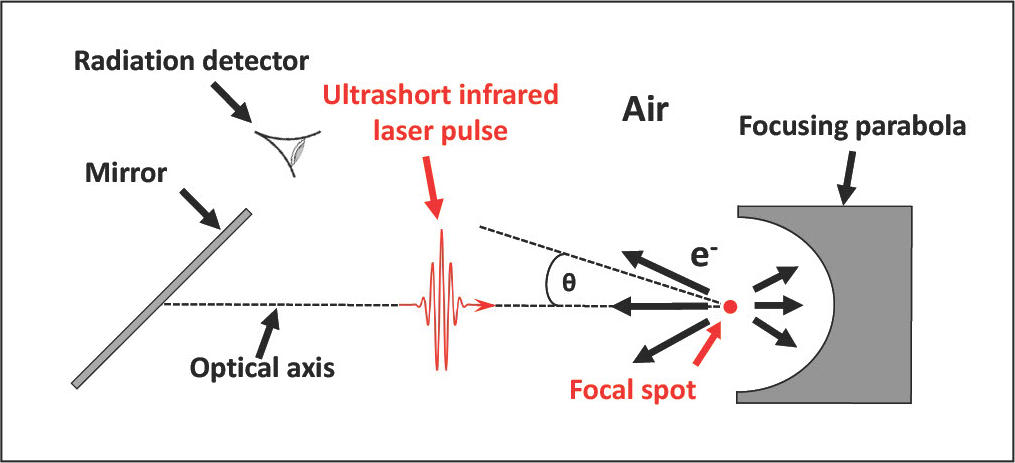
It was well established that focusing a laser pulse of sufficiently high intensity in ambient air would generate a plasma at the focal point. This plasma acts as a source of electrons that can be accelerated to energies up to a few keV (kilo electron volts) at most. Until recently, it was not possible to reach higher energies in ambient air, due to a physical limitation.
The research team was able to demonstrate that electrons accelerated in ambient air can reach energies in the MeV (megaelectronvolt) range, or around 1,000 times greater than this previously insurmountable limit.
Better cancer treatment
The breakthrough by the team at INRS’s EMT Centre opens the door to major advances in medical physics. A prime example is FLASH radiotherapy, a novel approach to treating tumors that are resistant to conventional radiation therapy. It is a technique that can be used to deliver high doses of radiation in an extremely short time (microseconds rather than minutes). This better protects the healthy tissue around the tumor. This FLASH effect is still poorly understood in research but seems to involve a rapid deoxygenation of healthy tissues, reducing their sensitivity to radiation.
“No study has been able to explain the nature of the FLASH effect. However, the electron sources used in FLASH radiotherapy have similar characteristics to the one we produced by focusing our laser strongly in ambient air. Once the radiation source is better controlled, further research will allow us to investigate what causes the FLASH effect and to, ultimately, offer better radiation treatments to cancer patients,” says Simon Vallières, postdoctoral researcher and first author of the study.
Safer handling
This discovery has concrete implications. Firstly, it requires extra caution when handling laser beams that are tightly focused in ambient air.
“The electron energies observed (MeV) allow them to travel more than three meters in air, or several millimeters under the skin. This poses a radiation exposure risk for users of the laser source,” explains Simon Vallières.
Moreover, by taking measurements near the source, the team observed a high radiation dose rate of electrons—three to four times greater than those used in conventional radiation therapy.
“Uncovering this radiation hazard is an opportunity to implement safer practices in laboratories,” says Simon Vallières. The young researcher notes that handling highly focused laser beams in ambient air must be done carefully, and that scientists need to avoid exposure to high doses of radiation as they are harmful to your health.
Reference: “High Dose-Rate MeV Electron Beam from a Tightly-Focused Femtosecond IR Laser in Ambient Air” by Simon Vallières, Jeffrey Powell, Tanner Connell, Michael Evans, Marianna Lytova, François Fillion-Gourdeau, Sylvain Fourmaux, Stéphane Payeur, Philippe Lassonde, Steve MacLean and François Légaré, 16 November 2023, Laser & Photonics Reviews.
DOI: 10.1002/lpor.202300078
The study was funded by the Natural Sciences and Engineering Research Council of Canada, the Fonds de recherche du Québec – Nature et technologies, the Digital Research Alliance of Canada, the Canada Foundation for Innovation, the Ministère de l’Économie, and de l’Innovation et de l’Énergie (MEIE).
Never miss a breakthrough: Join the SciTechDaily newsletter.
Follow us on Google and Google News.