
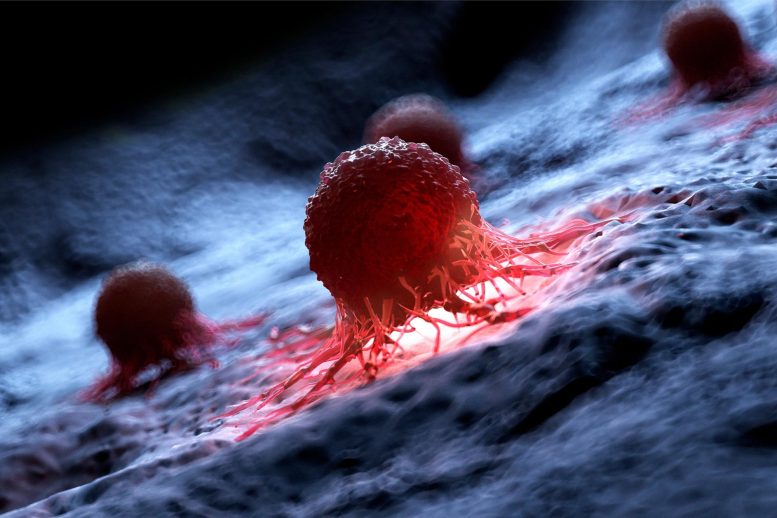
An experimental mRNA vaccine paired with immunotherapy reduced melanoma recurrence rates in a recent trial.
A recent clinical trial reveals that the combination of an experimental mRNA vaccine with an immunotherapy led to a 44% decrease in the risk of melanoma recurrence or death compared to the use of immunotherapy alone.
The randomized phase 2b trial, which was headed by researchers at NYU Langone Health and its Perlmutter Cancer Center, included both men and women who underwent surgery for the removal of melanoma from their lymph nodes or other organs and were at a heightened risk of the disease reappearing at distant sites from the original cancer.
Among 107 study subjects who were injected with both the experimental vaccine, called mRNA-4157/V940, and the immunotherapy pembrolizumab, the cancer returned in 24 subjects (22.4%) within two years of follow-up, compared with 20 out of 50 (40%) who received only pembrolizumab.
Vaccine and Immunotherapy Combination
“Our phase 2b study shows that a neoantigen mRNA vaccine, when used in combination with pembrolizumab, resulted in prolonged time without recurrence or death compared with pembrolizumab alone,” said study senior investigator Jeffrey Weber, MD, Ph.D., the deputy director of the Perlmutter Cancer Center.
The phase 2b trial results are to be presented at the annual meeting of the American Association for Cancer Research on April 16 in Orlando, Florida.
While randomized phase 3 trials test whether a treatment is superior to current standard therapies, phase 2 trials like the current study provide preliminary reassurance that one treatment is likely to be better than another, and lead to larger studies to confirm those results. Phase 3 trials of the combination of the mRNA-4157/V940 vaccine with pembrolizumab versus pembrolizumab alone are already planned at NYU Langone and a number of other medical centers globally, said Weber, the Laura and Isaac Perlmutter Professor of Oncology in the Department of Medicine at NYU Grossman School of Medicine.
Study results so far led the United States Food and Drug Administration in February to grant Breakthrough Therapy Designation to mRNA-4157/V940 in combination with pembrolizumab, a designation designed to speed government reviews of trial results.
How mRNA Technology Targets Cancer
The current results highlight the role of immune system T cells capable of attacking viruses as well as cancers. To spare normal cells, this system uses “checkpoint” molecules on T cell surfaces to “turn off” their attack against viruses when they clear the infection. The body may recognize tumors as abnormal, but cancer cells hijack checkpoints to turn off, evade and avoid immune responses. Immunotherapies like pembrolizumab seek to block checkpoints, making cancer cells more “visible” and vulnerable again to immune cells.
Immunotherapies have become the mainstay for treating melanoma, although they do not work for all patients because melanoma cells, known for their ability to evade the immune system, can become resistant to immunotherapy. For this reason, researchers have looked at adding vaccines. While most vaccines used today are designed to prevent infections, they can also be tailored to target proteins involved in cancer.
Like the COVID-19 vaccine, mRNA-4157/V940 is based on messenger RNA, a chemical cousin of DNA that provides instructions to cells for making proteins. mRNA cancer vaccines are designed to teach the body’s immune system to recognize cancer cells as different from normal cells. In designing a vaccine against melanoma, researchers attempted to trigger an immune response to specific abnormal proteins, called “neoantigens,” made by cancer cells.
Because the study volunteers all had their tumors removed, researchers were able to analyze their cells for neoantigens that were specific to each melanoma and create a “personalized” vaccine for each patient. As a result, T cells were produced specific to the neoantigen proteins encoded by the mRNA. Those T cells could then attack any melanoma cells trying to grow or spread.
Scientists involved in the study say that the personalized mRNA-4157/V940 vaccine took about six to eight weeks to develop for each patient and could recognize as many as 34 neoantigens. Severe side effects were similar between the two arms of the study, they said, with fatigue being the most common side effect specific to the vaccine reported by patients.
Watch a video with researcher and patient commentary here.
Meeting: AACR Annual Meeting 2023
The study was presented at the annual meeting of the American Association for Cancer Research on Sunday, April 16, 2023, at 11 a.m. EDT in Orlando, Fla., and was titled “A personalized cancer vaccine, mRNA-4157, combined with pembrolizumab in patients with resected high-risk melanoma: Efficacy and safety results from the randomized, open-label Phase 2b mRNA-4157-P201/Keynote-942 trial.
The study was funded by Moderna Inc. of Cambridge, Mass., and Merck of Rahway, NJ. mRNA-4157/V940 is being jointly developed and commercialized by Moderna and Merck. Merck is the manufacturer of pembrolizumab. About 1.3 million Americans are currently diagnosed with some form of melanoma.
Weber consults for and has received less than $10,000 per annum from Merck, Genentech, Astra Zeneca, GSK, Novartis, Nektar, Celldex, Incyte, Biond, Moderna, ImCheck, Sellas, Evaxion, Pfizer, Regeneron, and EMD Serono; has received $10-25,000 from BMS for membership on Advisory Boards; he holds equity in Biond, Evaxion, OncoC4, and Instil Bio; and is on scientific advisory boards for CytoMx, Incyte, ImCheck, Biond, Sellas, Instil Bio, OncoC4, and Neximmune, for which he is remunerated between $10,000-$50,000 dollars. He is not a member of any speaker’s bureau; NYU received research support from BMS, Merck, GSK, Moderna, Pfizer, Novartis, and Astra Zeneca; Weber is one of the co-authors on two patents filed by Moffitt Cancer Center and one patent filed by Biodesix and receives less than $6,000 yearly in royalties. These relationships are being managed in accordance with the policies and practices of NYU Langone Health.
Besides Weber, other study co-investigators are Adnan Khattak, at Hollywood Private Hospitals in Nedlands, Australia; Matteo Carlino, at Westmead Hospital in Westmead, Australia; Tarek Meniawy, at Saint John of God Subiaco Hospital in Subiaco, Australia; George Ansstas, at Washington University in St. Louis, Mo.; Teresa Medina, at University of Colorado in Aurora; Matthew Taylor, at the Earle A. Chiles Research Institute in Portland, Ore.; Kevin Kim, at California Pacific Medical Center Research Institute in Oakland; Meredith McKean, at the Sarah Cannon Research Institute in Nashville, Tenn.; Georgina Long, at Melanoma Institute Australia in Wollstonecraft, Australia; Ryan Sullivan, at Mass General Brigham in Boston; Mark Faries, at The Angeles Clinic and Research Institute in Los Angeles; Thuy Tran, at Yale-New Haven Hospital in New Haven, Conn.; Charles Cowey, at Baylor Scott & White Charles A. Sammons Cancer Center in Dallas; Andrew Pecora, at the John Thuerer Cancer Center in Hackensack, NJ; Jennifer Segar, at the University of Arizona in Tucson; Victoria Atkinson, at Princess Alexandra Hospital in Woolloongabba, Australia; Geoffrey Gibney, at Lombardi Cancer Center in Washington, DC; Jason Luke, at the University of Pittsburgh in Pennsylvania; Sajeve Thomas, at Orlando Health in Florida; Elizabeth Buckbinder, at Dana-Farber Cancer Institute in Boston; Peijie Hou, Lili Zhu, Michelle Brown, Praveen Aanur, and Robert Meehan, at Moderna Inc. in Cambridge, Mass.; and Tal Zaks, at OrbiMed in New York City.
Never miss a breakthrough: Join the SciTechDaily newsletter.
Follow us on Google and Google News.