

Converting carbon dioxide into oxygen and producing fuels, fertilizers on the red planet using a plasma-based method.
A plasma-based way to produce and separate oxygen within the Martian environment has been devised by an international team of researchers. It’s a complementary approach to NASA’s Mars Oxygen In-Situ Resource Utilization Experiment (MOXIE), and it may deliver high rates of molecule production per kilogram of instrumentation sent to space.
Such a system could play an essential role in the development of life-support systems on Mars. It could also produce the feedstock and base chemicals necessary for processing fuels, building materials, and fertilizers.
In the Journal of Applied Physics, from AIP Publishing, the researchers presented a method for harnessing and processing local resources to generate products on Mars. Because the atmosphere is primarily formed by carbon dioxide that can be split to produce oxygen, and its pressure is favorable for plasma ignition, natural conditions on the red planet are nearly ideal for in situ resource utilization by plasmas. The team included scientists from the University of Lisbon, the Massachusetts Institute of Technology, Sorbonne University, Eindhoven University of Technology, and the Dutch Institute for Fundamental Energy Research.
Major Challenges in Oxygen Production on Mars
There are two big hurdles that stand in the way of producing oxygen on Mars.
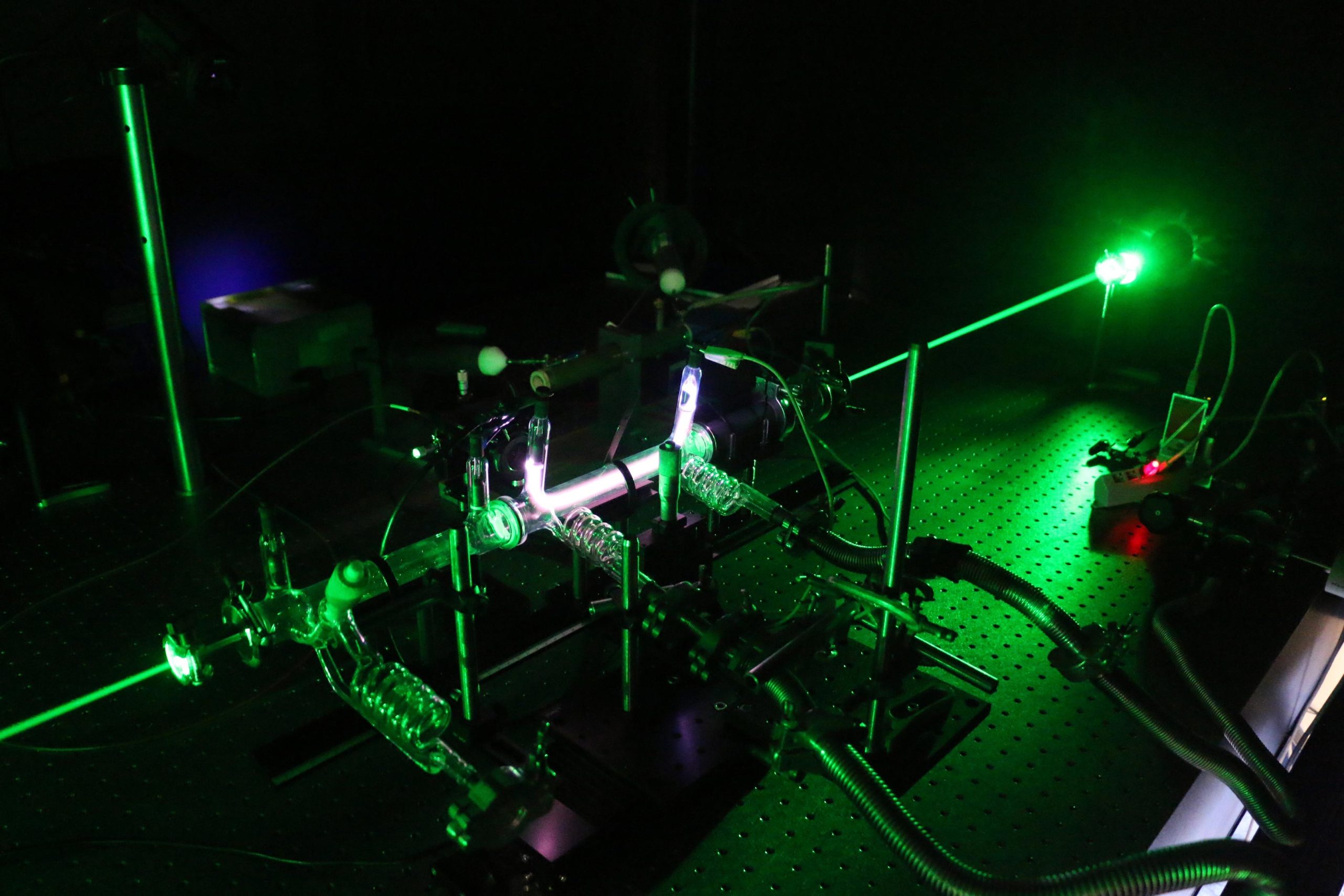
“First, the decomposition of carbon dioxide molecules to extract oxygen. It’s a very difficult molecule to break,” said author Vasco Guerra, of the University of Lisbon. “Second, the separation of the produced oxygen from a gas mixture that also contains, for example, carbon dioxide and carbon monoxide. We’re looking at these two steps in a holistic way to solve both challenges at the same time. This is where plasmas can help.”
Plasma in Carbon Dioxide Decomposition
Plasma, the fourth natural state of matter, contains free charged particles, such as electrons and ions. Electrons are light and easily accelerated up to very high energies with electric fields.
“When bulletlike electrons collide with a carbon dioxide molecule, they can directly decompose it or transfer energy to make it vibrate,” Guerra said. “This energy can be channeled, to a large extent, into carbon dioxide decomposition. Together with our colleagues in France and the Netherlands, we experimentally demonstrated the validity of these theories. Moreover, the heat generated in the plasma is also beneficial for the separation of oxygen.”
Oxygen is key to creating a breathable environment, It is also the starting point to produce fuels and fertilizers for future Martian agriculture. Local production of fuels will be required for future missions. All are crucial for future human settlement on Mars.
By dissociating carbon dioxide molecules to produce green fuels and recycle chemicals, the plasma technology may also be helpful in addressing climate change on Earth.
Reference: “Plasmas for in situ resource utilization on Mars: Fuels, life support, and agriculture” by V. Guerra, T. Silva, N. Pinhão, O. Guaitella, C. Guerra-Garcia, F. J. J. Peeters, M. N. Tsampas and M. C. M. van de Sanden, 16 August 2022, Journal of Applied Physics.
DOI: 10.1063/5.0098011
Never miss a breakthrough: Join the SciTechDaily newsletter.
Follow us on Google and Google News.
14 Comments
I think long-term Moon & Mars bases would need a tech to recycle air (as tech for recycling water already used by NASA)!
Imagine a device that constantly filters CO2 from air & gives back O2 (& accumulates Carbon powder to be just dumped/discarded) & by using only electricity!
I think it’s a buncha B.S.! Clean up this damn planet with all the trillions of $$$. Trying to Terraform a ball of ice twice as far from the sun is, imo, waste of assets. That money can, for the moment, be used everywhere else.
Sincerly, Oneoftheworld
Oxygen by itself may not be safe to breathe in the long term. Terrestrial air is composed of many gases , with nitrogen being the largest partial pressure. Nitrogen is necessary for normal health.
Before colonizing and polluting another planet we should think about fixing our own…
Yes we should because the lessons learned by teraforming mars about how planetary eco-systems work will provide the answer to how to save the earths bio-sphere bear in mind that mars is humanities second and last chance to get it right.
Then do it on earth! Co2 will be displaced or used. End of climate crisis!
If you can generate Oxygen in Mars, why you cannot do the same in my beloved Earth. Why are you worried about cutting trees.etc.
This article draws a direct line between learning to survive on Mars and benefitting us on earth. Space advancements are bipartisan because pursuing space goals clearly benefits humans on Earth. The return on investment is huge.
It’s good to start planting forests on mars, which can transform the CO2 to Oxygen by photosynthesis. Start planting trees and wait. By the time we are ready for mass migration the planet will be ready and trraformed.
Terroraforming mars is great and all but that should be more of a refuling station. Once the milkkyway and a Andromeda collide being on Mars wont help However it keep our species alive when when the earth turns 2500years old.The next time the 75h or 8th ice age takes over the earth again .ultimately we need to move farther away like Proxima b
Our earth first before Mars OK?€
I suppose the construction of a gigantic solar farm or a thermonuclear battery (like the thorium salt device used in the voyager probe, a larger scale one-that can be constructed underground) in Mars for energy supplies for the plasma based reactors…
It isn’t clear yet that there is any way we can possibly survive on Mars, independent of earth, much less become a thriving colony as a “Plan B” in case we botch things up horribly on Earth (as Elon Musk envisions). Even the simplest attempts at “terraforming” look impossible.
For instance, Dr. Vijay kumar suggests we engage in mass planting of trees on Mars. Temperatures on Mars range from -220 to 70F – with an avg. temp of -81F. There’s no free water on Mars,much less rain falling from the sky. Not just a little: there’s none.
Which trees did you have in mind, Dr. Kumar?
I admire Elon Musk’s intelligence and focus and his ethic, in searching for a way to possible save our species from our propensity for self-destruction. I’m not as well-educated, as smart or as driven as Mr. Musk, but confess his Plan B smacks more of desperation than of confident planning.
Sent Robots!
Much safer and cheaper.
500 robots the same as one human mission, I guess