
Close Menu
    Facebook X (Twitter) Instagram
    SciTechDaily
    • Biology
    • Chemistry
    • Earth
    • Health
    • Physics
    • Science
    • Space
    • Technology
    Facebook X (Twitter) Pinterest YouTube RSS
    SciTechDaily
    Home»Space»NASA’s Mars Perseverance Rover Produces Oxygen on Another Planet for the First Time
    Space

    NASA’s Mars Perseverance Rover Produces Oxygen on Another Planet for the First Time

    By Nancy Kotary and Sara Cody, Haystack ObservatoryApril 25, 20211 Comment4 Mins Read
    Facebook Twitter Pinterest Telegram LinkedIn WhatsApp Email Reddit
    Share
    Facebook Twitter LinkedIn Pinterest Telegram Email Reddit
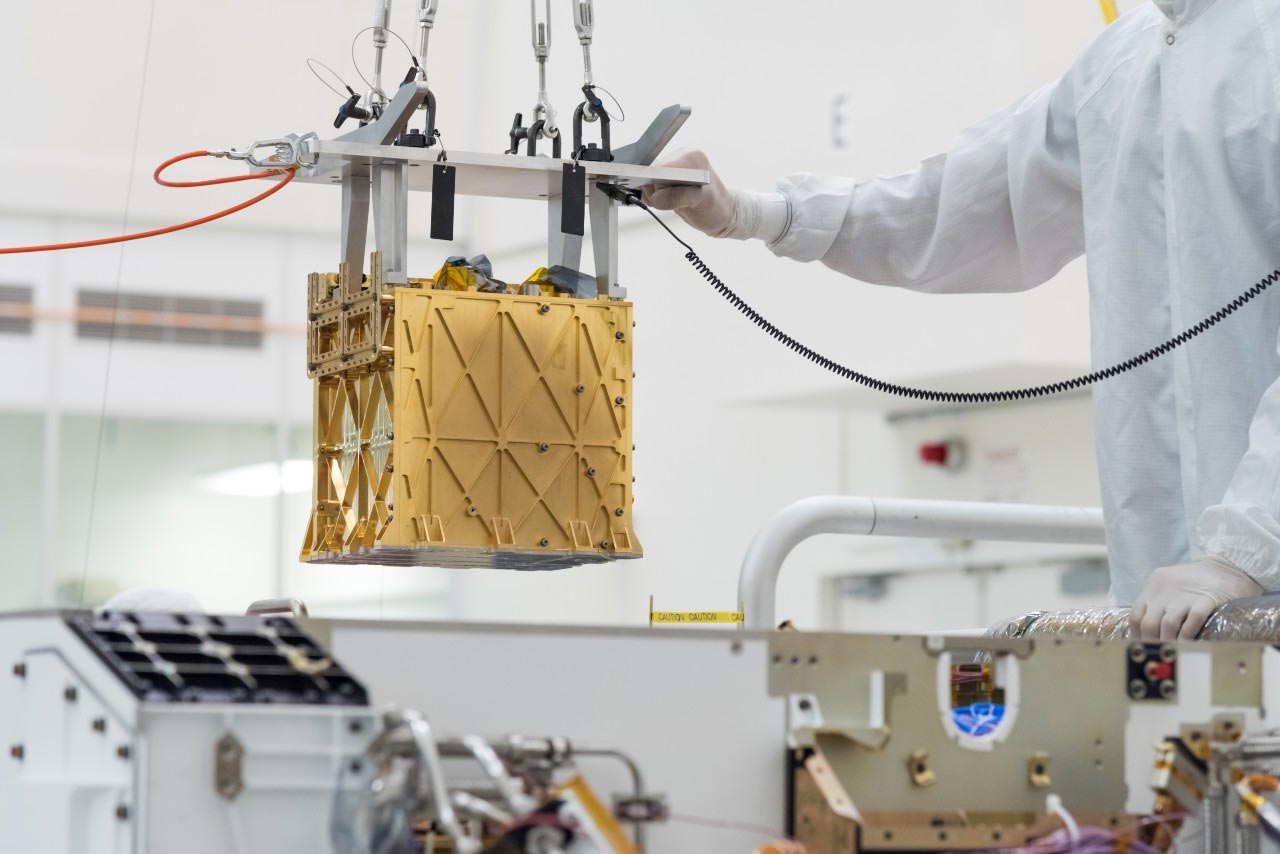
    Mars Oxygen In-Situ Resource Utilization Experiment
    Technicians at NASA’s Jet Propulsion Laboratory lowered MOXIE into the belly of the Perseverance rover prior to launch. Credit: NASA/JPL-Caltech

    Thanks to an MIT-designed instrument called MOXIE, a NASA mission has produced oxygen on another planet for the first time.

    NASA’s Perseverance rover has been marking milestones on Mars since landing on the Red Planet in February. Its latest historic accomplishment is the first creation of oxygen from carbon dioxide in the thin Mars atmosphere. Mission time is measured in sols, or Martian days. Oxygen production was achieved early in the evening of April 20, or early morning on Sol 60 in Jezero Crater.  

    MOXIE (Mars Oxygen In-situ Resource Utilization Experiment), a small, gold box-shaped instrument on the rover, successfully demonstrated a solid oxide electrolysis technology for converting the Martian atmosphere to oxygen. The atmosphere on Mars is about 95% carbon dioxide.

    MOXIE’s first oxygen run produced 5.4 grams of oxygen in an hour. The power supply limits potential production to 12 g/hr — about the same amount that a large tree would produce.
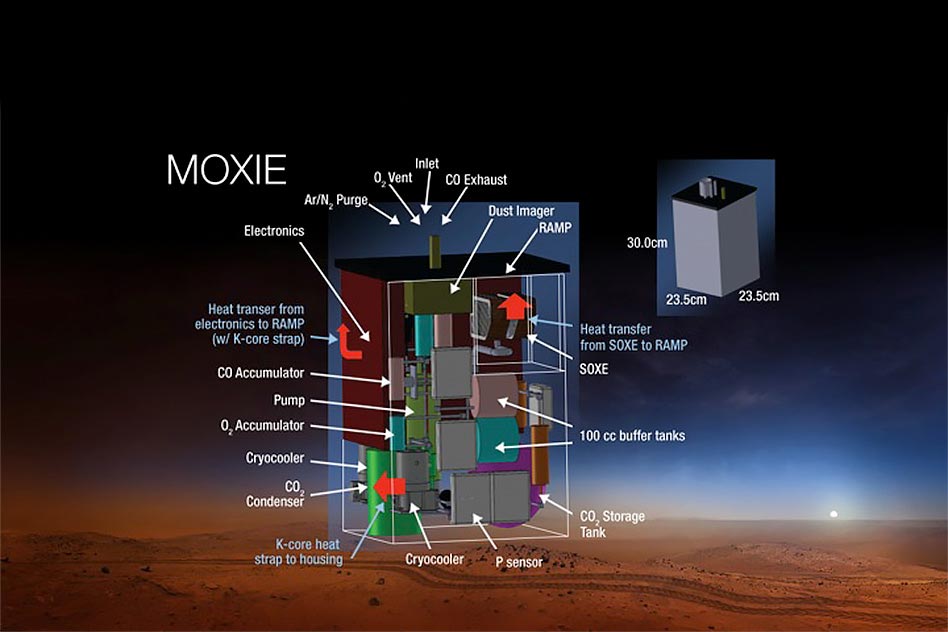
    MOXIE Mars Oxygen ISRU Experiment Instrument for Mars 2020 Rover
    Mars Oxygen ISRU Experiment (MOXIE) is an exploration technology investigation that produces oxygen from Martian atmospheric carbon dioxide. Credit: NASA

    For both rockets and astronauts, oxygen is crucial, says MOXIE’s principal investigator, Michael Hecht of MIT Haystack Observatory. “To burn its fuel, a rocket must have many times more oxygen by weight. To get four astronauts off the Martian surface on a future mission would require 15,000 pounds (7 metric tons) of rocket fuel and 55,000 pounds (25 metric tons) of oxygen.” In contrast, Hecht says, “The astronauts who spend a year on the surface will maybe use one metric ton between them to breathe.”

    The Process of Making Oxygen on Mars

    The oxygen production process starts with carbon dioxide intake; inside MOXIE, the Martian CO2 is compressed and filtered to remove any contaminants. It is then heated, which causes separation into oxygen and carbon monoxide. The oxygen is further isolated by a hot, charged ceramic component; the oxygen ions merge into O2. Carbon monoxide is expelled harmlessly back into the atmosphere.
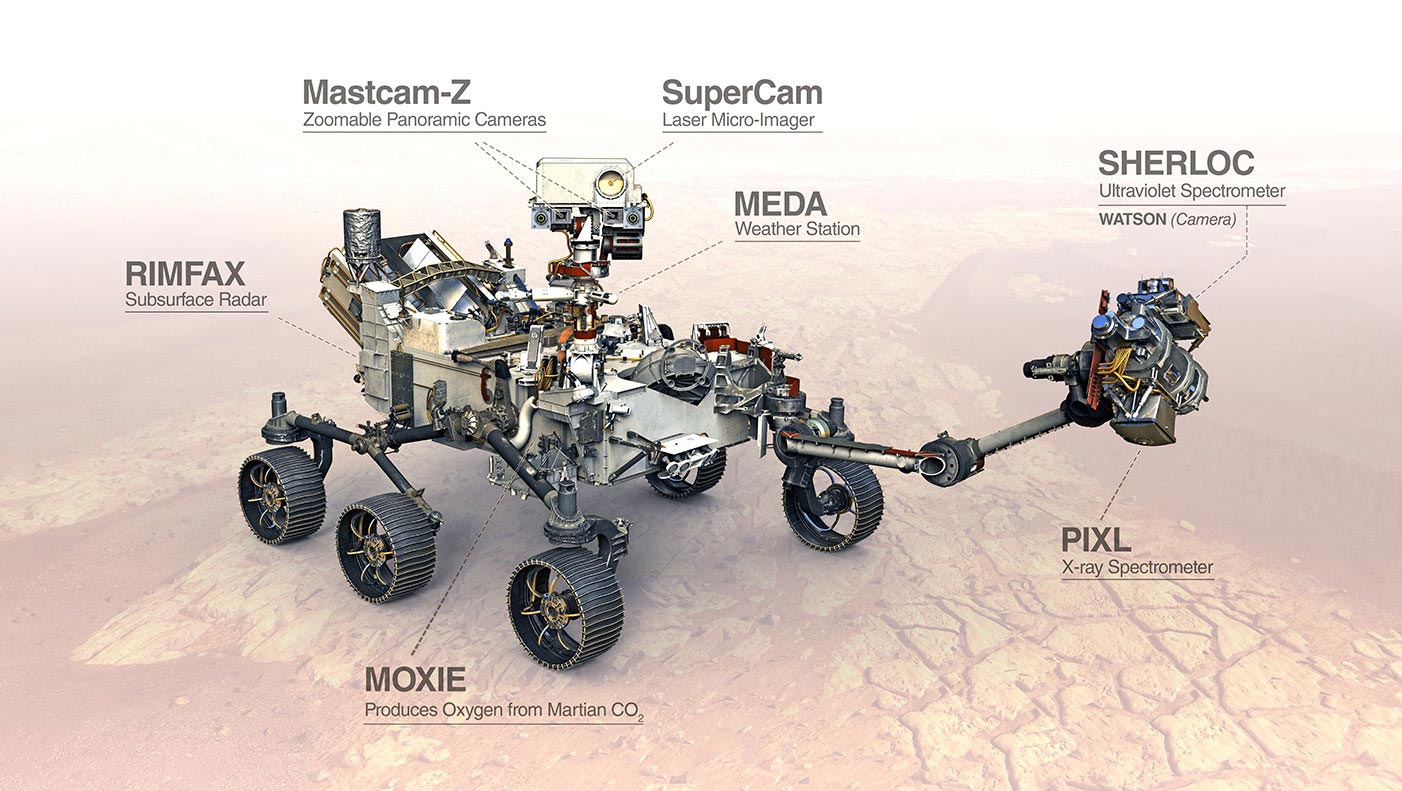
    NASA Mars Perseverance Rover Science Instruments
    Illustration of the Perseverance rover on Mars with its science instruments. Credit: NASA

    The MOXIE teams will next analyze the purity of the oxygen; preliminary indications are that once the background CO2 was flushed out by the flowing oxygen, the resulting product was nearly 100% pure oxygen.

    Serving as a proof of concept, MOXIE has paved the way for possible future Mars missions to produce oxygen, which will be needed for rocket propulsion on return trips for crewed missions.
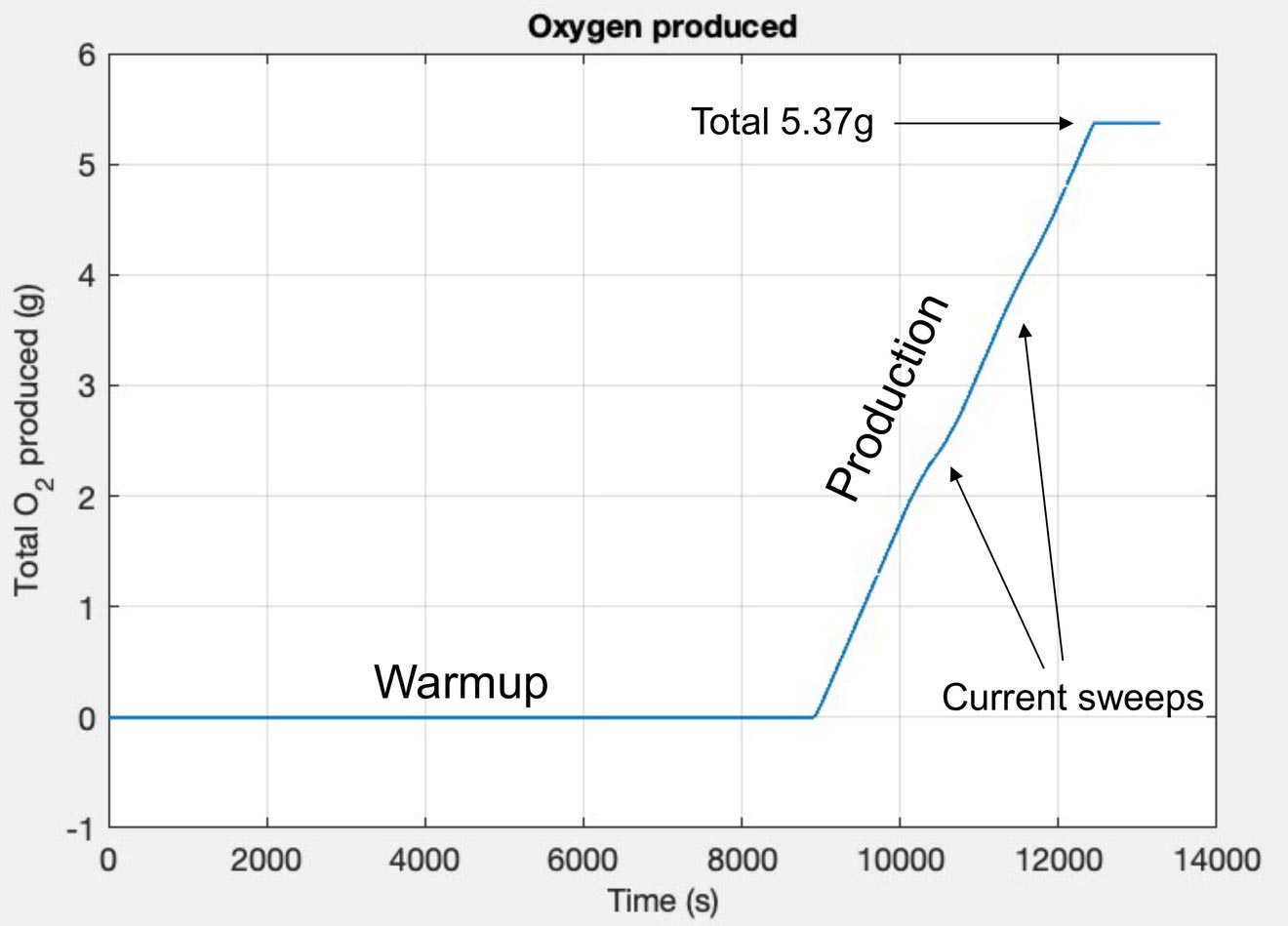
    MOXIE Oxygen Production
    After a two-hour warmup period, MOXIE began producing oxygen at a rate of 6 grams per hour. The was reduced two times during the run (labeled as “current sweeps”) in order to assess the status of the instrument. After an hour of operation the total oxygen produced was about 5.4 grams, enough to keep an astronaut healthy for about 10 minutes of normal activity. Credit: MIT Haystack Observatory

    “The first run of MOXIE is a step in the right direction to bring us closer to the possibility of human missions to Mars,” says Jeffrey Hoffman, a professor of the practice in the MIT Department of Aeronautics and Astronautics, who is the deputy principal investigator the project. “The technology that evolves from what we have been able to do here will be the grandchildren descended from the success of our MOXIE instrument.”

    MOXIE is sponsored by NASA’s Space Technology Mission Directorate and Human Exploration and Operations Mission Directorate. It is a joint venture between NASA, the Jet Propulsion Laboratory (JPL), MIT Haystack Observatory, and MIT’s Department of Aeronautics and Astronautics. JPL, which is managed for NASA by Caltech in Pasadena, California, built and manages operations of the Perseverance rover.

    Never miss a breakthrough: Join the SciTechDaily newsletter.
    Follow us on Google and Google News.

    JPL Mars Mars 2020 Perseverance Rover MIT
    Share. Facebook Twitter Pinterest LinkedIn Email Reddit

    Related Articles

    MOXIE Experiment Successfully Making Oxygen on Mars

    NASA Perseverance Mars Rover Images Confirm Jezero Crater Is an Ancient Martian Lake

    Finalists Chosen in NASA’s Mars 2020 Rover Naming Contest – Vote for Your Favorite

    NASA Narrows Down Mars 2020 Rover Names – Here Are the Semifinalists

    NASA’s Mars 2020 Rover Will Hunt for Evidence of Life on Mars in Microscopic Fossils

    NASA’s Mars 2020 Rover Heads Into Huge Vacuum Chamber for Testing

    That’s One Small Step for a Mars Rover – Mars 2020 Stands on Its Own Six Wheels for the First Time

    NASA Engineers and Technicians Test Mars 2020 Rover Descent-Stage Separation

    Rover McRoverface: NASA Invites Students to Name Mars 2020 Rover

    1 Comment

    1. John Jakson on April 26, 2021 3:17 pm

      Didn’t this article get posted before?

      Anyway from the few figures given, every astronaut looking for a ride home after a year on the surface will need (25+1)*6 of these Moxies or 160 or so. Since they don’t give the energy inputs, lets assume the entire rover nuclear battery output was used during this short run, so add 160 rover batteries worth of power supply to the project.

      At what point does reality set in, doesn’t anyone at Nasa do the math on energy required to do such a simple task. And do they know the energy required per capita on earth for all US citizens is close to 10KW of primary energy 24/365 or 300GJ/yr. On Mars it’s going to be 2 orders greater to have a normal life on the surface with 1000s of people living in a red city.

      Reply
    Leave A Reply Cancel Reply

    • Facebook
    • Twitter
    • Pinterest
    • YouTube

    Don't Miss a Discovery

    Subscribe for the Latest in Science & Tech!

    Trending News

    Your Blood Pressure Reading Could Be Wrong Because of One Simple Mistake

    Astronomers Stunned by Ancient Galaxy With No Spin

    Physicists May Be on the Verge of Discovering “New Physics” at CERN

    Scientists Solve 320-Million-Year Mystery of Reptile Skin Armor

    Scientists Say This Daily Walking Habit May Be the Secret to Keeping Weight Off After Dieting

    New Therapy Rewires the Brain To Restore Joy in Depression Patients

    Giant Squid Detected off Western Australia in Stunning Deep-Sea Discovery

    Popular Sugar-Free Sweetener Linked to Liver Disease, Study Warns

    Follow SciTechDaily
    • Facebook
    • Twitter
    • YouTube
    • Pinterest
    • Newsletter
    • RSS
    SciTech News
    • Biology News
    • Chemistry News
    • Earth News
    • Health News
    • Physics News
    • Science News
    • Space News
    • Technology News
    Recent Posts
    • New Stroke Study Challenges Decades-Old Medical Beliefs
    • These Simple Plant Foods Are Linked to Lower Blood Pressure
    • Common Blood Pressure Drug Supercharges Cancer Treatment in Surprising New Study
    • Key Magic Mushroom Ingredient Increases Laziness and Reduces Aggression
    • Researchers Solve 15-Year Mystery Behind Cancer-Causing Gut Toxin
    Copyright © 1998 - 2026 SciTechDaily. All Rights Reserved.
    • Science News
    • About
    • Contact
    • Editorial Board
    • Privacy Policy
    • Terms of Use

    Type above and press Enter to search. Press Esc to cancel.