
Tumors Partially Destroyed With Sound Don’t Come Back
A new technique pioneered in rats at the University of Michigan could improve outcomes for cancer and neurological conditions.
Noninvasive sound technology developed at the University of Michigan breaks down liver tumors in rats, kills cancer cells, and spurs the immune system to prevent further spread—an advance that could lead to improved cancer outcomes in humans.
By destroying only 50% to 75% of liver tumor volume, the rats’ immune systems were able to clear away the rest, with no evidence of recurrence or metastases in more than 80% of the animals.
“Even if we don’t target the entire tumor, we can still cause the tumor to regress and also reduce the risk of future metastasis,” said Zhen Xu, professor of biomedical engineering at U-M and corresponding author of the study in Cancers.

Results also showed the treatment stimulated the rats’ immune responses, possibly contributing to the eventual regression of the untargeted portion of the tumor and preventing further spread of the cancer.
Histotripsy: A Precise Ultrasound Technique
The treatment, called histotripsy, noninvasively focuses ultrasound waves to mechanically destroy target tissue with millimeter precision. The relatively new technique is currently being used in a human liver cancer trial in the United States and Europe.
In many clinical situations, the entirety of a cancerous tumor cannot be targeted directly in treatments for reasons that include the mass’ size, location or stage. To investigate the effects of partially destroying tumors with sound, this latest study targeted only a portion of each mass, leaving behind a viable intact tumor. It also allowed the team, including researchers at Michigan Medicine and the Ann Arbor VA Hospital, to show the approach’s effectiveness under less than optimal conditions.

“Histotripsy is a promising option that can overcome the limitations of currently available ablation modalities and provide safe and effective noninvasive liver tumor ablation,” said Tejaswi Worlikar, a doctoral student in biomedical engineering. “We hope that our learnings from this study will motivate future preclinical and clinical histotripsy investigations toward the ultimate goal of clinical adoption of histotripsy treatment for liver cancer patients.”
Liver cancer ranks among the top 10 causes of cancer related deaths worldwide and in the U.S. Even with multiple treatment options, the prognosis remains poor with five-year survival rates less than 18% in the U.S. The high prevalence of tumor recurrence and metastasis after initial treatment highlights the clinical need for improving outcomes of liver cancer.
How Histotripsy Works
Where a typical ultrasound uses sound waves to produce images of the body’s interior, U-M engineers have pioneered the use of those waves for treatment. And their technique works without the harmful side effects of current approaches such as radiation and chemotherapy.

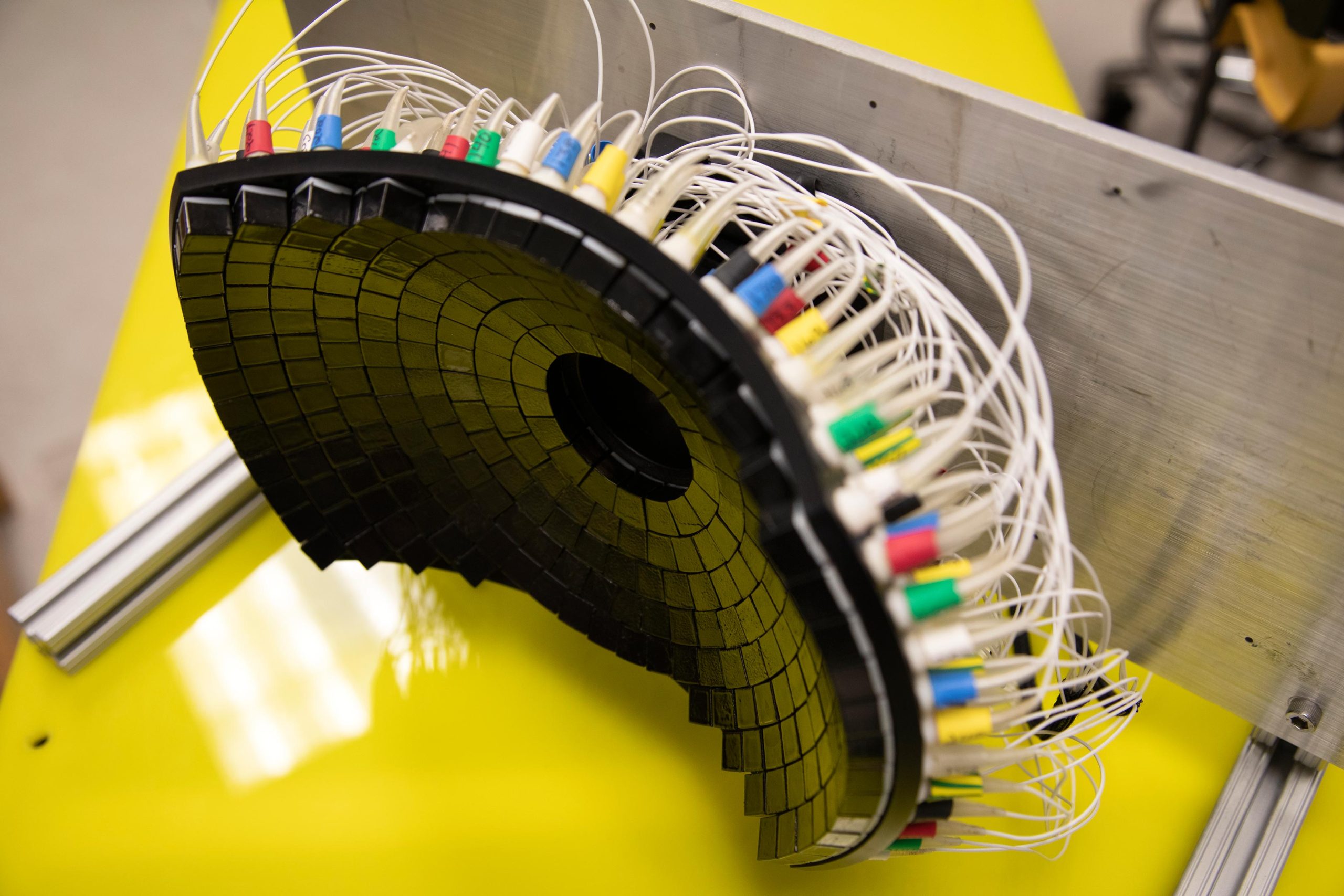
“Our transducer, designed and built at U-M, delivers high amplitude microsecond-length ultrasound pulses—acoustic cavitation—to focus on the tumor specifically to break it up,” Xu said. “Traditional ultrasound devices use lower amplitude pulses for imaging.”
The microsecond long pulses from UM’s transducer generate microbubbles within the targeted tissues—bubbles that rapidly expand and collapse. These violent but extremely localized mechanical stresses kill cancer cells and break up the tumor’s structure.
Reference: “Impact of Histotripsy on Development of Intrahepatic Metastases in a Rodent Liver Tumor Model” by Tejaswi Worlikar, Man Zhang, Anutosh Ganguly, Timothy L. Hall, Jiaqi Shi, Lili Zhao, Fred T. Lee, Mishal Mendiratta-Lala, Clifford S. Cho and Zhen Xu, 22 March 2022, Cancers.
DOI: 10.3390/cancers14071612
Since 2001, Xu’s laboratory at U-M has pioneered the use of histotripsy in the fight against cancer, leading to the clinical trial #HOPE4LIVER sponsored by HistoSonics, a U-M spinoff company. More recently, the group’s research has produced promising results on histotripsy treatment of brain therapy and immunotherapy.
The study was supported by grants from the National Institutes of Health, Focused Ultrasound Foundation, VA Merit Review, U-M’s Forbes Institute for Discovery and Michigan Medicine-Peking University Health Sciences Center Joint Institute for Translational and Clinical Research.
Never miss a breakthrough: Join the SciTechDaily newsletter.
Follow us on Google and Google News.
5 Comments
This method has been used for 20 years to successfully treat Prostate and other types of cancer. Its call HIFU
Everything is curable in rats. And it never gets transferred to human ailments. As a type-1 diabetic for 44 years, I’ve seen reports of not less than one thousand rats cured of diabetes. And that’s where it ends. Rat ailments aren’t human ailments. The sad thing is the grant money eaten-up by these researchers that grab it, spend it, then disappear. Please prove me wrong.
Royal Rife invented a machine a long time ago that emits specific vibrations to treat specific health issues. It worked then, it works now. This isn’t new. Funny how scientist get all the credit…
I’ve lived long enough to watch millenial “scientists” rediscover something for the tenth time and try and claim glory for something patented half a century earlier.
No me duele que el dinero se lo gasten los científicos.me duele que se lo gasten los burócratas.
Ojalá tenga buen término el “descubrimiento”