
Researchers from North Carolina State University (NCSU) and the University of Pennsylvania (Penn) have developed soft robots that are capable of navigating complex environments, such as mazes, without input from humans or computer software.
“These soft robots demonstrate a concept called ‘physical intelligence,’ meaning that structural design and smart materials are what allow the soft robot to navigate various situations, as opposed to computational intelligence,” says Jie Yin, corresponding author of a paper on the work and an associate professor of mechanical and aerospace engineering at NC State.
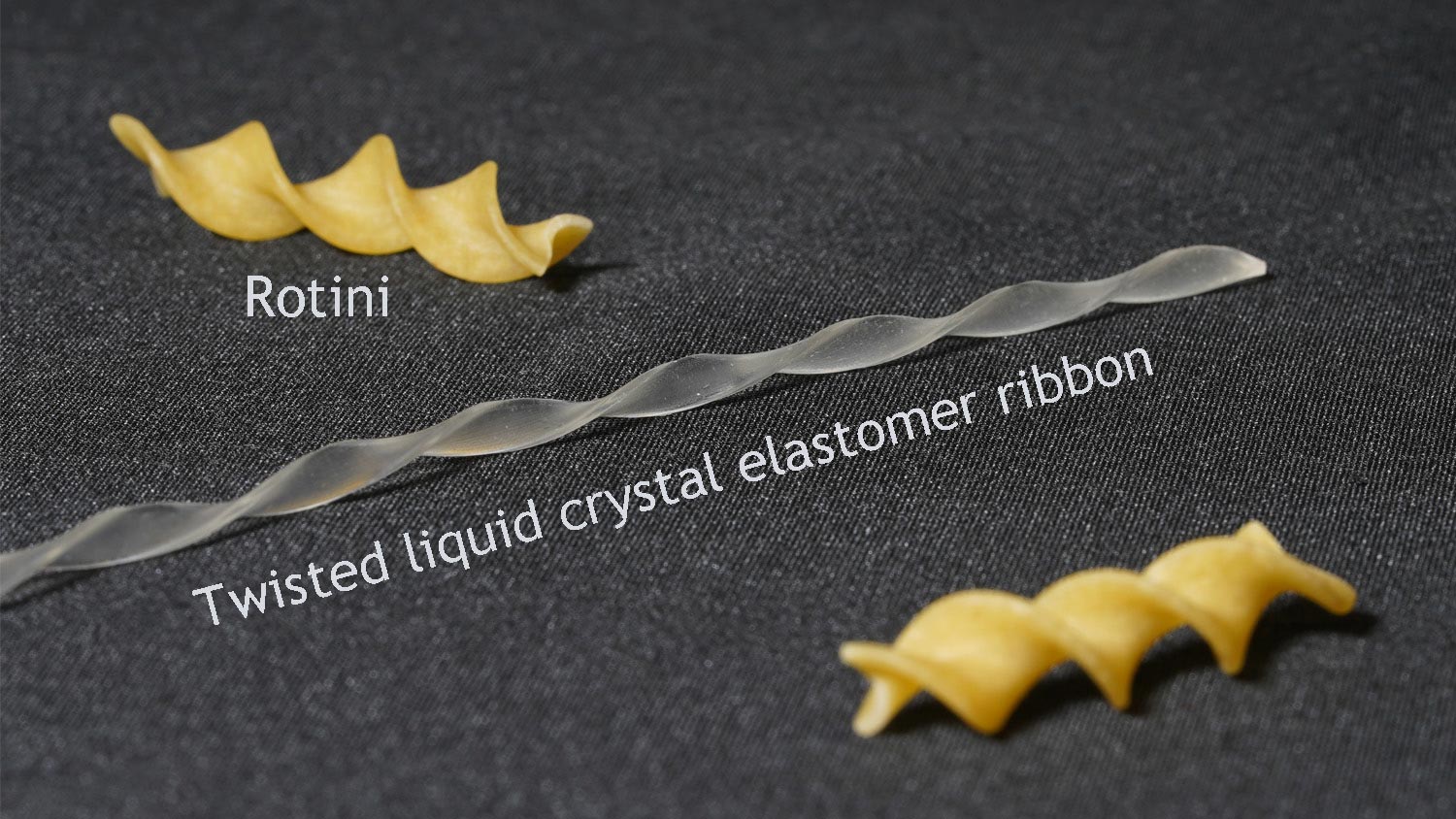
The soft robots are made of liquid crystal elastomers in the shape of a twisted ribbon, resembling the pasta rotini, except translucent. When you place the ribbon on a surface that is at least 55 degrees Celsius (131 degrees Fahrenheit), which is hotter than the ambient air, the portion of the ribbon touching the surface contracts, while the portion of the ribbon exposed to the air does not. This induces a rolling motion in the ribbon. And the warmer the surface, the faster it rolls.
A collaborative research team from NCSU and Penn has recently developed an autonomous and intelligent twisted soft robot that can self-escape from simple maze-like obstacle courses without any external control and human interventions. The soft robot is made of heat-responsive liquid crystal elastomers with its soft body resembling a translucent rotini. When encountering obstacles, it utilizes the embodied physical intelligence of self-snapping and self-turning for autonomous obstacle negotiation and avoidance. They also show that the robot can self-roll on hot loose sand dunes without getting stuck and slipping, as well as cross hot rocks. It can also harvest thermal energy from environments for self-powered rolling on a car roof and BBQ grills.
“This has been done before with smooth-sided rods, but that shape has a drawback – when it encounters an object, it simply spins in place,” says Yin. “The soft robot we’ve made in a twisted ribbon shape is capable of negotiating these obstacles with no human or computer intervention whatsoever.”
Obstacle Negotiation Through Rotating and Snapping
The ribbon robot does this in two ways. First, if one end of the ribbon encounters an object, the ribbon rotates slightly to get around the obstacle. Second, if the central part of the robot encounters an object, it “snaps.” The snap is a rapid release of stored deformation energy that causes the ribbon to jump slightly and reorient itself before landing. The ribbon may need to snap more than once before finding an orientation that allows it to negotiate the obstacle, but ultimately it always finds a clear path forward.
“In this sense, it’s much like the robotic vacuums that many people use in their homes,” Yin says. “Except the soft robot we’ve created draws energy from its environment and operates without any computer programming.”
“The two actions, rotating and snapping, that allow the robot to negotiate obstacles operate on a gradient,” says Yao Zhao, first author of the paper and a postdoctoral researcher at NC State. “The most powerful snap occurs if an object touches the center of the ribbon. But the ribbon will still snap if an object touches the ribbon away from the center, it’s just less powerful. And the further you are from the center, the less pronounced the snap, until you reach the last fifth of the ribbon’s length, which does not produce a snap at all.”
The researchers conducted multiple experiments demonstrating that the ribbon-like soft robot is capable of navigating a variety of maze-like environments. The researchers also demonstrated that the soft robots would work well in desert environments, showing they were capable of climbing and descending slopes of loose sand.
“This is interesting, and fun to look at, but more importantly it provides new insights into how we can design soft robots that are capable of harvesting heat energy from natural environments and autonomously negotiating complex, unstructured settings such as roads and harsh deserts,” Yin says.
Reference: “Twisting for Soft Intelligent Autonomous Robot in Unstructured Environments” by Yao Zhao, Yinding Chi, Yaoye Hong, Yanbin Li, Shu Yang and Jie Yin, 23 May 2022, Proceedings of the National Academy of Sciences.
DOI: 10.1073/pnas.2200265119
The paper will be published the week of May 23 in the Proceedings of the National Academy of Sciences. The paper was co-authored by NC State Ph.D. students Yinding Chi, Yaoye Hong and Yanbin Li; as well as Shu Yang, the Joseph Bordogna Professor of Materials Science and Engineering at the University of Pennsylvania.
The work was done with support from the National Science Foundation, under grants CMMI-431 2010717, CMMI-2005374 and DMR-1410253.
Never miss a breakthrough: Join the SciTechDaily newsletter.
Follow us on Google and Google News.