
Researchers Engineer the First Sustainable Chromosomal Alterations in Mice
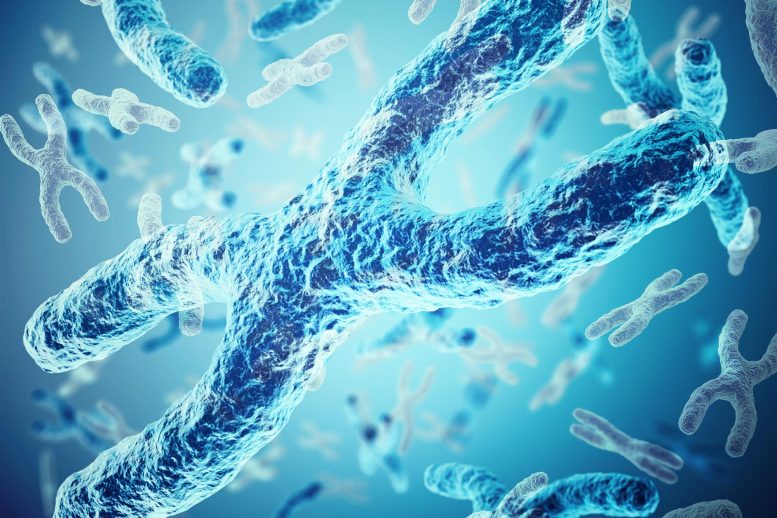
In nature, evolutionary chromosomal changes may take a million years, but scientists have recently reported a novel technique for programmable chromosome fusion that has successfully created mice with genetic changes that occur on a million-year evolutionary scale in the laboratory. The findings might shed light on how chromosomal rearrangements – the neat bundles of structured genes provided in equal numbers by each parent, which align and trade or mix characteristics to produce offspring – impact evolution.
In a study published in the journal Science, the researchers show that chromosome level engineering is possible in mammals. They successfully created a laboratory house mouse with a novel and sustainable karyotype, offering crucial insight into how chromosome rearrangements may influence evolution.
“The laboratory house mouse has maintained a standard 40-chromosome karyotype — or the full picture of an organism’s chromosomes — after more than 100 years of artificial breeding,” said co-first author Li Zhikun, researcher in the Chinese Academy of Sciences (CAS) Institute of Zoology and the State Key Laboratory of Stem Cell and Reproductive Biology. “Over longer time scales, however, karyotype changes caused by chromosome rearrangements are common. Rodents have 3.2 to 3.5 rearrangements per million years, whereas primates have 1.6.”
According to Li, even little changes can have a massive impact. In primates, the 1.6 changes are the difference between humans and gorillas. Gorillas have two distinct chromosomes, while humans have two merged chromosomes, and a translocation between ancestral human chromosomes resulted in two different chromosomes in gorillas. Individually, fusions or translocations may result in missing or additional chromosomes, as well as diseases such as childhood leukemia.
While the chromosomes’ consistent reliability is useful for learning how things operate on a short time scale, Li believes that the capacity to engineer modifications might enrich genetic understanding throughout millennia, including how to correct misaligned or malformed chromosomes. Other scientists have successfully altered chromosomes in yeast, but efforts to transfer the technology to mammals have failed.
Challenges in Engineering Mammalian Chromosomes
The challenge, according to co-first author Wang Libin of CAS and the Beijing Institute for Stem Cell and Regenerative Medicine, is that the process entails extracting stem cells from unfertilized mouse embryos, which means the cells only have one pair of chromosomes.
There are two sets of chromosomes in diploid cells that align and negotiate the genetics of the resulting organism. This is known as genomic imprinting, and it occurs when a dominant gene is marked active while a recessive gene is marked inactive. The process can be scientifically manipulated, but the information has not stuck in previous attempts in mammal cells.
“Genomic imprinting is frequently lost, meaning the information about which genes should be active disappears, in haploid embryonic stem cells, limiting their pluripotency and genetic engineering,” Wang said. “We recently discovered that by deleting three imprinted regions, we could establish a stable sperm-like imprinting pattern in the cells.”
Successful Chromosome Fusions and Their Impact
Without the three naturally imprinted regions, the researchers’ engineered imprinting pattern could take hold, allowing them to fuse specific chromosomes. They tested it by fusing two medium-sized chromosomes — 4 and 5 — head to tail and the two largest chromosomes — 1 and 2 — in two orientations, resulting in karyotypes with three different arrangements.
“The initial formations and stem cell differentiation were minimally affected; however, karyotypes with fused 1 and 2 chromosomes resulted in arrested development,” Wang said. “The smaller fused chromosome composed of chromosomes 4 and 5 was successfully passed to offspring.”
Reproductive Isolation and Species Evolution
The karyotypes with chromosome 2 fused to the top of chromosome 1 did not lead to any full-term mouse pups, while the opposite arrangement produced pups that grew into larger, more anxious, and physically slower adults, compared to the mice with fused 4 and 5 chromosomes. Only the mice with fused 4 and 5 chromosomes were able to produce offspring with wild-type mice, but at a much lower rate than standard lab mice.
The researchers found that the weakened fertility resulted from an abnormality in how chromosomes separated after alignment, Wang said. He explained that this finding demonstrated the importance of chromosomal rearrangement in establishing reproductive isolation, which is a key evolutionary sign of the emergence of a new species.
“Some engineering mice showed abnormal behavior and postnatal overgrowth, whereas others exhibited decreased fecundity, suggesting that although the change of genetic information was limited, fusion of animal chromosomes could have profound effects,” LI said. “Using an imprint fixed haploid embryonic stem cell platform and gene editing in a laboratory mouse model, we experimentally demonstrated that the chromosomal rearrangement event is the driving force behind species evolution and important for reproductive isolation, providing a potential route for large-scale engineering of DNA in mammals.”
Reference: “A sustainable mouse karyotype created by programmed chromosome fusion” by Li-Bin Wang, Zhi-Kun Li, Le-Yun Wang, Kai Xu, Tian-Tian Ji, Yi-Huan Mao, Si-Nan Ma, Tao Liu, Cheng-Fang Tu, Qian Zhao, Xu-Ning Fan, Chao Liu, Li-Ying Wang, You-Jia Shu, Ning Yang, Qi Zhou and Wei Li, 25 August 2022, Science.
DOI: 10.1126/science.abm1964
The study was funded by the Chinese Academy of Sciences and the National Natural Science Foundation of China.
Never miss a breakthrough: Join the SciTechDaily newsletter.
Follow us on Google and Google News.
5 Comments
Now that BIDEN at WH.Gov today is Tilted fully towards Genetic Engineering, with his Executive Order on Advancing Biotechnology and Biomanufacturing Innovations – We will Certainly have Real Progress for all Humans. Orientation in Past Couple of Centuries was towards building Bridges & Vehicles. Before that on constructing huge buildings, if we look at Ancient Ruins..1 Example is Pyramids. So, Now it is high time to focus on Real Necessities of this Period, we are currently living in.
… when genetics happen in humans it will be fun. Can’t imagine people who look like, … Oh my God…
Why would someone mess up with a million-year process? Why would someone do that? Who are these ‘scientists’?
Animal abuse.
Sounds promising for preventing cancer, blindness, illnesses… but I question the invasiveness of it… takes risk to whole new level, right? As great as it might sound at first, when do you stop?