
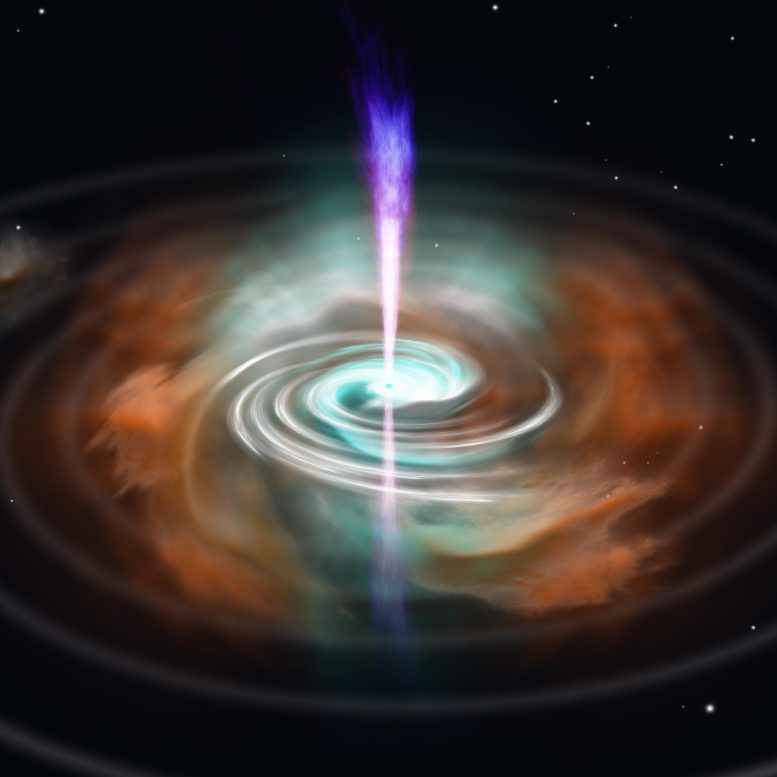
According to recent research from the University of Bath in the UK, newborn supramassive stars, rather than black holes, may be the cause of gamma-ray bursts.
Satellites orbiting Earth have detected Gamma-ray bursts (GRBs) as luminous flashes of extremely energetic gamma-ray radiation that last from milliseconds to hundreds of seconds. These catastrophic blasts occur in distant galaxies billions of light-years away from Earth.
A type of GRB called a short-duration GRB is produced when two neutron stars collide. These ultra-dense stars, which have the mass of our Sun compressed into a size smaller than a city, generate ripples in space-time called gravitational waves just before triggering a GRB in their final moments.
Until now, space scientists have largely agreed that the ‘engine’ powering such energetic and short-lived bursts must always come from a newly formed black hole (a region of space-time where gravity is so strong that nothing, not even light, can escape from it). However, new research by an international team of astrophysicists, led by Dr. Nuria Jordana-Mitjans at the University of Bath in the UK, is challenging this scientific orthodoxy.
According to the study’s findings, some short-duration GRBs are triggered by the birth of a supramassive star (otherwise known as a neutron star remnant) not a black hole.
Dr. Jordana-Mitjans said: “Such findings are important as they confirm that newborn neutron stars can power some short-duration GRBs and the bright emissions across the electromagnetic spectrum that have been detected accompanying them. This discovery may offer a new way to locate neutron star mergers, and thus gravitational waves emitters when we’re searching the skies for signals.”
Competing Theories
Much is known about short-duration GRBs. They start life when two neutron stars, which have been spiraling ever closer, constantly accelerating, finally crash. And from the crash site, a jetted explosion releases the gamma-ray radiation that makes a GRB, followed by a longer-lived afterglow. A day later, the radioactive material that was expelled in all directions during the explosion produced what researchers call a kilonova.
However, precisely what remains after two neutron stars collide – the ‘product’ of the crash – and consequently the power source that gives a GRB its extraordinary energy, has long been a matter of debate. Scientists may now be closer to resolving this debate, thanks to the findings of the Bath-led study.
Space scientists are split between two theories. The first theory has it that neutron stars merge to briefly form an extremely massive neutron star, only for this star to then collapse into a black hole in a fraction of a second. The second argues that the two neutron stars would result in a less heavy neutron star with a higher life expectancy.
So the question that has been needling astrophysicists for decades is this: are short-duration GRBs powered by a black hole or by the birth of a long-lived neutron star?
To date, most astrophysicists have supported the black hole theory, agreeing that to produce a GRB, it is necessary for the massive neutron star to collapse almost instantly.
Electromagnetic Signals
Astrophysicists learn about neutron star collisions by measuring the electromagnetic signals of the resultant GRBs. The signal originating from a black hole would be expected to differ from that coming from a neutron star remnant.
The electromagnetic signal from the GRB explored for this study (named GRB 180618A) made it clear to Dr. Jordana-Mitjans and her collaborators that a neutron star remnant rather than a black hole must have given rise to this burst.
Elaborating, Dr. Jordana-Mitjans said: “For the first time, our observations highlight multiple signals from a surviving neutron star that lived for at least one day after the death of the original neutron star binary.”
Professor Carole Mundell, study co-author and professor of Extragalactic Astronomy at Bath, where she holds the Hiroko Sherwin Chair in Extragalactic Astronomy, said: “We were excited to catch the very early optical light from this short gamma-ray burst – something that is still largely impossible to do without using a robotic telescope. But when we analyzed our exquisite data, we were surprised to find we couldn’t explain it with the standard fast-collapse black hole model of GRBs.
“Our discovery opens new hope for upcoming sky surveys with telescopes such as the Rubin Observatory LSST with which we may find signals from hundreds of thousands of such long-lived neutron stars before they collapse to become black holes.”
Disappearing Afterglow
What initially puzzled the researchers was that the optical light from the afterglow that followed GRB 180618A disappeared after just 35 minutes. Further analysis showed that the material responsible for such a brief emission was expanding close to the speed of light due to some source of continuous energy that was pushing it from behind.
What was more surprising was that this emission had the imprint of a newborn, rapidly spinning and highly magnetized neutron star called a millisecond magnetar. The team found that the magnetar after GRB 180618A was reheating the leftover material of the crash as it was slowing down.
In GRB 180618A, the magnetar-powered optical emission was one-thousand times brighter than what was expected from a classical kilonova.
Reference: “A Short Gamma-Ray Burst from a Protomagnetar Remnant” by N. Jordana-Mitjans, C. G. Mundell, C. Guidorzi, R. J. Smith, E. Ramírez-Ruiz, B. D. Metzger, S. Kobayashi, A. Gomboc, I. A. Steele, M. Shrestha, M. Marongiu, A. Rossi and B. Rothberg, 10 November 2022, The Astronomical Journal.
DOI: 10.3847/1538-4357/ac972b
The study was funded by the Hiroko and Jim Sherwin Postgraduate Studentship.
Never miss a breakthrough: Join the SciTechDaily newsletter.
Follow us on Google and Google News.
2 Comments
Seems to me there are more gamma-ray bursts than there would be neutron star collisions! And most of the very active bursts seem to be coming from galaxies.
One view of String Theory suggests that active galaxies, including radio galaxies, Seyfert galaxies, and Quasars, may be explained with branes (dimensional membranes) at their centers rather than Black Holes. This view also explains those curious low surface brightness galaxies like Malin 1. Specifics on this can be found by searching YouTube for “Active Galaxies – A String Theory Way”
So if that’s true then they have it backwards and physics needs parts flipped or rewritten cause that wouldn’t be the death of a star…. or a collision of dead stars turning to a black hole and may have never even seen a black be formed which the math supports. Which if wrong means someone somewhere had to have made a massive mistake that allows the math to say it’s black holes forming…or purposefully made numbers to match what they wanted it to.
And then the supermassive star would also just be being born and survives the explosion somehow yet can’t be seen either allowing it to be mistaken for a black hole. …. Or was blown apart leaving an empty space but leaves no evidence a star was born and died almost instantly…. Cause if it’s a star then it should be visible. Tho Maybe that’s why they put out so much energy. All the sun’s energy in its life in a fraction of second…. Would be explainable by a star firming rapidly then exploding apart for some reason……. Could zero point energy cores explain it… Super massive stars pull to much energy, the mass being the catalyst, smaller ones pull less. Mass gets lost and smaller stars swell from the zero point energy then lose more mass still the point shuts down letting it shrink again… Bigger stars pull to much and go supernova and so on…. neutron star’s and magnetars fields powered by zero point energy as the mass is just enough to not be blow apart but isn’t to little causing expansion…. What would the math say if that were put in.