
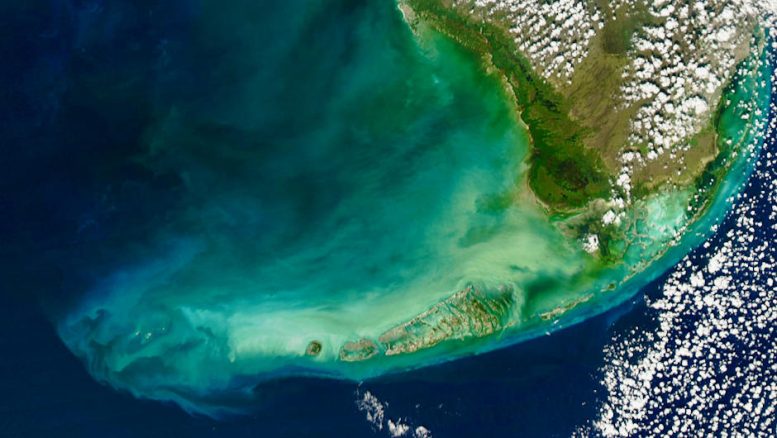
The largest spatial assessment to date highlights the need for improved management practices and coral restoration efforts in Florida.
According to recent research, 70% of Florida’s reefs are eroding and suffering a net loss of reef habitat. The study, carried out by an interdisciplinary team of scientists through the University of Miami Rosenstiel School of Marine, Earth, and Atmospheric Science’s NOAA Cooperative Institute for Marine and Atmospheric Studies, provides new details on the condition of Florida’s renowned coral reefs.
“This research helps us to better understand which reefs along Florida’s reef tract are vulnerable to habitat loss and require management and restoration efforts to prevent further habitat loss,” said the study’s lead author John Morris, a researcher at NOAA’s Atlantic Oceanographic and Meteorological Laboratory. “On the contrary, we also identified reefs that may be potential hold-outs to reef development and are more likely to persist in the future.”
Analyzing Reef Carbonate Budgets
The researchers analyzed the benthic ecology, which is the assemblage of all living organisms inhabiting the sea floor, and parrotfish data from 723 reef sites in three biogeographic regions across the state’s reef tract to calculate each site’s carbonate budget. The reef tract extends 350 miles (560 kilometers) from the Dry Tortugas to the St. Lucie Inlet. A positive carbonate budget indicates a reef is growing over time, whereas a negative carbonate budget suggests the reef is losing structure.
The data, from NOAA’s National Coral Reef Monitoring Program and National Geodetic Surveys, was used to calculate carbonate production and carbonate erosion throughout South Florida. The primary drivers of carbonate budgets along the Florida reef tract are the amount of coral cover and parrotfish biomass. They found that 506 of the sites were losing reef habitat on an annual basis.
“These findings underscore the need for enhanced management strategies like outplanting corals to help restore coral structure that has been lost,” said study co-author Erica Towle, coordinator of NOAA’s National Coral Reef Monitoring Program and alumna of the UM Rosenstiel School. “Moving forward, we can use this as a baseline to implement and track the success of management strategies.”
The Florida Reef Tract is the only living coral barrier reef in the continental United States and the third largest coral barrier reef system in the world.
Major Drivers of Coral Loss
The largest drivers of coral loss in Florida over the last decade include bleaching events, ship groundings, and disease, such as the stony coral tissue loss disease discovered in 2014 which continues to decimate Florida and Caribbean reefs.
According to NOAA, Florida’s coral reefs support 70,000 jobs and generate about $8.5 billion in sales and income annually. Healthy reefs also protect coastlines from flooding and storm surges.
“Unless management strategies are implemented, Florida’s eroding reefs will likely reduce the extent to which coral reefs can sustain these important economic and ecosystem services,” said Morris.
Reference: “Low net carbonate accretion characterizes Florida’s coral reef” by John T. Morris, Ian C. Enochs, Nicole Besemer, T. Shay Viehman, Sarah H. Groves, Jeremiah Blondeau, Cory Ames, Erica K. Towle, Laura Jay W. Grove and Derek P. Manzello, 15 November 2022, Scientific Reports.
DOI: 10.1038/s41598-022-23394-4
The study was funded by the NOAA Coral Reef Conservation Program.
Never miss a breakthrough: Join the SciTechDaily newsletter.
Follow us on Google and Google News.