
Close Menu
    Facebook X (Twitter) Instagram
    SciTechDaily
    • Biology
    • Chemistry
    • Earth
    • Health
    • Physics
    • Science
    • Space
    • Technology
    Facebook X (Twitter) Pinterest YouTube RSS
    SciTechDaily
    Home»Chemistry»Novel Carbon Coating Technology of Li-Rich Layered Oxide Cathode
    Chemistry

    Novel Carbon Coating Technology of Li-Rich Layered Oxide Cathode

    By Wuhan University of TechnologyDecember 29, 2017No Comments2 Mins Read
    Facebook Twitter Pinterest Telegram LinkedIn WhatsApp Email Reddit
    Share
    Facebook Twitter LinkedIn Pinterest Telegram Email Reddit
    Carbon Coating Technology of Li-Rich Layered Oxide Cathode
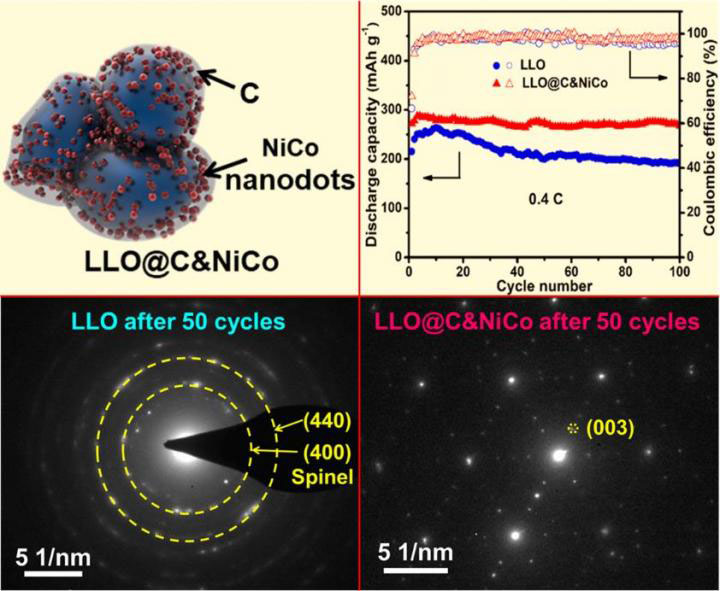
    This is a schematic illustration of LLO@C&NiCo; Cycling performance and the corresponding Coulombic efficiencies tested at current densities of 0.4 C; SAED patterns of LLO and LLO@C&NiCo after 50 cycles at 0.4 C. ©Science China Press

    The rapid development of portable electronics and electric vehicles requires lithium-ion batteries (LIBs) to have high energy/power density, low cost, good safety, and long lifespan. In a commercial LIB, the traditional cathode and anode materials are LiCoO2 and graphite, respectively. Compared with commercial graphite (theoretical capacity 372 mAh g−1), LiCoO2 has a low specific capacity of 150 mAh g−1 which becomes a big bottleneck of the battery breakthroughs. Among numerous cathode materials, Li-rich layered oxide (LLO) materials have attracted increasing attention as promising candidates because of their high specific capacity (> 250 mAh g−1) and high operating voltage (> 3.5 V vs. Li+/Li). However, an undesired spinel growth in the layered host structure usually occurred from the surface during the long-term cycling, which led to the fast capacity fading and voltage decaying.

    Prof. L. Q. Mai has led a research team at Wuhan University of Technology aiming to improve the electrochemical performance of electrode materials. They have developed a facile and general carbon coating technology. The unique NiCo nanodots decorated carbon shell was constructed on the as-prepared Li1.2Mn0.54Ni0.13Co0.13O2 nanoparticles masterly on this basis. The obtained LLO@C&NiCo cathode exhibits enhanced cycling and rate capability with a capacity retention of 95% after 100 cycles at 0.4 C, 90% after 300 cycles at 2 C, and a high capacity of 159 mAh g−1 at 5 C, respectively.

    The in-situ X-ray diffraction, electrochemical impedance spectroscopy, and selected area electron diffraction analyses after cycling demonstrate that the LLO@C&NiCo as a cathode material for LIBs exhibiting superior electrochemical performances, which is due to its unique protective C&NiCo shell. It promotes the electron conductivity (5 times), reduces the diffusion impedance, provides a robust structure for LLO which suppresses the undesired formation of the spinel phase initiated from the particle surface during cycling, and also protects the surface structure from side reactions at the electrode/electrolyte interface.

    Publication: “Novel MOF shell-derived surface modification of Li-rich layered oxide cathode for enhanced lithium storage” by Zhitong Xiao, Jiashen Meng, Qi Li, Xuanpeng Wang, Meng Huang, Ziang Liu, Chunhua Han and Liqiang Mai, 13 December 2017,  Science Bulletin.
    DOI: 10.1016/j.scib.2017.12.011

    Never miss a breakthrough: Join the SciTechDaily newsletter.
    Follow us on Google and Google News.

    Battery Technology Materials Science Nanoparticles Nanoscience Nanotechnology Wuhan University of Technology
    Share. Facebook Twitter Pinterest LinkedIn Email Reddit

    Related Articles

    Aluminum “Yolk-and-Shell” Nanoparticle Boosts Capacity and Power of Lithium-ion Batteries

    New Method to Control Nanoparticles with Light and Magnets

    New Observations Reveal the Inner Workings of Lithium-Ion Batteries

    Researchers Produce Uniform Antimony Nanocrystals for the First Time

    Silicon Nanoparticles Clustered Like Pomegranate Seeds Solve Problems for Lithium-Ion Batteries

    Gold Nanoparticles Recycle CO2 Into Useful Forms of Carbon

    Cerium Oxide Nanocrystals Act as Super Antioxidants

    Flexible Sensors May Lead to “Artificial Skin” That Senses Touch, Humidity and Temperature

    Researchers Uncover Why Lithium Iron Phosphate Works So Well

    Leave A Reply Cancel Reply

    • Facebook
    • Twitter
    • Pinterest
    • YouTube

    Don't Miss a Discovery

    Subscribe for the Latest in Science & Tech!

    Trending News

    Collapsing Plasma May Hold the Key to Cosmic Magnetism

    This Breakthrough Solar Panel Generates Power From Both Sunlight and Raindrops

    Scientists Uncover New Metabolic Effects Beyond Weight Loss of Mounjaro

    Scientists Discover Cancer Tumors Are “Addicted” to This Common Antioxidant

    1,800 Miles Down: Scientists Uncover Mysterious Movements at the Edge of Earth’s Core

    Scientists Discover Hidden “Good Fats” in Green Rice That Could Transform Nutrition

    Your Child’s Clothes Could Contain Toxic Lead, Study Finds

    Researchers Break a 150-Year-Old Math Law With a Surprising Donut Discovery

    Follow SciTechDaily
    • Facebook
    • Twitter
    • YouTube
    • Pinterest
    • Newsletter
    • RSS
    SciTech News
    • Biology News
    • Chemistry News
    • Earth News
    • Health News
    • Physics News
    • Science News
    • Space News
    • Technology News
    Recent Posts
    • Why Some People Reach 100: New Study Reveals Key Biological Differences
    • This Is How Ovarian Cancer Spreads Before Doctors Can Detect
    • Scientists Discover Hidden Virus Linked to Colorectal Cancer
    • Hidden Danger: Widely Used Pesticides Linked to 150% Higher Cancer Risk
    • The Mystery of the Notes: Why No One Knows How This 120-Year-Old Song Should Sound
    Copyright © 1998 - 2026 SciTechDaily. All Rights Reserved.
    • Science News
    • About
    • Contact
    • Editorial Board
    • Privacy Policy
    • Terms of Use

    Type above and press Enter to search. Press Esc to cancel.