
Close Menu
    Facebook X (Twitter) Instagram
    SciTechDaily
    • Biology
    • Chemistry
    • Earth
    • Health
    • Physics
    • Science
    • Space
    • Technology
    Facebook X (Twitter) Pinterest YouTube RSS
    SciTechDaily
    Home»Biology»Novel Coronavirus hCoV-EMC Infects Humans & Animals
    Biology

    Novel Coronavirus hCoV-EMC Infects Humans & Animals

    By SciTechDailyDecember 12, 2012No Comments3 Mins Read
    Facebook Twitter Pinterest Telegram LinkedIn WhatsApp Email Reddit
    Share
    Facebook Twitter LinkedIn Pinterest Telegram Email Reddit
    coronavirus-bats-pigs
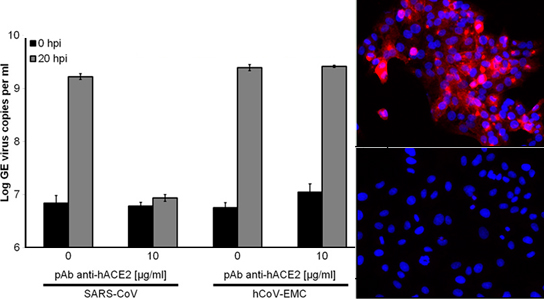
    The hCoV-EMC virus could still enter bat cells (blue) even when the ACE2 receptor was blocked by antibodies (red). Studies in monkey kidney cells (left) also showed that blocking ACE2 prevented the entry of the SARS virus (top right) but not hCoV-EMC (bottom right). Credit: Marcel A. Müller and Christian Drosten/University of Bonn Medical Center, Germany

    The novel coronavirus which was discovered this summer in the Middle East might infect more than just human patients. The pathogen is closely related to SARS, and it may also be able to infect pigs and a wide range of bat species.

    The scientists published their findings in the journal mBio. The findings might help public health officials track the source of the outbreak and identify the role of wild animals and livestock in the spread of the virus.

    The hCoV-EMC (human coronavirus-Erasmus Medical Center) was identified in the Erasmus MC in Rotterdam, the Netherlands, from a sample obtained from a 60-year-old Saudi. Cases have appeared in Qatar and Jordan, and researchers have confirmed nine infections, including five deaths. Several other cases are suspected, but these haven’t been confirmed.

    The virus has been fully sequenced and its genome revealed that it is closely related to the SARS coronavirus. The SARS virus uses a receptor called ACE2 to open cells, which are found deep inside the human lung. If hCoV-EMC used the same receptor, researchers would be able to understand how the virus spreads and how to stop it.

    The team engineered baby hamster kidney cells to express the human ACE2 receptor. The cells could be infected with the SARS coronavirus, but not hCoV-EMC. This led the scientists to conclude that hCoV-EMC doesn’t use ACE2 to get into cells. It’s yet unclear which receptor it uses.

    Epidemiologists also wanted to know which species of animals hCoV-EMC was capable of infecting to keep it from spreading further, so they tested cells from humans, pigs and bats, the key natural reservoirs of coronaviruses. They found that hCoV-EMC could infect all of these cells.

    Most coronaviruses come from bats, but once they jump to other species, they usually can never reinfect bat cells. This could mean that hCoV-EMC is unique in its ability and researchers believe it could still have come from a bat. Either way, they believe the new coronavirus can infect a wide range of species, so public health officials may have to start looking for infections and deaths in local wild animal and livestock populations.

    Reference: “Human Coronavirus EMC Does Not Require the SARS-Coronavirus Receptor and Maintains Broad Replicative Capability in Mammalian Cell Lines” by Marcel A. Müller, V. Stalin Raj, Doreen Muth, Benjamin Meyer, Stephan Kallies, Saskia L. Smits, Robert Wollny, Theo M. Bestebroer, Sabine Specht, Tasnim Suliman, Katrin Zimmermann, Tabea Binger, Isabella Eckerle, Marco Tschapka, Ali M. Zaki, Albert D. M. E. Osterhaus, Ron A. M. Fouchier, Bart L. Haagmans and Christian Drosten, 11 December 2012, mBio.
    DOI: 10.1128/mBio.00515-12

    Never miss a breakthrough: Join the SciTechDaily newsletter.
    Follow us on Google and Google News.

    Disease Epidemiology Virology Virus
    Share. Facebook Twitter Pinterest LinkedIn Email Reddit

    Related Articles

    Cases of New Coronavirus Announced By WHO

    Crystal Meth Could Reduce Susceptibility to the Common Flu

    Gene Sequencing of New Coronavirus Speeds Up Testing

    New Coronavirus Could Infect Millions During Hajj in Saudi Arabia

    West Nile Virus Might Be Linked to Kidney Problems

    Brucella Blocked From Bonding With Host, Could Lead to Superbug Cure

    Monkeys Cured of Ebola Zaire Virus With Antibody Cocktail

    Visual Science’s Ebolavirus 3D Model is 10 Times More Complex Than Their HIV Model

    Ruminant Orthobunyavirus Takes Northern Europe By Surprise

    Leave A Reply Cancel Reply

    • Facebook
    • Twitter
    • Pinterest
    • YouTube

    Don't Miss a Discovery

    Subscribe for the Latest in Science & Tech!

    Trending News

    Wasp Colonies Explode Into Violence After Losing Their Queen

    Scientists Create “Living Plastic” That Self-Destructs in Just Six Days

    Your Blood May Carry a 700-Million-Year-Old Secret

    Scientists Discover Some “Zombie Cells” May Actually Help You Live Longer

    Earth May Be Seeding Venus With Life, According to New Research

    What Scientists Found Inside a 117-Year-Old Woman Reveals New Clues to Long Life

    Scientists Discover Mysterious Creature Living in the Great Salt Lake – and It Exists Nowhere Else on Earth

    It’s Alive? Surprising Discovery Changes What We Know About Fog

    Follow SciTechDaily
    • Facebook
    • Twitter
    • YouTube
    • Pinterest
    • Newsletter
    • RSS
    SciTech News
    • Biology News
    • Chemistry News
    • Earth News
    • Health News
    • Physics News
    • Science News
    • Space News
    • Technology News
    Recent Posts
    • A Psychologist Explains Why 40% of People Are Avoiding the News
    • Scientists Discover Alzheimer’s-Linked Proteion’s Surprising Role in Making Memories Last
    • Vitamin D Drug Shows Surprising Promise Against One of the Deadliest Cancers
    • Scientists Crack Major Ammonia Problem With a Platinum Catalyst Breakthrough
    • MIT Engineers Solve a Major Lidar Problem That Has Stumped Researchers for Years
    Copyright © 1998 - 2026 SciTechDaily. All Rights Reserved.
    • Science News
    • About
    • Contact
    • Editorial Board
    • Privacy Policy
    • Terms of Use

    Type above and press Enter to search. Press Esc to cancel.