
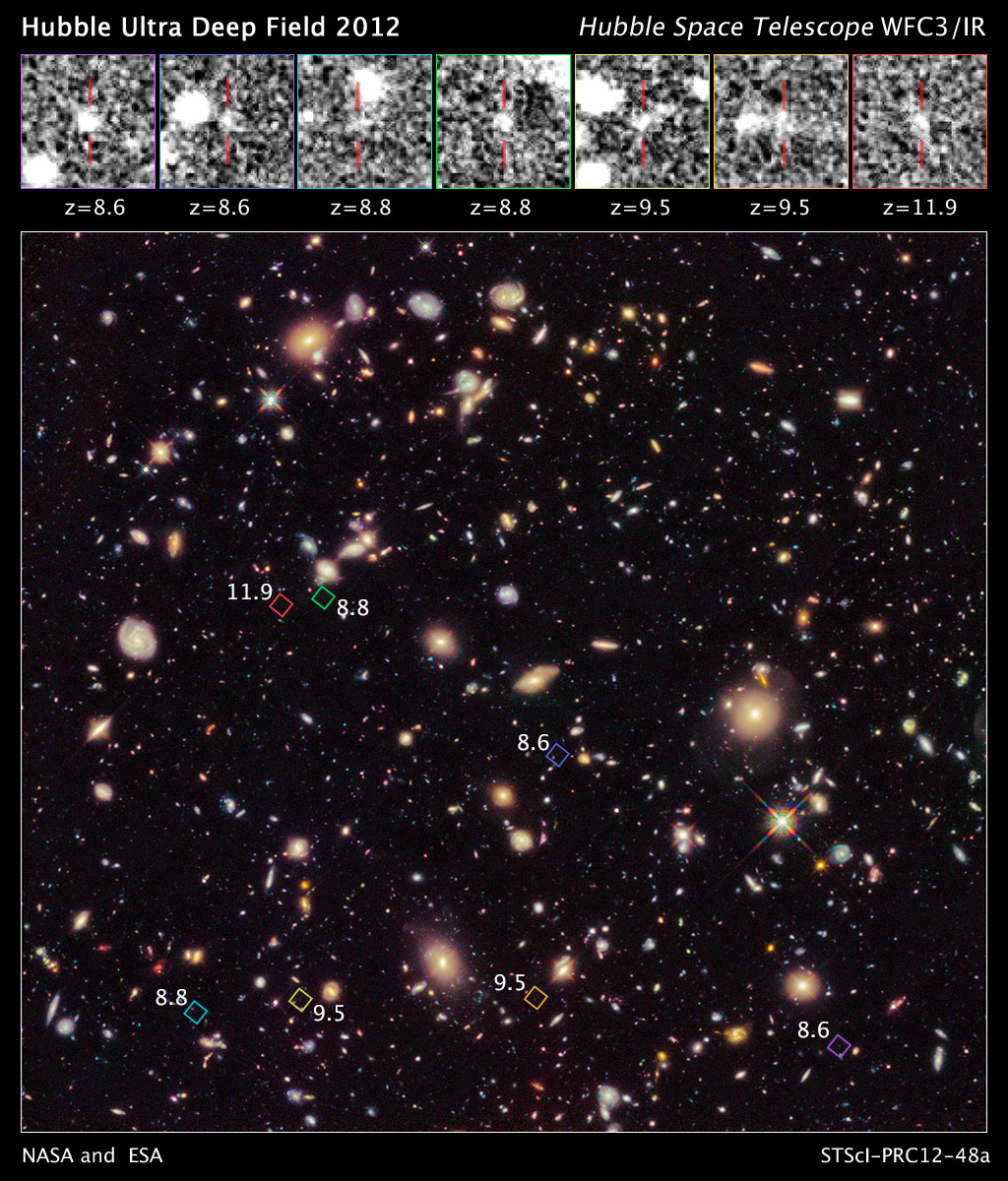
The Hubble Ultra Deep Field 2012 campaign revealed seven previously unseen populations of faraway galaxies, viewing them as they looked 350 to 600 million years after the Big Bang, more than 13 billion years ago.
Using NASA’s Hubble Space Telescope, astronomers have uncovered a previously unseen population of seven primitive galaxies that formed more than 13 billion years ago, when the universe was less than 4 percent of its present age. The deepest images to date from Hubble yield the first statistically robust sample of galaxies that tells how abundant they were close to the era when galaxies first formed.
The results are from an ambitious Hubble survey of an intensively studied patch of sky known as the Ultra Deep Field (UDF). In the 2012 campaign, called UDF12, a team of astronomers led by Richard Ellis of the California Institute of Technology in Pasadena used Hubble’s Wide Field Camera 3 (WFC 3) to peer deeper into space in near-infrared light than any previous Hubble observation.
The observations were made during six weeks in August and September, and the first scientific results now are appearing in a series of scientific papers. The UDF12 team is releasing these unique data to the public after preparing them for other research groups to use.
The results show a smooth decline in the number of galaxies looking back in time to about 450 million years after the Big Bang. The observations support the idea galaxies assembled continuously over time and also may have provided enough radiation to reheat, or re-ionize, the universe a few hundred million years after the theorized Big Bang.
Looking deeper into the universe also means peering further back in time. The universe is estimated to be 13.7 billion years old. The newly discovered galaxies are seen as they looked 350 to 600 million years after the Big Bang. Their light is just arriving at Earth now.
Astronomers study the distant universe in near-infrared light because the expansion of space stretches ultraviolet and visible light from galaxies into infrared wavelengths, a phenomenon called “redshift.” The more distant a galaxy, the higher its redshift.
The greater depth of the new Hubble images, together with a carefully designed survey strategy, allows this work to go further than previous studies, thereby providing what researchers say is the first reliable census of this epoch. Notably, one of the galaxies may be a distance record breaker, observed 380 million years after the birth of our universe in the Big Bang, corresponding to a redshift of 11.9.
A major goal of the new program was to determine how rapidly the number of galaxies increases over time in the early universe. This measure is the key evidence for how quickly galaxies build up their constituent stars.
“Our study has taken the subject forward in two ways,” Ellis explained. “First, we have used Hubble to make longer exposures. The added depth is essential to reliably probe the early period of cosmic history. Second, we have used Hubble’s available color filters very effectively to more precisely measure galaxy distances.”
The team estimated the galaxy distances by studying their colors through a carefully chosen set of four filters at specific near-infrared wavelengths. “We added one filter, and undertook much deeper exposures in some filters than in earlier work, in order to convincingly reject the possibility that some of our galaxies might be foreground objects,” said team member James Dunlop of the Institute for Astronomy at the University of Edinburgh in Scotland.
Astronomers have long debated whether hot stars in such early galaxies could have provided enough radiation to warm the cold hydrogen that formed soon after the Big Bang. This process, called “re-ionization,” is thought to have occurred 200 million to 1 billion years after the birth of the universe. This process made the universe transparent to light, allowing astronomers to look far back into time. The galaxies in the new study are seen in this early epoch.
“Our data confirm re-ionization was a gradual process, occurring over several hundred million years, with galaxies slowly building up their stars and chemical elements,” said Brant Robertson of the University of Arizona in Tucson. “There wasn’t a single dramatic moment when galaxies formed. It was a gradual process.”
The team’s finding on the distant galaxy census has been accepted for publication in The Astrophysical Journal Letters.
Reference: “The Abundance of Star-Forming Galaxies in the Redshift Range 8.5–12: New Results From the 2012 Hubble Ultra Deep Field Campaign” by Richard S. Ellis, Ross J. McLure, James S. Dunlop, Brant E. Robertson, Yoshiaki Ono, Matthew A. Schenker, Anton Koekemoer, Rebecca A. A. Bowler, Masami Ouchi, Alexander B. Rogers, Emma Curtis-Lake, Evan Schneider, Stephane Charlot, Daniel P. Stark, Steven R. Furlanetto and Michele Cirasuolo, 27 December 2012, The Astrophysical Journal Letters.
DOI: 10.1088/2041-8205/763/1/L7
Never miss a breakthrough: Join the SciTechDaily newsletter.
Follow us on Google and Google News.
1 Comment
My little brother and I share a dream of owning our own galaxy, and would really appreciate it if you posted the names of discovered galaxies. Name at least 10.