
Close Menu
    Facebook X (Twitter) Instagram
    SciTechDaily
    • Biology
    • Chemistry
    • Earth
    • Health
    • Physics
    • Science
    • Space
    • Technology
    Facebook X (Twitter) Pinterest YouTube RSS
    SciTechDaily
    Home»Space»October 2021 Skywatching Highlights From NASA – Two Brilliant Stars Vying for “Pole” Position
    Space

    October 2021 Skywatching Highlights From NASA – Two Brilliant Stars Vying for “Pole” Position

    By NASAOctober 5, 2021No Comments4 Mins Read
    Facebook Twitter Pinterest Telegram LinkedIn WhatsApp Email Reddit
    Share
    Facebook Twitter LinkedIn Pinterest Telegram Email Reddit

    What’s Up for October? What to look for this month at sunrise and sunset, and two brilliant stars vying for the “pole” position.

    On October 10th look for the five-day-old crescent Moon to join Venus and bright, orange-colored Antares in the southwest after sunset. Then watch as Venus closes on Antares, for a close conjunction on the 15th and 16th, where the two will be only about a degree and a half apart.
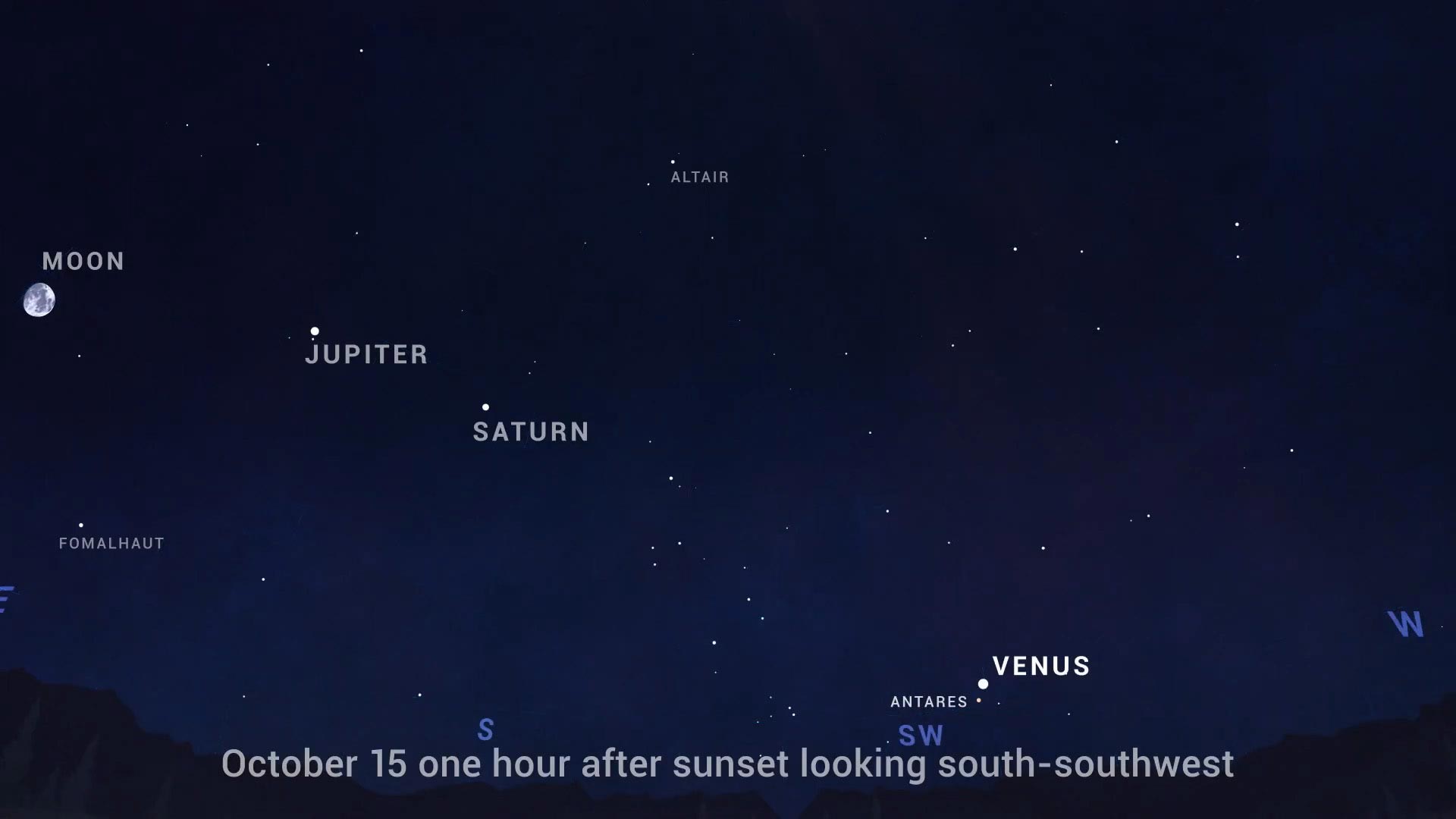
    October 15, 2021, Astronomy
    Venus comes within about 1.5° of the bright orange-colored star Antares on October 15 and 16, in the hour or so after sunset. Credit: NASA/JPL-Caltech

    During the last week of October, Mercury pops briefly into view for early risers.

    Look for it about 10 degrees above the eastern horizon, or about the width of your fist held at arm’s length, about 30-45 minutes before sunrise.
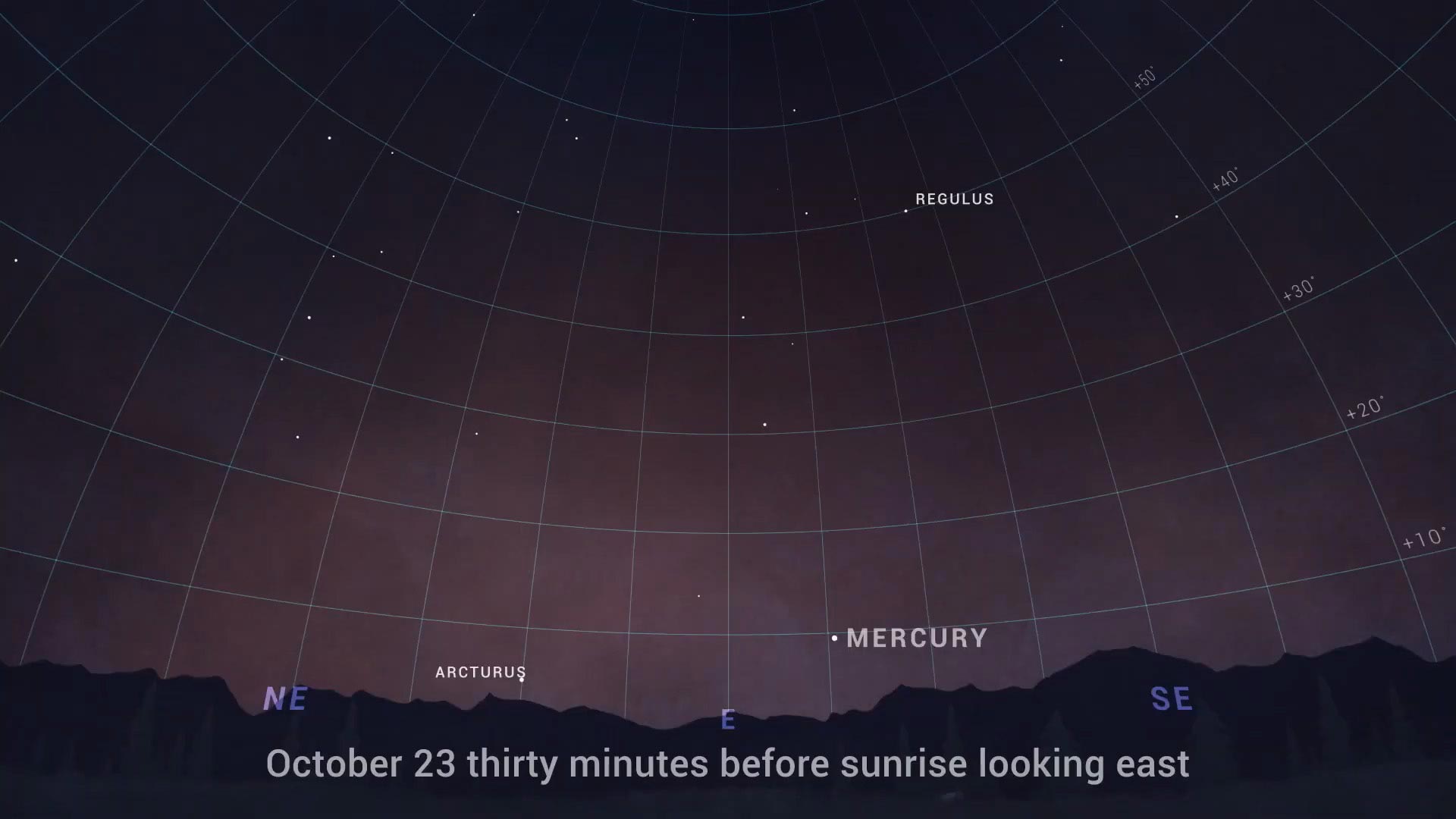
    October 23, 2021, Astronomy
    In the last week of October, Mercury can be glimpsed briefly in the morning sky before sunrise for those with a fairly clear view of the eastern horizon. Credit: NASA/JPL-Caltech

    Then on October 30th, in the last couple of hours before daybreak, look for the 24-day-old crescent Moon to join brilliant blue-white star Regulus.
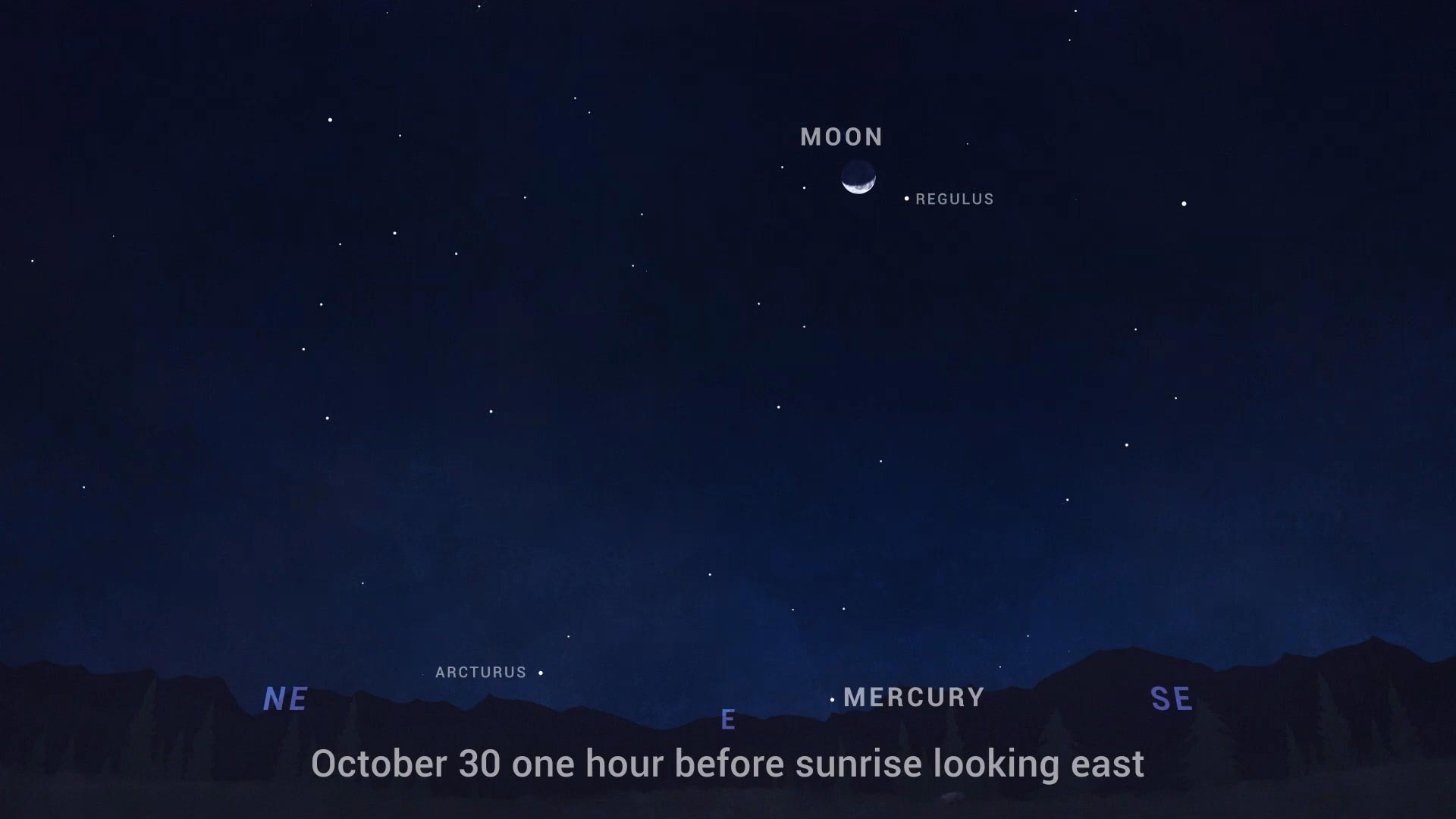
    October 30, 2021, Astronomy
    Find the crescent Moon near brilliant star Regulus in the east before dawn on October 30. Credit: NASA/JPL-Caltech

    All month long, look high overhead early in the evening to find two bright stars that take turns with Polaris being the North Star. Their names are Vega and Deneb. Both of these stars are part of the Summer Triangle, and we introduced the other member of the trio, Altair, in last month’s video. To find Vega and Deneb, look high overhead in the first few hours after it gets dark. They’ll be two of the brightest stars you can see up there.
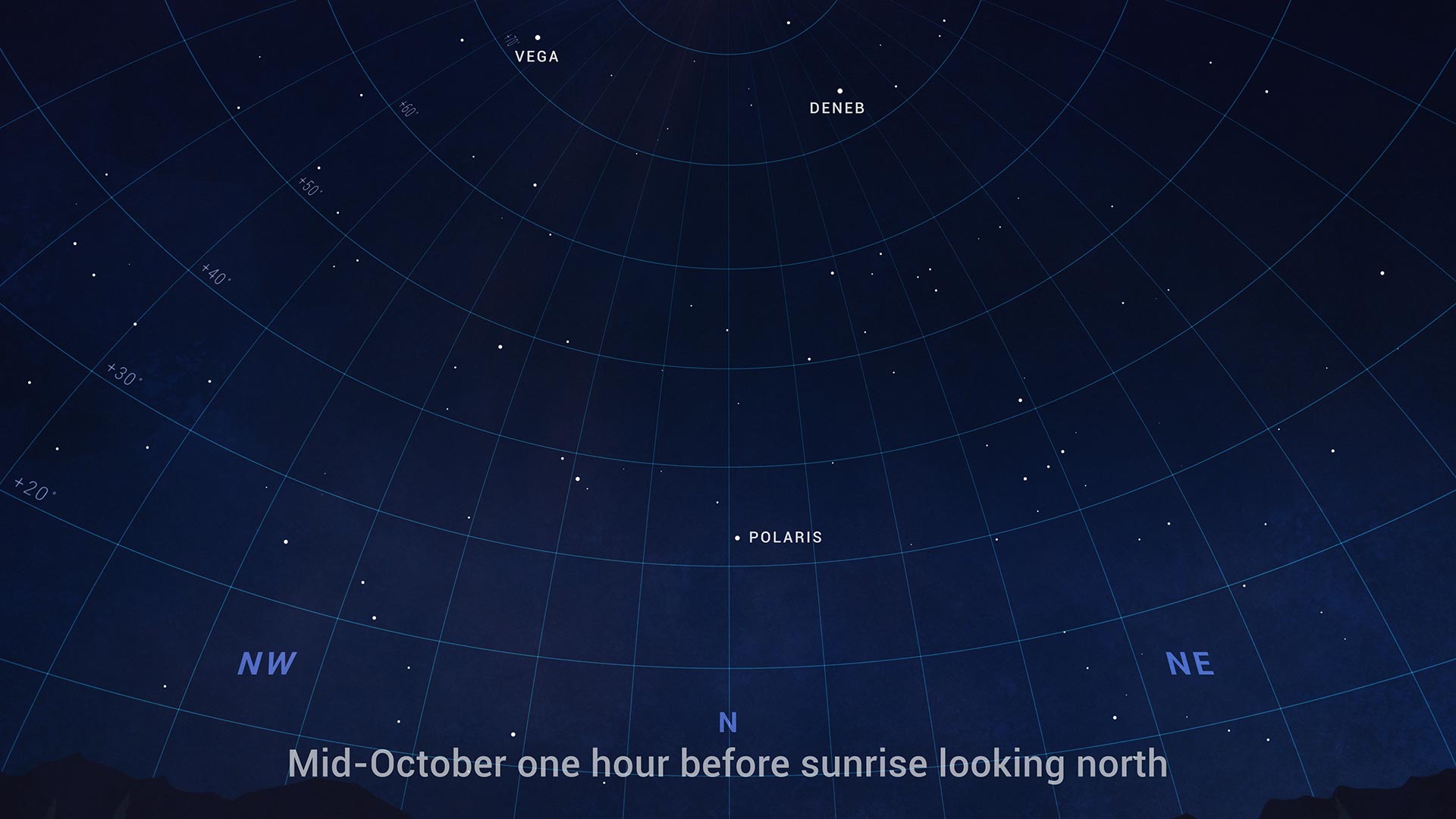
    Mid-October 2021, Astronomy
    In October, look high overhead to find bright stars Vega and Deneb in the few hours after sunset. The pair rotate toward the west, setting in the pre-dawn hours. Credit: NASA/JPL-Caltech

    Vega is a bluish-white star, and like Altair, it’s a fast rotator, spinning every 12 and a half hours, compared to the Sun’s 27-day rotation. NASA’s Spitzer Space Telescope found Vega to have a debris disk around it that could be similar to regions in our own solar system.

    Deneb is a blue-white supergiant star that is fusing hydrogen at a phenomenal rate.

    With this sort of fury, the party won’t last all that much longer. Deneb is likely headed for an explosive end as a supernova within a few million years. Deneb is much farther away than most bright stars in our night sky. This means it’s SUPER luminous to be that bright from so far away. Because it’s so bright, it’s one of the most distant stars you can see with the unaided eye.

    These stars rotate around the northern celestial pole, and this time of year, they dip toward the western horizon before setting in the pre-dawn hours. Both Vega and Deneb are part of a special group of stars that take turns being the pole star in the north, as Earth’s axis wobbles in a circle over a period of 26,000 years. For now the distinction of “North Star” belongs to Polaris, for at least a few hundred years more.
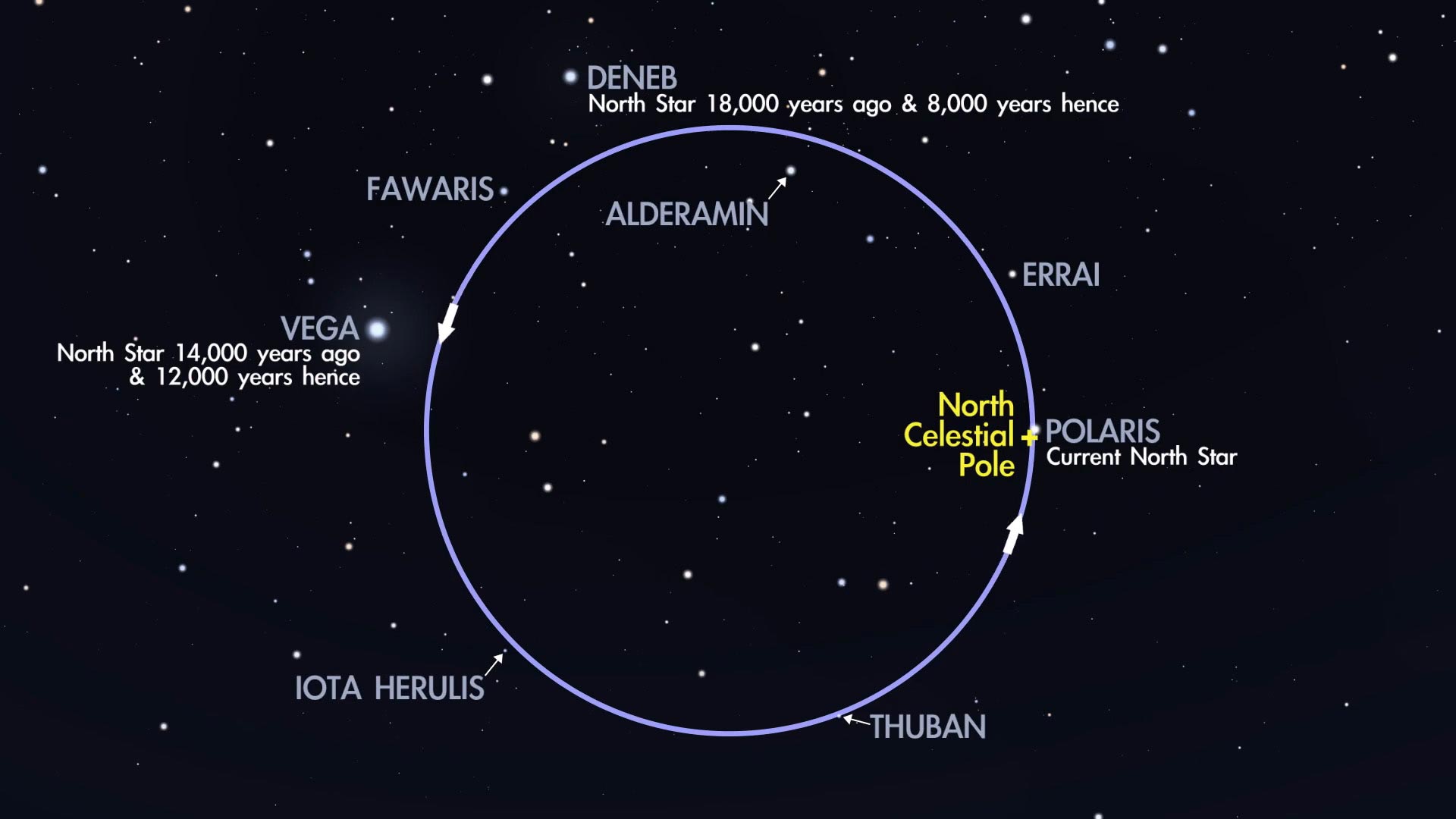
    Polaris North Star
    Over 26,000 years, Polaris trades the title of North Star with a group of others, including Vega and Deneb. Of these special stars, Polaris is the bright star that coincides closest with the Celestial North Pole. Credit: NASA/JPL-Caltech

    Finally, October 16th is International Observe the Moon Night, when everyone is invited to learn about the science and exploration of the Moon. Visit this link to find out how you can take part.

    Never miss a breakthrough: Join the SciTechDaily newsletter.
    Follow us on Google and Google News.

    Astronomy JPL NASA Popular
    Share. Facebook Twitter Pinterest LinkedIn Email Reddit

    Related Articles

    Don’t Miss: Total Solar Eclipse, Mars and Saturn Rising, Slim Lunar Crescent, Comet 12P

    Webb’s Ethanol Discovery Fuels Search for Alien Life

    Don’t Miss: Jupiter Plows Through the Pleiades

    NASA’s Next-Gen Exoplanet-Imaging Technology Advances Search for Extraterrestrial Life

    NASA Telescopes Are Unlocking the Secrets Behind Mysterious Deep Space Signals

    Catch the Quadrantid Fireballs: A January Sky Spectacle With Moon and Planet Pairings

    From IRAS to Webb: The Incredible Evolution of NASA’s Infrared Telescopes

    End of an Era: NASA’s NEOWISE 10-Year Mission Ending Due to Solar Activity

    Don’t Miss: Geminid Meteor Shower and Asteroid Vesta

    Leave A Reply Cancel Reply

    • Facebook
    • Twitter
    • Pinterest
    • YouTube

    Don't Miss a Discovery

    Subscribe for the Latest in Science & Tech!

    Trending News

    Millions of People Have Osteopenia Without Realizing It – Here’s What You Need To Know

    Researchers Discover Boosting a Single Protein Helps the Brain Fight Alzheimer’s

    World-First Study Reveals Human Hearts Can Regenerate After a Heart Attack

    Why Your Dreams Feel So Real Sometimes and So Strange Other Times

    This Simple Home Device May Boost Brain Power in Adults Over 40

    Enormous Prehistoric Insects Puzzle Scientists

    Scientists Develop Bioengineered Chewing Gum That Could Help Fight Oral Cancer

    After 37 Years, the World’s Longest-Running Soil Warming Experiment Uncovers a Startling Climate Secret

    Follow SciTechDaily
    • Facebook
    • Twitter
    • YouTube
    • Pinterest
    • Newsletter
    • RSS
    SciTech News
    • Biology News
    • Chemistry News
    • Earth News
    • Health News
    • Physics News
    • Science News
    • Space News
    • Technology News
    Recent Posts
    • Researchers Discover Natural Compound That Disarms Deadly Superbug
    • New Research Reveals That Your Morning Coffee Activates an Ancient Longevity Switch
    • Researchers Identify the Most Common Recessive Neurodevelopmental Disorder Ever Discovered
    • This Is What Makes You Irresistible to Mosquitoes
    • Shockingly Powerful Giant Octopuses Ruled the Seas 100 Million Years Ago
    Copyright © 1998 - 2026 SciTechDaily. All Rights Reserved.
    • Science News
    • About
    • Contact
    • Editorial Board
    • Privacy Policy
    • Terms of Use

    Type above and press Enter to search. Press Esc to cancel.