

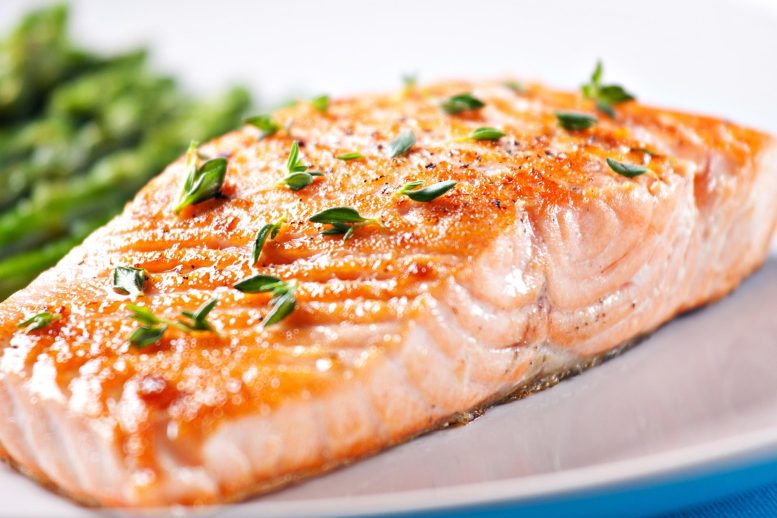
Holy mackerel! Could eating salmon, tuna, cod, herring, or sardines keep our brains healthy and our thinking agile in middle age? New research on omega-3 fatty acids makes this connection.
New evidence indicates that eating food that contains omega-3 fatty acids, such as cold-water fish, may preserve brain health and enhance cognition in middle age.
Omega-3 fatty acids (omega-3s) are present in certain foods such as flaxseed and fish, as well as dietary supplements such as fish oil. Several different omega-3s exist, but the majority of scientific research focuses on three: alpha-linolenic acid (ALA), eicosapentaenoic acid (EPA), and docosahexaenoic acid (DHA). ALA contains 18 carbon atoms, whereas EPA and DHA are considered “long-chain” (LC) omega-3s because EPA contains 20 carbons and DHA contains 22.
Omega-3s Linked to Better Brain Structure and Cognition
According to new research, having at least some omega-3s in red blood cells was associated with better brain structure and cognitive function among healthy study volunteers in their 40s and 50s. The study was published online on October 5 in Neurology, the medical journal of the American Academy of Neurology. Faculty of The University of Texas Health Science Center at San Antonio (UT Health San Antonio) and other investigators of the Framingham Heart Study conducted the analysis.
“Studies have looked at this association in older populations. The new contribution here is that, even at younger ages, if you have a diet that includes some omega-3 fatty acids, you are already protecting your brain for most of the indicators of brain aging that we see at middle age,” said Claudia Satizabal, PhD, lead author of the study. She is an assistant professor of population health sciences with the Glenn Biggs Institute for Alzheimer’s and Neurodegenerative Diseases at UT Health San Antonio.
Volunteers for the study had an average age was 46. The research team examined the relation of red blood cell omega-3 fatty acid concentrations with MRI and cognitive markers of brain aging. Scientists also studied the effect of omega-3 red blood cell concentrations in participants who carried APOE4, a genetic variation linked to a higher risk of Alzheimer’s disease.
Brain Benefits of Omega-3s and APOE4 Carriers
The study of 2,183 dementia- and stroke-free participants found that:
- Higher omega-3 index was associated with larger hippocampal volumes. The hippocampus, a structure in the brain, plays a major role in learning and memory.
- Consuming more omega-3s was associated with better abstract reasoning, or the ability to understand complex concepts using logical thinking.
- APOE4 carriers with a higher omega-3 index had less small-vessel disease. The APOE4 gene is associated with cardiovascular disease and vascular dementia.
Scientists used a technique called gas chromatography to measure docosahexaenoic acid (DHA) and eicosapentaenoic acid (EPA) concentrations from red blood cells. The omega-3 index was calculated as DHA plus EPA.
Flaxseed (linseed), soybean, and canola oils are examples of plant oils that contain ALA. Walnuts and chia seeds also contain ALA. The amount of omega-3 in fish varies greatly.Cold-water fatty fish, such as salmon, mackerel, tuna, herring, and sardines, contain high amounts of LC omega-3s, while fish with a lower fat content—such as bass, tilapia, and cod—as well as shellfish contain lower levels. Beef is very low in omega-3s. However, beef from grass-fed cows contains somewhat higher levels of omega-3s, mainly as ALA, than that from grain-fed cows. Some foods, such as certain brands of eggs, milk, yogurt, juices, and soy beverages, are fortified with DHA and other omega-3s.
“Omega-3 fatty acids such as EPA and DHA are key micronutrients that enhance and protect the brain,” said Debora Melo van Lent, PhD, study coauthor. She is a postdoctoral research fellow at the Biggs Institute. “Our study is one of the first to observe this effect in a younger population. More studies in this age group are needed.”
The researchers divided participants into those who had very little omega-3 red blood cell concentration and those who had at least a little more. “We saw the worst outcomes in the people who had the lowest consumption of omega-3s,” Satizabal said. “So, that is something interesting. Although the more omega-3 the more benefits for the brain, you just need to eat some to see benefits.”
Genetic Factors and the Protective Power of Omega-3s
Scientists don’t know how DHA and EPA protect the brain. One theory is that, because those fatty acids are needed in the membrane of neurons, when they are replaced with other types of fatty acids, that’s when neurons (nerve cells) become unstable. Another explanation may have to deal with the anti-inflammatory properties of DHA and EPA. “It’s complex. We don’t understand everything yet, but we show that, somehow, if you increase your consumption of omega-3s even by a little bit, you are protecting your brain,” Satizabal said.
It’s encouraging that DHA and EPA also protected APOE4 carriers’ brain health. “It’s genetics, so you can’t change it,” Melo van Lent said, referring to the vulnerability of this risk group. “So, if there is a modifiable risk factor that can outweigh genetic predisposition, that’s a big gain.”
Reference: “Association of Red Blood Cell Omega-3 Fatty Acids With MRI Markers and Cognitive Function in Midlife: The Framingham Heart Study” by Claudia L. Satizabal, Jayandra Jung Himali, Alexa S. Beiser, Vasan Ramachandran, Debora Melo van Lent, Dibya Himali, Hugo J. Aparicio, Pauline Maillard, Charles S. DeCarli, William Harris and Sudha Seshadri, 5 October 2022, Neurology.
DOI: 10.1212/WNL.0000000000201296
Never miss a breakthrough: Join the SciTechDaily newsletter.
Follow us on Google and Google News.