

Close Menu
    Facebook X (Twitter) Instagram
    SciTechDaily
    • Biology
    • Chemistry
    • Earth
    • Health
    • Physics
    • Science
    • Space
    • Technology
    Facebook X (Twitter) Pinterest YouTube RSS
    SciTechDaily
    Home»Science»On the Pathway to Unlocking Ocean Wave Energy for Reliable, Renewable Power
    Science

    On the Pathway to Unlocking Ocean Wave Energy for Reliable, Renewable Power

    By Texas A&M UniversityDecember 8, 2021No Comments3 Mins Read
    Facebook Twitter Pinterest Telegram LinkedIn WhatsApp Email Reddit
    Share
    Facebook Twitter LinkedIn Pinterest Telegram Email Reddit
    Ocean Wave Underwater
    In the shift towards energy transition, the energy industry is turning to the oceans for dependable, sustainable, and renewable energy sources.

    As part of the energy transition, the energy industry is looking toward the oceans for reliable, sustainable, and renewable energy sources. Researchers and engineers aim to create technology that can supply cost-competitive ocean renewable power to support coastal communities, which comprise half of the U.S. population.

    Dr. HeonYong Kang, assistant professor in the Department of Ocean Engineering at Texas A&M University, is stepping up to this challenge with two separate projects focusing on wave energy converters: one for small-scale and the other for utility-scale applications.

    Progress With Federal Support

    Kang’s first project initially came from the U.S. Department of Energy’s (DOE) Wave Energy Prize Competition in 2015.

    The competition showed that a few conceptual floating wave energy converters are promising, but their designs tend to result in expensive or uncompetitive capital expenditure (CapEx) and operational expenditure (OpEx).
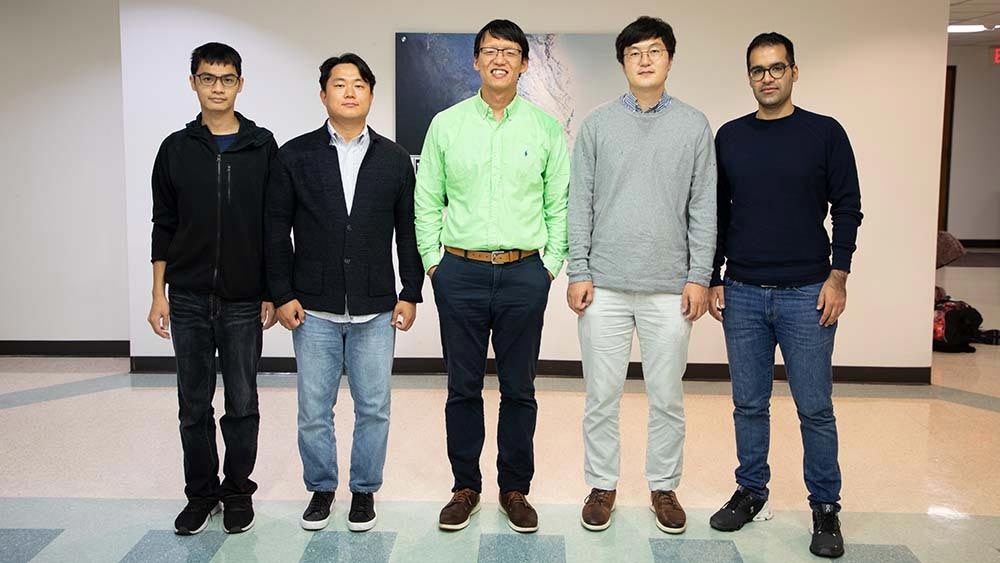
    Unlocking Ocean Wave Energy
    A team of researchers from Texas A&M University, led by Dr. HeonYong Kang (center), is working on two projects focusing on wave energy converters. Credit: Texas A&M Engineering

    To achieve competitive Levelized Cost of Energy (LCOE) below 40 cents per kilowatt-hour, Kang’s DOE-funded project involves a team of multidisciplinary researchers seeking to actualize their patented Surface Riding Wave Energy Converter (SR-WEC) as a cost-competitive solution for small- to intermediate-scale power supplies. SR-WECs feature a unique adaptive resonance for varying random waves, which produce high-capture width ratios, and a modular lightweight system that has the generator sealed. These properties substantially reduce CapEx, OpEx, and consequently the competitive LCOE.

    Since this project was initially introduced to the department, Kang’s team has developed two optimum prototype designs of SR-WEC: a small-scale SR-WEC for self-recharging autonomous underwater vehicles and an intermediate-scale SR-WEC for kilowatt-scale power supplies for Powering the Blue Economy applications. Now, they are working on crafting scaled prototypes. The prototypes will first be tested in a dry testbed and then in the 2D wave-current-wind basin in College Station.

    Chaitanya Kesanapalli, Cody Marquardt and Aghamarshana Meduri
    Graduate students (left to right) Chaitanya Kesanapalli, Cody Marquardt and Aghamarshana Meduri are also part of Kang’s research team. Credit: Courtesy of Dr. Kang

    “Although we have been facing numerous challenges throughout this pioneering research, we get more excited and motivated as we discover new knowledge and recognize we are helping the energy transition,” said Kang.

    Partnering With Industry To Commercialize Ocean Wave Energy

    Kang is also working with Global Perpetual Energy (GPE), a Texas renewable energy company, to create a utility-scale wave energy converter that will be able to produce megawatt-scale power. Evolving from GPE’s patented ocean renewable energy platform, Kang is developing an optimum wave energy converter system that effectively extracts energy from elastic deformation resonance with waves over a large area. The system design was inspired by the fact that the wave energy spans the entire length of the wave — measuring tens to hundreds of meters. The goal of this GPE-sponsored project is to test a prototype offshore in Galveston.

    “What we are trying to do is find a solution, both effective and cost-competitive,” he said. “By combining both, we can reach a competitive LCOE so that the public can access wave energy that is renewable, clean, close to half of the U.S. population, and consistently available throughout the day and night and in mild to severe sea states.”

    Never miss a breakthrough: Join the SciTechDaily newsletter.
    Follow us on Google and Google News.

    Energy Green Energy Texas A&M University
    Share. Facebook Twitter Pinterest LinkedIn Email Reddit

    Related Articles

    Turning Hazelnut Shells Into a Clean, Renewable Energy Source

    Solar and Wind Power Could Mitigate Conflict Surrounding Grand Ethiopian Renaissance Dam in Northeast Africa

    India Can Boost Clean Energy While Doubling Its Power Supply by 2030

    Science Made Simple: What Are Solar Fuels?

    Scientists Discover a Prime Renewable Energy Source: Water Vapor in the Atmosphere

    Harvesting Ocean Energy: Bio-Inspired Membrane Efficiently Produces Electricity From Saltwater

    Carbon Intensity of Power Sector Down in 2019 As Renewables Saw Considerable Growth

    Innovative Hydrogen Boride Nanosheets: Huge Potential As Hydrogen Carrier

    New Technologies to Extract Clean Fuel From Sunlight

    Leave A Reply Cancel Reply

    • Facebook
    • Twitter
    • Pinterest
    • YouTube

    Don't Miss a Discovery

    Subscribe for the Latest in Science & Tech!

    Trending News

    New Study Reveals Why Ozempic Works Better for Some People Than Others

    Climate Change Is Altering a Key Greenhouse Gas in a Way Scientists Didn’t Expect

    New Study Suggests Gravitational Waves May Have Created Dark Matter

    Scientists Discover Why the Brain Gets Stuck in Schizophrenia

    Scientists Engineer “Tumor-Eating” Bacteria That Devour Cancer From Within

    Even “Failed” Diets May Deliver Long-Term Health Gains, Study Finds

    NIH Scientists Discover Powerful New Opioid That Relieves Pain Without Dangerous Side Effects

    Collapsing Plasma May Hold the Key to Cosmic Magnetism

    Follow SciTechDaily
    • Facebook
    • Twitter
    • YouTube
    • Pinterest
    • Newsletter
    • RSS
    SciTech News
    • Biology News
    • Chemistry News
    • Earth News
    • Health News
    • Physics News
    • Science News
    • Space News
    • Technology News
    Recent Posts
    • Household Cats Could Hold the Secret to Fighting Breast Cancer
    • Scientists Say This Natural Hormone Reverses Obesity by Targeting the Brain
    • This 15,000-Year-Old Discovery Changes What We Know About Early Human Creativity
    • 35-Million-Year-Old Mystery: Strange Arachnid Discovered Preserved in Amber
    • Revolutionary Gas Turbine Generates Power Without Air Compression
    Copyright © 1998 - 2026 SciTechDaily. All Rights Reserved.
    • Science News
    • About
    • Contact
    • Editorial Board
    • Privacy Policy
    • Terms of Use

    Type above and press Enter to search. Press Esc to cancel.