
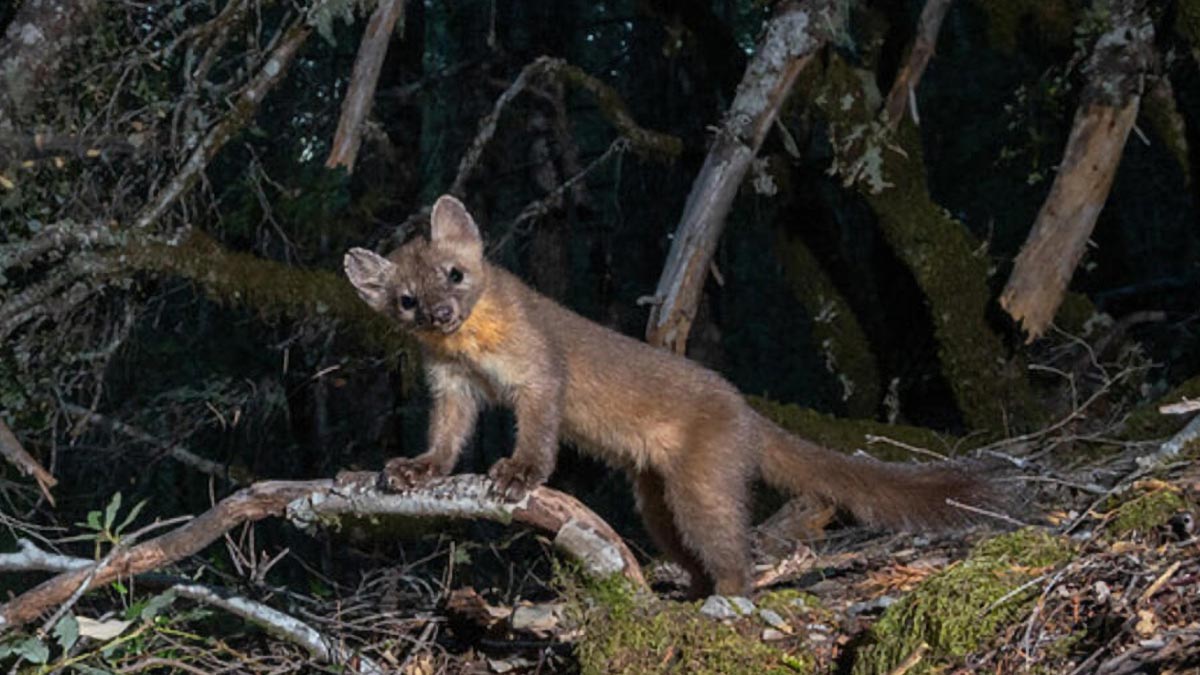
A new study sheds light on the hidden lives of coastal marten.
Researchers at Oregon State University have sharpened the picture of one of the West Coast’s most elusive mammals: the coastal marten. About the size of a ferret, this small forest carnivore was nearly wiped out in the 20th century as trapping and logging devastated its numbers.
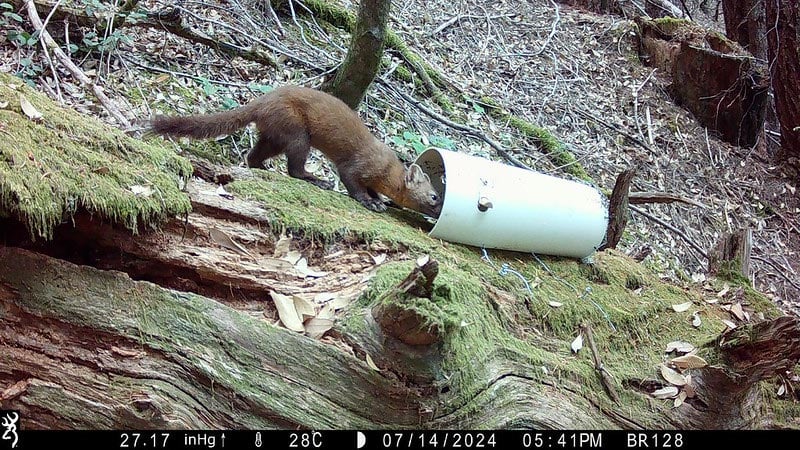
To learn where the species still survives, scientists from OSU’s Institute for Natural Resources carried out a three month field study in 2022 across 150 square miles (388 square kilometers) east of Klamath in northern California. Instead of capturing animals, the team relied on noninvasive tools, using hair snares and remote cameras to document martens and the habitats they use.
The genetic results showed 46 martens in the study area, including 28 males and 18 females. The animals turned up across the landscape, but they were most common in two very different settings: high forested ridgetops with reliable winter snowpack, and lower elevation ravines and riparian corridors in coastal forests.
A Species Still at Risk
The results provide valuable information for conservation and land management planning related to the coastal marten, a member of the weasel family also known as the Humboldt marten. The species is listed as threatened under the federal Endangered Species Act. The small populations that remain in northern California and southern Oregon face multiple threats, including rodenticides, vehicle collisions, disease, and habitat loss.
“Coastal martens like forests with old-growth characteristics, and those types of forests are being threatened by the effects of climate change, including more frequent and severe wildfire, and certain forest management practices,” said OSU wildlife ecologist Sean Matthews. “Beyond that, there’s a lot we don’t know about this species, including information as basic as what forests do coastal martens still occupy, how many martens are there, and are these populations increasing.”
Matthews describes coastal martens as “among the most adorable animals that call our Pacific Northwest forests home.” Historically, the species ranged from northern Oregon to northern California. However, heavy trapping for the fur trade and widespread logging sharply reduced both its numbers and geographic range during the last century.
At one point, scientists even believed the species had disappeared entirely. That assumption changed in 1996 when a U.S. Forest Service biologist discovered a small surviving population in the coastal forests of northern California.
Research Across Tribal and Public Lands
The OSU led project involved multiple partner institutions, including Cal Poly Humboldt and the University of Wisconsin-Madison. Fieldwork took place on the ancestral lands of the Yurok and Karuk Tribes. The study area spans elevations from 100 feet to 4,600 feet (about 30 to 1,400 meters) and includes lands managed by the U.S. Forest Service, the Yurok Tribe, and the Green Diamond Resource Company.
About one-third of the study area is owned by the Yurok Tribe. This land had been managed for commercial timber production by Green Diamond until 2019. Today, the Tribe manages it for several purposes, including plant and wildlife habitat restoration, protection of cultural resources, and some timber harvesting.
Green Diamond continues to own and manage roughly one-fifth of the study area. The U.S. Forest Service oversees the remaining lands, which are used for activities such as habitat and watershed restoration, recreation, timber harvesting, and cattle grazing.
To collect their data, the researchers installed 285 hair snares made from PVC pipe and deployed 135 remote cameras across the landscape.
“Martens tend to select forest stands with greater than 50% canopy cover and lots of large-diameter trees, snags, and hollow logs,” said OSU faculty research assistant Erika Anderson, who led the study under Matthews’ direction. “Structural complexity with coarse woody debris helps them hunt and also provides cover from predators and competitors. But despite continued conservation concern over the last 30 years, we have a lot to learn about marten distribution and demography, and how forest conditions influence their distribution and density.”
Reference: “Landscape conditions and elevation interact to influence the distribution and density of state-endangered Humboldt martens” by Erika L. Anderson, Marie E. Martin, Micaela S. Gunther, Kristine L. Pilgrim, Scott A. Demers and Sean M. Matthews, 19 November 2025, Global Ecology and Conservation.
DOI: 10.1016/j.gecco.2025.e03980
Also participating in the research were scientists from the California Department of Fish and Wildlife, the Yurok Tribe, Green Diamond, Six Rivers National Forest, the National Council for Air and Stream Improvement, and the National Genomics Center for Wildlife and Fish Conservation. Partner organizations funded the project with support from the U.S. Fish and Wildlife Service and the Volgenau Foundation.
Never miss a breakthrough: Join the SciTechDaily newsletter.
Follow us on Google and Google News.
2 Comments
I live in a little town called Shasta lake. And I’ve seen the Humboldt marten out by my kids school farm. It’s an older forest next to some train tracks. About 2 miles from Shasta lake. I’ve seen it a few times in early morning.
great, now trappers can easily find it. would you consider acting as guide for a small fee…