
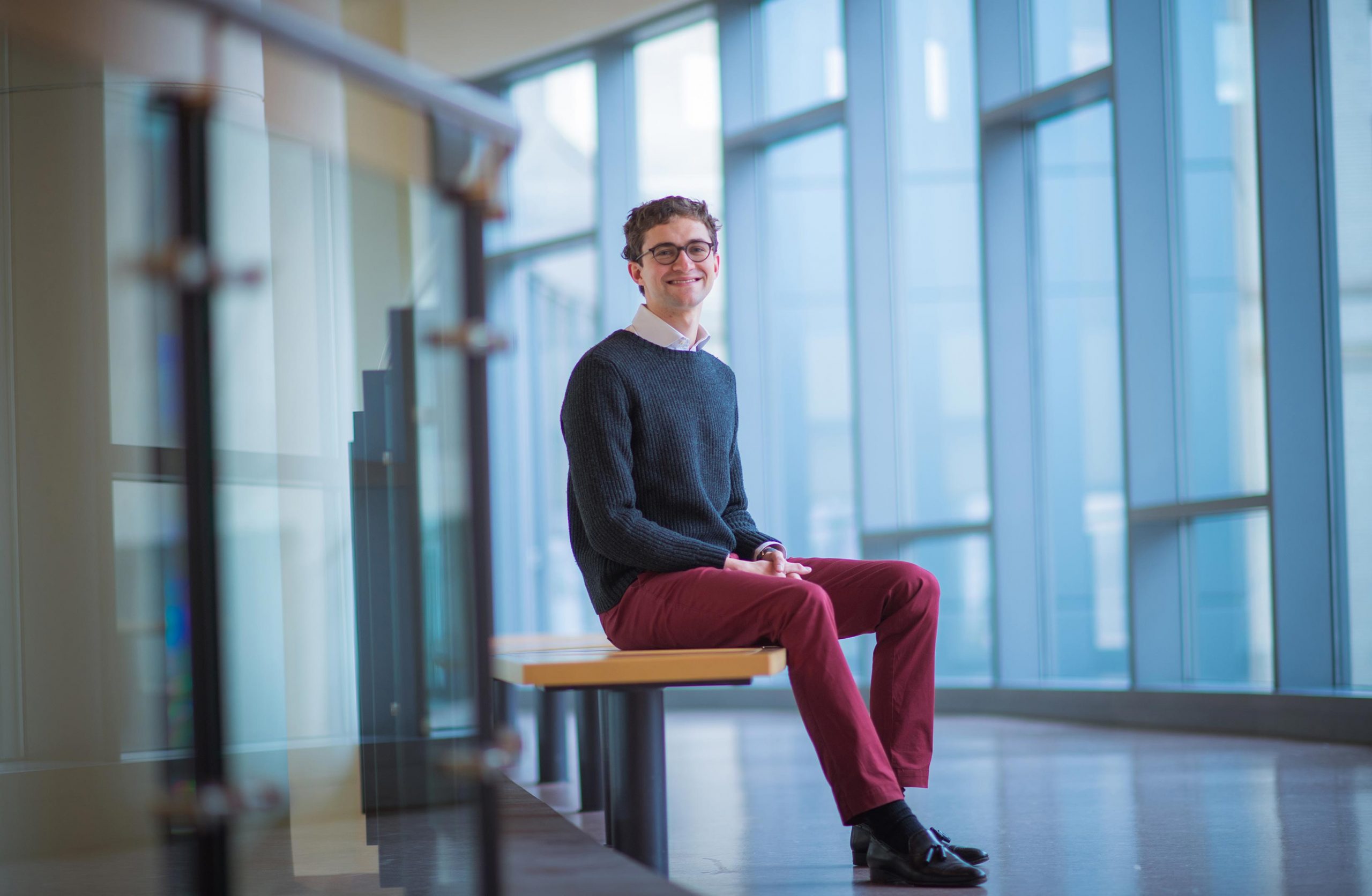
“Operations in practice are very messy, but I think that’s what makes them exciting,” says graduate student Jean Pauphilet.
When he began his engineering program at École Polytechnique in his hometown of Paris, Jean Pauphilet did not aspire to the academy.
“I used to associate academia with fundamental research, which I don’t enjoy much,” he says. “But slowly, I discovered another type of research, where people use rigorous scientific principles for applied and impactful projects.”
A fascination with projects that have direct applications to organizational problems led Pauphilet to the field of operations research and analytics — and to a Ph.D. at the Operations Research Center (ORC), a joint program between the MIT Stephen A. Schwarzman College of Computing and the MIT Sloan School of Management.
Operations research models decision-making processes as mathematical optimization problems, such as planning for energy production given unpredictable fluctuations in demand. It’s a complex subject that Pauphilet finds exhilarating. “Operations in practice are very messy, but I think that’s what makes them exciting. You’re never short on problems to solve,” he says.
Working in the lab of Professor Dimitris Bertsimas, and in collaboration with Beth Israel Deaconess Medical Center, Pauphilet focuses on solving challenges in the health care field. For example, how can hospitals best make bed assignments and staffing decisions? These types of logistical decisions are “a pain point for everyone,” he notes.
“You really feel that you’re making people’s lives easier because when you’re talking about it to doctors and nurses, you realize that they don’t like to do it, they’re not trained at it, and it’s keeping them from actually doing their job. So, for me it was clear that it had a positive impact on their workload.” More recently, he has been involved in a group effort led by his advisor to develop analytics tools to inform policymakers and health care managers during the COVID-19 pandemic.

Becoming an expert
As the son of two doctors, Pauphilet is already comfortable working within the medical field. He also feels well-prepared by his training in France, which allows students to choose their majors late and emphasizes a background in math. “Operations research requires versatility,” he explains. “Methodologically, it can involve anything ranging from probability theory to optimization algorithms and machine learning. So, having a strong and wide math background definitely helps.”
This mentality has allowed him to grow into an expert in his field at MIT. “I’m less scared of research now,” he explains, “You might not find what you were expecting, but you always find something that is relevant to someone. So [research] is uncertain, but not risky. You can always get back on your feet in some way.” It’s a mentality that’s given him the confidence to find, solve, and address operations problems in novel ways in collaboration with companies and hospitals.
Pauphilet, who will join London Business School as an assistant professor in the fall, has found himself thinking about the different pedagogical philosophies in the U.S. and France. At MIT, he completed the Kaufman Teaching Certificate Program to become more familiar with aspects of teaching not typically experienced as a teaching assistant, such as designing a course, writing lectures, and creating assignments.
“Coming from France and teaching in the U.S., I think it’s especially interesting to learn from other peoples’ experiences and to compare what their first experience of learning was at their universities in their countries. Also [it’s challenging] to define what is the best method of teaching that you can think of that acknowledges the differences between the students and the way they learn, and to try to take that into account in your own teaching style.”
Culture and community
In his free time, before the COVID-19 emergency, Pauphilet often took advantage of cultural and intellectual offerings in Cambridge and Boston. He frequented the Boston Symphony Orchestra (which offered $25 tickets for people under 40) and enjoys hearing unfamiliar composers and music, especially contemporary music with surprising new elements.
Pauphilet is an avid chef who relishes the challenge of cooking large pieces of meat, such as whole turkeys or lamb shoulders, for friends. Beyond the food, he enjoys the long conversations that these meals facilitate and that people can’t necessarily experience in a restaurant. (As an aside he notes, “I think the service in a restaurant here is much more efficient than in Europe!”).
Pauphilet has also been the president of MIT’s French Club, which organizes a variety of events for around 100 French-speaking graduate students, postdocs, and undergraduates. Though his undergraduate institution is well-represented at MIT, Pauphilet feels strongly about creating a network for those Francophones who may not have his luck, so they can feel as at home as he does.
Now at the end of his Ph.D., Pauphilet has the chance to reflect on his experiences over the past three and a half years. In particular, he has found a deep sense of community in his cohort, lab, and community here. He attributes some of that to his graduate program’s structure — which begins with two required classes that everyone in the cohort takes together — but that’s just one aspect of the investment in building community Pauphilet has felt at MIT.
“It’s a great environment. Honestly, I find that everyone is very mindful of students. I have a great relationship with my advisor that is not only based on research, and I think that’s very important,” he says.
Overall, Pauphilet attributes his significant personal and professional growth in grad school to learning in MIT’s collaborative and open environment. And, he notes, being at the Institute has affected him in another important way.
“I’m a bit nerdier than I used to be!”
Never miss a breakthrough: Join the SciTechDaily newsletter.
Follow us on Google and Google News.
1 Comment
In fact, you need to make decisions as early as the admissions phase to understand which direction is right for you. That’s why I personally remember looking for information about departments when I went to college, because I wanted to finish it quickly and without problems. Fortunately, then I found an interesting material, you can just look at the top 10 hardest college majors and there you can probably find yours. So, you will need to think several times about whether to go there or not. It is better to enter a lighter specialty, and to study what is interesting through self-education. I did this and made my life much easier.