
Close Menu
    Facebook X (Twitter) Instagram
    SciTechDaily
    • Biology
    • Chemistry
    • Earth
    • Health
    • Physics
    • Science
    • Space
    • Technology
    Facebook X (Twitter) Pinterest YouTube RSS
    SciTechDaily
    Home»Space»Orbital ATK Mission to Space Station Contains New Experiments for Astronauts
    Space

    Orbital ATK Mission to Space Station Contains New Experiments for Astronauts

    By Kathryn Hambleton, NASAMay 21, 2018No Comments3 Mins Read
    Facebook Twitter Pinterest Telegram LinkedIn WhatsApp Email Reddit
    Share
    Facebook Twitter LinkedIn Pinterest Telegram Email Reddit
    NASA Sends New Research on Orbital ATK Mission
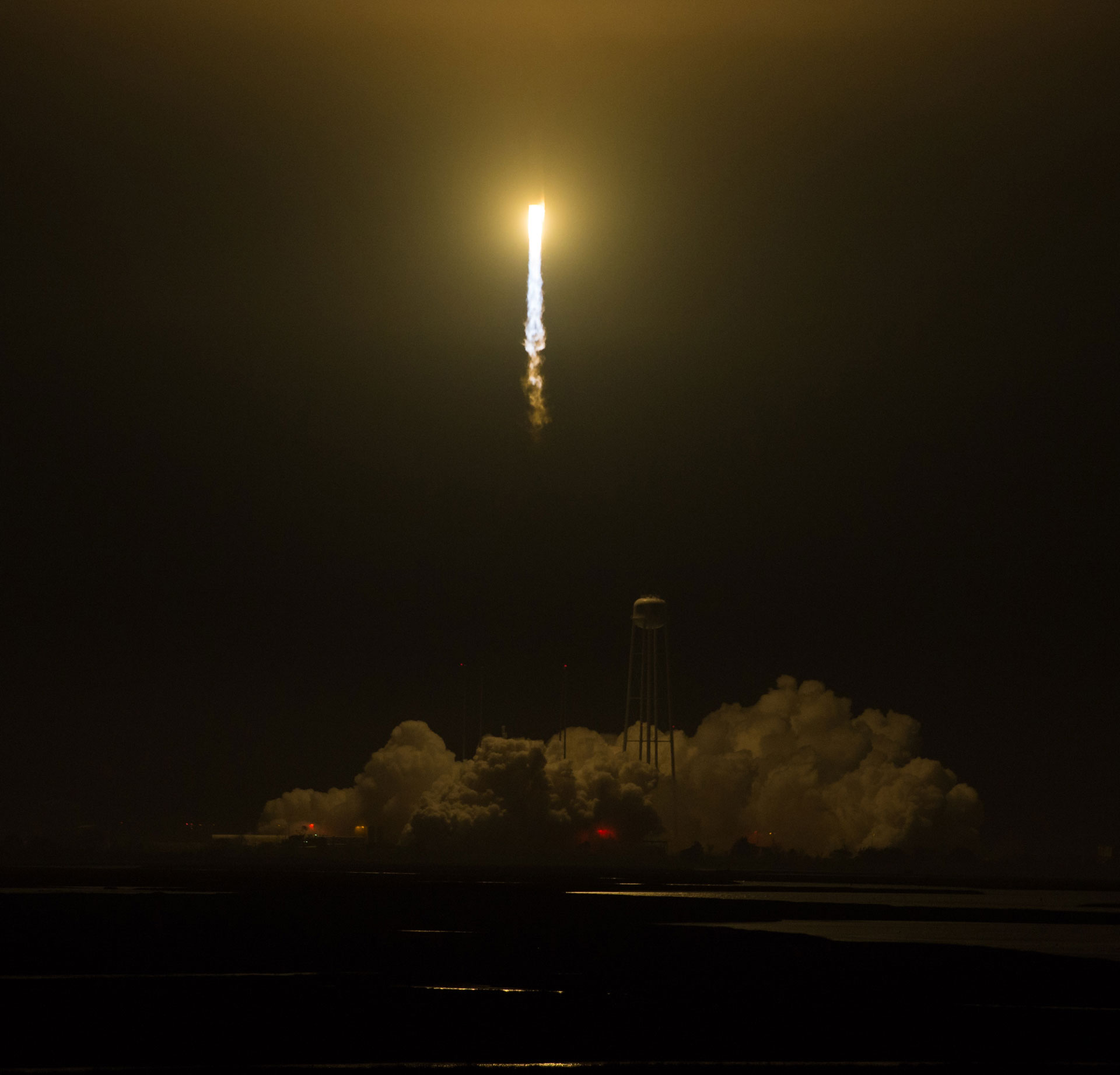
    The Orbital ATK Antares rocket, with the Cygnus spacecraft onboard, launches from Pad-0A, Monday, May 21, 2018 at NASA’s Wallops Flight Facility in Virginia. Orbital ATK’s ninth contracted cargo resupply mission with NASA to the International Space Station will deliver approximately 7,400 pounds of science and research, crew supplies and vehicle hardware to the orbital laboratory and its crew. Credit: NASA/Aubrey Gemignani

    Astronauts soon will have new experiments to conduct related to emergency navigation, DNA sequencing and ultra-cold atom research when the research arrives at the International Space Station following the 4:44 a.m. EDT Monday launch of an Orbital ATK Cygnus spacecraft.

    Cygnus lifted off on an Antares 230 rocket from NASA’s Wallops Flight Facility in Virginia on Orbital ATK’s ninth cargo mission under NASA’s Commercial Resupply Services contract. The spacecraft is carrying about 7,400 pounds of research equipment, cargo and supplies that will support dozens of the more than 250 investigations underway on the space station.

    NASA astronauts Scott Tingle and Ricky Arnold will use the space station’s robotic arm to capture Cygnus when it arrives at the station Thursday, May 24. Live coverage of the rendezvous and capture will air on NASA Television and the agency’s website beginning at 3:45 a.m. Installation coverage is set to begin at 7:30 a.m.

    Included in the cargo in the pressurized area of Cygnus is a centuries-old method of celestial navigation. The Sextant Navigation investigation will explore the use of a hand-held sextant for emergency navigation on missions in deep space as humans look to travel farther from Earth. The ability to sight angles between the Moon or planets and stars offers crews another option to find their way home if communications and main computers are compromised.

    Monitoring crew health and the biological environment of the space station, and understanding long-term effects of space travel on both, are critical to NASA’s plans for long-duration, deep space exploration. The Biomolecule Extraction and Sequencing Technology (BEST) study is the agency’s next step toward advancing in-space DNA sequencing technologies that can identify microbial organisms living on the space station and understanding how the DNA of humans, plants and microbes are affected by microgravity. BEST will use a process that sequences DNA directly from a sample, with minimal preparation, rather than using the traditional technique of growing a culture from the sample.

    In the realm of modern physics, the new Cold Atom Lab (CAL) on Cygnus could help answer some big questions. CAL creates a temperature 10 billion times colder than the vacuum of space, then uses lasers and magnetic forces to slow down atoms until they are almost motionless. In the microgravity environment of the space station, CAL can observe these ultra-cold atoms for much longer than possible on Earth. Results of this research could lead to a number of improved technologies, including sensors, quantum computers and atomic clocks used in spacecraft navigation.

    Cygnus is scheduled to depart the station in July with several tons of trash and burn up during re-entry into Earth’s atmosphere, over the Pacific Ocean. The vehicle is named after James “J.R.” Thompson, a leader in the aerospace industry.

    For more than 17 years, humans have lived and worked continuously aboard the International Space Station, advancing scientific knowledge and demonstrating new technologies, making research breakthroughs not possible on Earth that will enable long-duration human and robotic exploration into deep space. A global endeavor, more than 200 people from 18 countries have visited the unique microgravity laboratory that has hosted more than 2,400 research investigations from researchers in 103 countries.

    Never miss a breakthrough: Join the SciTechDaily newsletter.
    Follow us on Google and Google News.

    Orbital ATK Antares Rocket Space Station
    Share. Facebook Twitter Pinterest LinkedIn Email Reddit

    Related Articles

    Axiom’s Free-Flying Space Station Is Breaking Away From the ISS Sooner Than Expected

    How Does Space Affect the Brain? Groundbreaking ISS Experiment Reveals Surprising Insights

    Starlab Hits Major Milestones, Redefining Space Exploration

    Starliner Stranded in Space? NASA Answers FAQs on Astronauts’ Return Status

    Dragon Spacecraft Emergency Training for Astronauts and Cosmonauts Aboard ISS

    NASA’s Artemis IV: Building Gateway, Humanity’s First Lunar Space Station

    Lunar Gateway’s Revolutionary Powerhouse: Unveiling High-Tech Power and Propulsion Element

    From Star Trek to the Lab: The Real Challenge of Fungi in Hypergravity

    NASA Selects Three Companies To Develop Commercial Space Stations

    Leave A Reply Cancel Reply

    • Facebook
    • Twitter
    • Pinterest
    • YouTube

    Don't Miss a Discovery

    Subscribe for the Latest in Science & Tech!

    Trending News

    Breakthrough Parkinson’s Drug Targets Disease at Its Genetic Roots

    Just 4 Weeks of Simple Diet Changes Reversed Signs of Aging in Older Adults

    Scientists May Have Finally Solved Why Humans Are Right-Handed

    NASA’s Hubble Accidentally Witnesses a Comet Shattering in Space

    Researchers Discover the Body’s Hidden “Off Switch” for Inflammation

    Scientists Discover Metformin Doesn’t Work the Way We Thought

    Tea or Coffee? Your Daily Choice Could Affect Osteoporosis Risk

    Vitamin C May Fight Cancer in a Surprising Way

    Follow SciTechDaily
    • Facebook
    • Twitter
    • YouTube
    • Pinterest
    • Newsletter
    • RSS
    SciTech News
    • Biology News
    • Chemistry News
    • Earth News
    • Health News
    • Physics News
    • Science News
    • Space News
    • Technology News
    Recent Posts
    • Banned Antibiotic Discovered in Fish Raises Food Safety Concerns
    • Common Asthma Drug May Reverse Dangerous Fatty Liver Disease
    • Scientists Develop Experimental Eye Drop That Could Transform Dry Eye Treatment
    • Extra Weight Could Age Your Brain Faster, Study Warns
    • Scientists Warn: America’s Most Popular Cooking Oil May Be Harming Your Intestines
    Copyright © 1998 - 2026 SciTechDaily. All Rights Reserved.
    • Science News
    • About
    • Contact
    • Editorial Board
    • Privacy Policy
    • Terms of Use

    Type above and press Enter to search. Press Esc to cancel.