
Finding your way through the winding streets of certain cities can be a real challenge without a map. To orient ourselves, we rely on a variety of information, including digital maps on our phones, as well as recognizable shops and landmarks. Cells in our bodies face a similar problem when building our organs during embryogenesis. They need instructions on where to go and how to behave. Luckily, like cell phone towers in a city, embryos feature special cells in specific locations, known as organizers, that send signals to other cells and help them organize to build our complex organs.
Some of these signals are molecules sent from the organizer, a privileged signaling center. Cells around it receive stronger or weaker signals depending on their location, and they take decisions accordingly. Errors in the location of these messaging centers in the tissue lead to embryonic malformations that can be fatal. Scientists have known the relevance of these signaling centers for a long time, but how these appear at specific locations remained elusive.
Discovery Through International Collaboration
It took an international collaboration of physicists and biologists to pinpoint the answer. Several years ago, the laboratories of Prof. Ophir Klein at Cedars-Sinai Guerin Children’s and the University of California, San Francisco (UCSF), and Prof. Otger Campàs at the Physics of Life Excellence Cluster of TU Dresden and the University of California, Santa Barbara (UCSB), had a hint of how it may work and joined forces. Together, they figured out that it is the mechanical pressure inside the growing tissue that dictates where the signaling center will emerge.
“Our work shows that both mechanical pressure and molecular signaling play a role in organ development,” said Ophir Klein, MD, PhD, Executive Director of Cedars-Sinai Guerin Children’s, where he is also the David and Meredith Kaplan Distinguished Chair in Children’s Health, and co-corresponding author of the study.
Mechanical Pressure in Organizing Cells
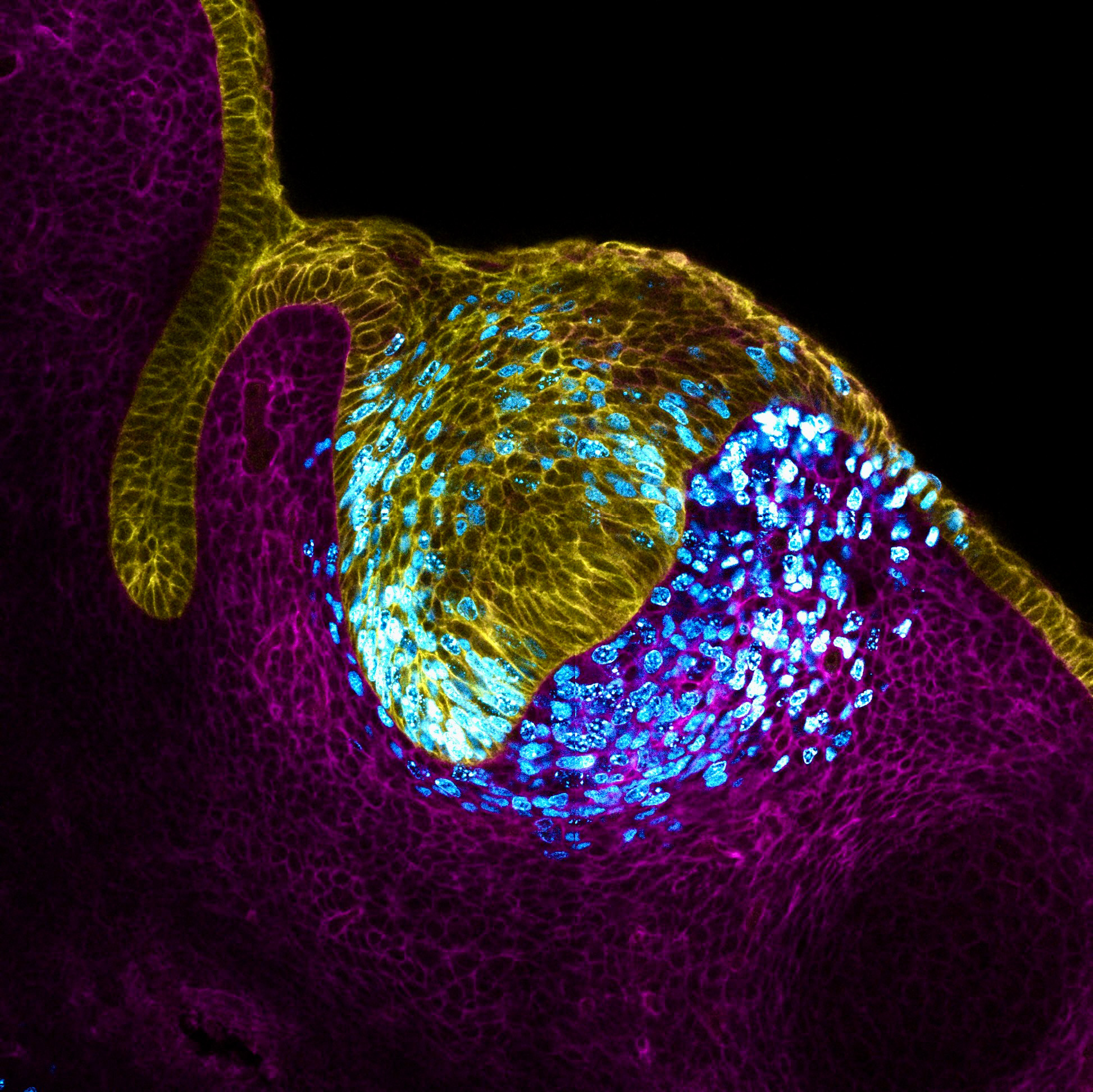
The study, published in Nature Cell Biology, shows that as cells grow in the embryonic incisor tooth, they feel the growing pressure and use this information to organize themselves. “It’s like those toys that absorb water and grow in size,” said Neha Pincha Shroff, PhD, a postdoctoral scholar in the School of Dentistry at UCSF, and co-first author of the study. “Just imagine that happening in a confined space. What happens in the incisor knot is that the cells multiply in number in a fixed space and this causes a pressure to build up at the center, which then becomes a cluster of specialized cells.” Like people in a crowded bar, cells in the tissue start feeling the squeeze from their peers. The researchers found that the cells feeling the stronger pressure stop growing and start sending signals to organize the other surrounding cells in the tooth. They were literally pressed into becoming the tooth organizer.
“We were able to use microdroplet techniques that our lab previously developed to figure out how the buildup of mechanical pressure affects organ formation,” said co-corresponding author of the study Otger Campàs, Ph.D., who is currently Managing Director, Professor and Chair of Tissue Dynamics at the Physics of Life Excellence Cluster of TU Dresden, and former Associate Professor of Mechanical Engineering at UCSB. “It is really exciting that tissue pressure has a role in establishing signaling centers. It will be interesting to see if or how mechanical pressure affects other important developmental processes.”
Embryos use several of these signaling centers to guide cells as they form tissues and organs. Like building skyscrapers or bridges, sculpting our organs involves tight planning, a lot of coordination, and the right structural mechanics. Failure in any of these processes can be catastrophic when it comes to building a bridge, and it can also be damaging for us when growing in the womb.
“By understanding how an embryo forms organs, we can start to ask questions about what goes wrong in children born with congenital malformations,” said Ophir Klein. “This work may lead to additional research into how birth defects are formed and can be prevented.”
Reference: “Proliferation-driven mechanical compression induces signalling centre formation during mammalian organ development” by Neha Pincha Shroff, Pengfei Xu, Sangwoo Kim, Elijah R. Shelton, Ben J. Gross, Yucen Liu, Carlos O. Gomez, Qianlin Ye, Tingsheng Yu Drennon, Jimmy K. Hu, Jeremy B. A. Green, Otger Campàs and Ophir D. Klein, 3 April 2024, Nature Cell Biology.
DOI: 10.1038/s41556-024-01380-4
The study was funded by the National Institute of Dental and Craniofacial Research (OK and OC) in the USA, the Deutsche Forschungsgemeinschaft under Germany’s Excellence Strategy, and the Cluster of Excellence Physics of Life of TU Dresden (OC).
Never miss a breakthrough: Join the SciTechDaily newsletter.
Follow us on Google and Google News.
1 Comment
And to think educated people believe this all happened by random chance over a long time.
LMAO