
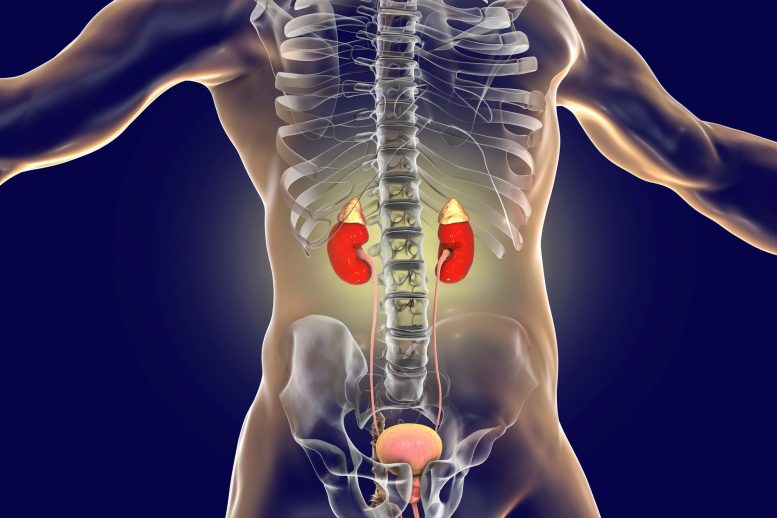
A study of 40,000 patients suggests IgA nephropathy originates in the immune system, not the kidney. Researchers identified genetic links, potential treatments, and a risk profile for early detection.
A recent study by Columbia University researchers suggests that the cause of a common kidney disease might not be in the kidney itself. This research identified 16 novel genetic sites associated with immunoglobulin A (IgA) nephropathy, reinforcing the prior belief that the immune system plays a pivotal role in the progression of this disease.
This discovery paves the way for fresh approaches in its detection and management. Up to now, the lack of clarity about the disease’s root cause has meant no targeted treatments have received approval for IgA nephropathy.
Identifying genes linked to a disease can provide clues to its source and guide the development of new drugs, but thousands of patients are needed for such studies. For IgA nephropathy, those numbers are difficult to achieve.
Though common compared to other forms of kidney disease related to the immune system, IgA nephropathy is hard to diagnose, and confirmed patients are difficult to find. “The diagnosis requires a kidney biopsy, which is an invasive procedure that carries a lot of risks, so the diagnosis is frequently missed,” says Krzysztof Kiryluk, MD, associate professor of medicine at Columbia University Vagelos College of Physicians and Surgeons and lead author of the study.
Kiryluk and his colleagues tackled the numbers problem by building a vast network of collaborators, eventually including nephrologists, geneticists, and other scientists scattered across four continents. Each collaborator recruited biopsied patients locally and sent blood samples to Kiryluk’s Columbia team for DNA extraction and analysis.
Reinforcing the Role of the Immune System
With samples from almost 40,000 subjects, the researchers compared DNA from IgA nephropathy cases to DNA from people who do not have the disease. The study, which took 10 years to complete and involved nearly 200 scientists and clinicians at more than 100 institutions, is the largest ever of the genetics of IgA nephropathy.
Many of the new genes identified in the study are involved in the production of IgA antibodies, reinforcing the idea that regulation of IgA levels is the key factor behind the disease.
“That’s a very important finding because IgA nephropathy is considered to be a kidney disease, but it seems like its source is outside the kidney,” says Kiryluk.
“We also developed a genetic risk profile that may help identify patients at highest risk of progression to kidney failure,” says Ali Gharavi, MD, the Jay Meltzer, MD, Professor of Nephrology and Hypertension and co-leader of the study.
Potential Drug Targets Identified
The researchers also identified proteins produced by the newly identified genes that look like the best targets for drug development. And they identified two drugs already studied for other conditions that may have potential as IgA nephropathy treatments.
“A recent analysis found that drug targets backed by genetic studies are more likely to succeed,” Kiryluk says, “and we hope that pharmaceutical companies will start developing new therapies based on our findings.”
Reference: “Genome-wide association analyses define pathogenic signaling pathways and prioritize drug targets for IgA nephropathy” by Krzysztof Kiryluk, Elena Sanchez-Rodriguez, Xu-Jie Zhou, Francesca Zanoni, Lili Liu, Nikol Mladkova, Atlas Khan, Maddalena Marasa, Jun Y. Zhang, Olivia Balderes, Simone Sanna-Cherchi, Andrew S. Bomback, Pietro A. Canetta, Gerald B. Appel, Jai Radhakrishnan, Hernan Trimarchi, Ben Sprangers, Daniel C. Cattran, Heather Reich, York Pei, Pietro Ravani, Kresimir Galesic, Dita Maixnerova, Vladimir Tesar, Benedicte Stengel, Marie Metzger, Guillaume Canaud, Nicolas Maillard, Francois Berthoux, Laureline Berthelot, Evangeline Pillebout, Renato Monteiro, Raoul Nelson, Robert J. Wyatt, William Smoyer, John Mahan, Al-Akash Samhar, Guillermo Hidalgo, Alejandro Quiroga, Patricia Weng, Raji Sreedharan, David Selewski, Keefe Davis, Mahmoud Kallash, Tetyana L. Vasylyeva, Michelle Rheault, Aftab Chishti, Daniel Ranch, Scott E. Wenderfer, Dmitry Samsonov, Donna J. Claes, Oleh Akchurin, Dimitrios Goumenos, Maria Stangou, Judit Nagy, Tibor Kovacs, Enrico Fiaccadori, Antonio Amoroso, Cristina Barlassina, Daniele Cusi, Lucia Del Vecchio, Giovanni Giorgio Battaglia, Monica Bodria, Emanuela Boer, Luisa Bono, Giuliano Boscutti, Gianluca Caridi, Francesca Lugani, GianMarco Ghiggeri, Rosanna Coppo, Licia Peruzzi, Vittoria Esposito, Ciro Esposito, Sandro Feriozzi, Rosaria Polci, Giovanni Frasca, Marco Galliani, Maurizio Garozzo, Adele Mitrotti, Loreto Gesualdo, Simona Granata, Gianluigi Zaza, Francesco Londrino, Riccardo Magistroni, Isabella Pisani, Andrea Magnano, Carmelita Marcantoni, Piergiorgio Messa, Renzo Mignani, Antonello Pani, Claudio Ponticelli, Dario Roccatello, Maurizio Salvadori, Erica Salvi, Domenico Santoro, Guido Gembillo, Silvana Savoldi, Donatella Spotti, Pasquale Zamboli, Claudia Izzi, Federico Alberici, Elisa Delbarba, Michał Florczak, Natalia Krata, Krzysztof Mucha, Leszek Pączek, Stanisław Niemczyk, Barbara Moszczuk, Malgorzata Pańczyk-Tomaszewska, Malgorzata Mizerska-Wasiak, Agnieszka Perkowska-Ptasińska, Teresa Bączkowska, Magdalena Durlik, Krzysztof Pawlaczyk, Przemyslaw Sikora, Marcin Zaniew, Dorota Kaminska, Magdalena Krajewska, Izabella Kuzmiuk-Glembin, Zbigniew Heleniak, Barbara Bullo-Piontecka, Tomasz Liberek, Alicja Dębska-Slizien, Tomasz Hryszko, Anna Materna-Kiryluk, Monika Miklaszewska, Maria Szczepańska, Katarzyna Dyga, Edyta Machura, Katarzyna Siniewicz-Luzeńczyk, Monika Pawlak-Bratkowska, Marcin Tkaczyk, Dariusz Runowski, Norbert Kwella, Dorota Drożdż, Ireneusz Habura, Florian Kronenberg, Larisa Prikhodina, David van Heel, Bertrand Fontaine, Chris Cotsapas, Cisca Wijmenga, Andre Franke, Vito Annese, Peter K. Gregersen, Sreeja Parameswaran, Matthew Weirauch, Leah Kottyan, John B. Harley, Hitoshi Suzuki, Ichiei Narita, Shin Goto, Hajeong Lee, Dong Ki Kim, Yon Su Kim, Jin-Ho Park, BeLong Cho, Murim Choi, Ans Van Wijk, Ana Huerta, Elisabet Ars, Jose Ballarin, Sigrid Lundberg, Bruno Vogt, Laila-Yasmin Mani, Yasar Caliskan, Jonathan Barratt, Thilini Abeygunaratne, Philip A. Kalra, Daniel P. Gale, Ulf Panzer, Thomas Rauen, Jürgen Floege, Pascal Schlosser, Arif B. Ekici, Kai-Uwe Eckardt, Nan Chen, Jingyuan Xie, Richard P. Lifton, Ruth J. F. Loos, Eimear E. Kenny, Iuliana Ionita-Laza, Anna Köttgen, Bruce A. Julian, Jan Novak, Francesco Scolari, Hong Zhang and Ali G. Gharavi, 19 June 2023, Nature Genetics.
DOI: 10.1038/s41588-023-01422-x
The study was funded by the National Institutes of Health and the IGA Nephropathy Foundation of America.
Never miss a breakthrough: Join the SciTechDaily newsletter.
Follow us on Google and Google News.