
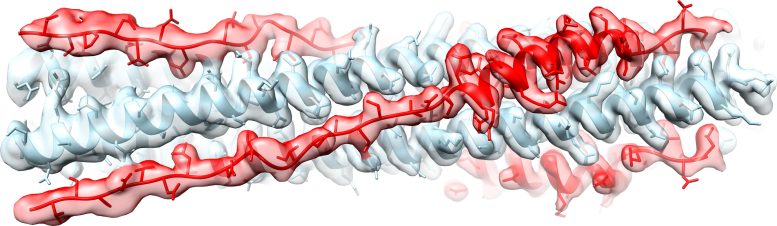
By creating a drug that’s based on part of the SARS-CoV-2 spike protein, researchers can block the virus from entering cells.
The virus that causes COVID-19, called SARS-CoV-2, uses its spike protein in order to stick to and infect our cells. The final step for the virus to enter our cells is for part of its spike protein to act like a twist tie, forcing the host cell’s outer membrane to fuse with the virus. Kailu Yang, in the lab of Axel Brunger, colleagues at Stanford University, and collaborators at the University of California Berkeley, Harvard Medical School, and the University of Finland have generated a molecule based on the twisted part of the spike protein (called HR2), which sticks itself onto the virus and prevents the spike protein from twisting. Their research shows that it prevents cells from infection even with new SARS-COV-2 variants. Yang’s work was published in the Proceedings of the National Academy of Sciences in October and was presented on Tuesday, February 21 at the 67th Annual Biophysical Society Meeting in San Diego, California.
Other treatments for COVID-19 have worked by sticking to the outside of the spike protein to block it from infecting cells, but they’ve had drawbacks. For example, bebtelovimab was an antibody treatment that targeted the spike protein, however, it didn’t work well against new COVID-19 variants because that part of the spike protein has mutated over time. Yang and Brunger are hopeful that their molecule, which they call the longHR2_42 inhibitor, is the lead compound to develop a new type of antiviral therapeutic to prevent infections even with new variants.
The reason the longHR2_42 inhibitor may work against an evolving virus is that it is based on part of the spike protein that hasn’t changed even as other parts have. “In the virus, there are two parts of the spike protein that come together forming this bundle. So we simply took a short piece of one part of this bundle, and by synthesizing that small piece chemically, it can insert itself into the spike protein and prevent the virus from infecting cells,” Brunger explained. Past research from before this COVID-19 pandemic aimed to create a similar molecule that would work to block infection of the SARS coronavirus, but those past attempts weren’t as effective as the longHR2_42 inhibitor.
Brunger believes their molecule is more effective than past attempts due to Yang’s work determining a detailed structure of the twisted together parts of the SARS-CoV-2 virus, called the postfusion so-called HR1HR2 complex, so they knew longer molecules would help block the spike protein from twisting into the HR1HR2 complex in the first place. “We made the molecule a little longer than previously published work based on the structure, and indeed, we confirmed in our fusion and infection assays that this longer piece inhibits much better,” Brunger said.
The team is currently testing the longHR2_42 inhibitor in mice infected with SARS-CoV-2 (collaboration with Giuseppe Ballisteri and co-workers, University of Finland). They are hopeful that they will be able to deliver it to people via an inhaler so that it gets to the airway, which is exactly where you want to treat an early infection to prevent infection from becoming severe. “The moment people start developing sniffles will be the time to take it,” Brunger explained.
Reference: “Nanomolar inhibition of SARS-CoV-2 infection by an unmodified peptide targeting the prehairpin intermediate of the spike protein” by Kailu Yang, Chuchu Wang, Alex J. B. Kreutzberger, Ravi Ojha, Suvi Kuivanen, Sergio Couoh-Cardel, Serena Muratcioglu, Timothy J. Eisen, K. Ian White, Richard G. Held, Subu Subramanian, Kendra Marcus, Richard A. Pfuetzner, Luis Esquivies, Catherine A. Doyle, John Kuriyan, Olli Vapalahti, Giuseppe Balistreri, Tom Kirchhausen and Axel T. Brunger, 19 September 2022, Proceedings of the National Academy of Sciences.
DOI: 10.1073/pnas.2210990119
Never miss a breakthrough: Join the SciTechDaily newsletter.
Follow us on Google and Google News.
1 Comment
I have sealed specimens from late 2019 that my doctors were not sure what I should do with them. I’ve watched them grow. Still possess them (20)+.