
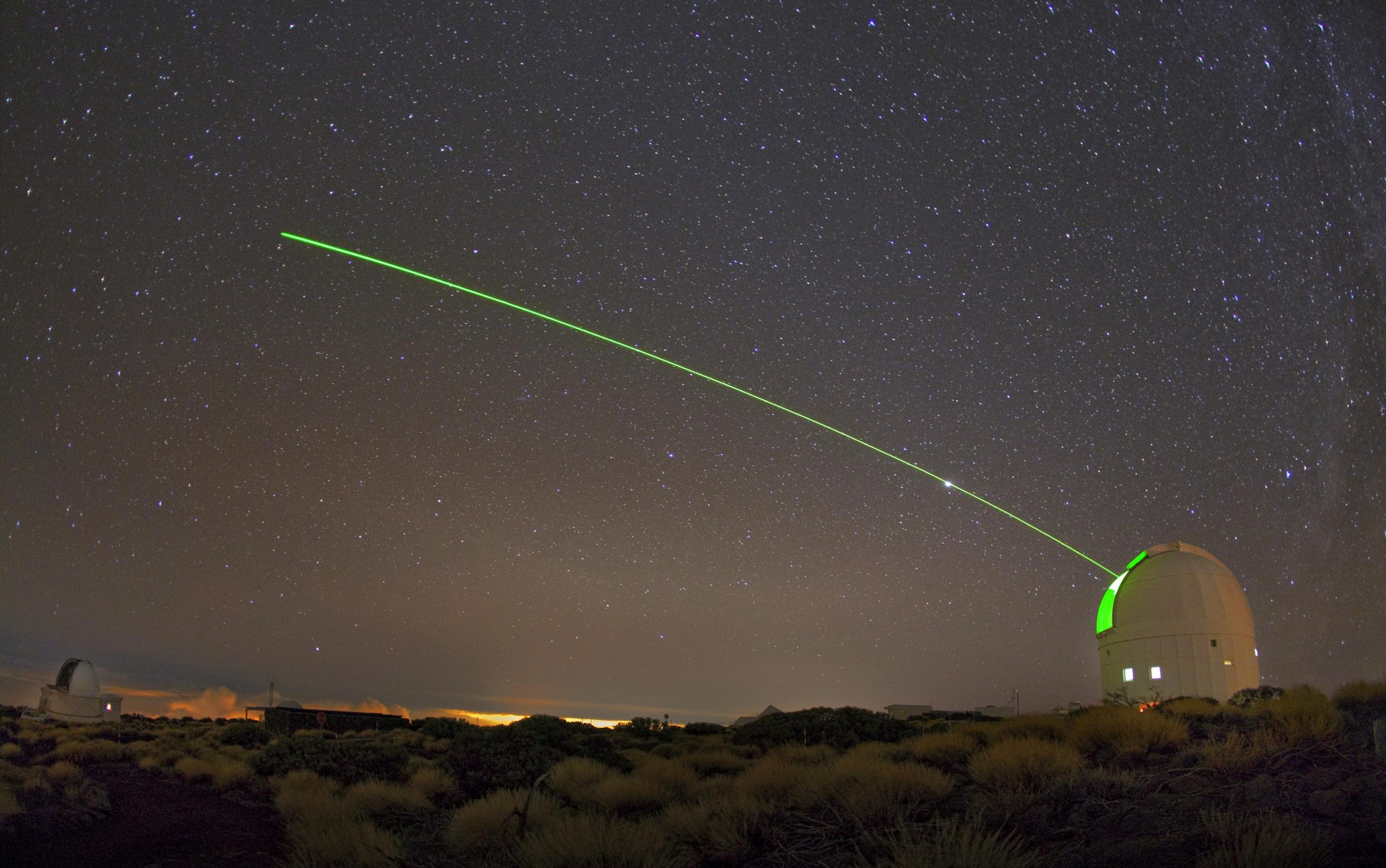
Lasers on Earth are used to measure the position of space debris high above, providing crucial information on how to avoid in-space collisions. Until now, this technique has suffered from a fatal flaw.
For some time, lasers could only be used to measure the distance to space debris during the few twilight hours in which the ‘laser ranging’ station on Earth is in darkness, but debris objects high above are still bathing in the last of the Sun’s rays.
In the same way that the Moon is brightest when it is glistening in sunlight while it is night on Earth, space debris is easier to spot when reflecting the Sun’s light as seen from a dark vantage point.
Because debris objects are so much closer to Earth, however, there is only a small window in which they are lit up but observers on Earth are not.
Now, a recent study has proved it is indeed possible, in full daylight, to use lasers to determine the distance to debris. This new laser ranging method will help improve orbit predictions for debris objects, drastically increasing the time available to make observations and keeping valuable spacecraft safe.
Distribution of space debris in orbit around Earth.
By using a special combination of telescopes, detectors, and light filters at specific wavelengths, researchers have found that it is in fact possible to increase the contrast of objects with respect to the daylight sky, revealing objects previously hiding in plain sight.
“We are used to the idea that you can only see stars at night, and this has similarly been true for observing debris with telescopes, except with a much smaller time window to observe low-orbit objects,” explains Tim Flohrer, Head of ESA’s Space Debris Office.
“Using this new technique, it will become possible to track previously ‘invisible’ objects that had been lurking in the blue skies, which means we can work all day with laser ranging to support collision avoidance.”

Debris dancing in darkness
Our planet is shrouded in a veil of debris — millions of small, but dangerous, fragments left over from previous space launches and in-orbit explosions and collisions.
They are joined by hundreds of whole, but defunct, spacecraft and rocket bodies that have failed or been abandoned, orbiting uncontrolled through space.
Even millimeter-sized fragments, traveling about seven kilometers (4 miles) per second, can damage a satellite upon impact, but collision with a dead spacecraft or large fragments can destroy functioning missions altogether.

As such, it’s important to understand where debris fragments are so that we can avoid them — but getting this information isn’t easy.
Laser ranging is a very well-established technology that uses a laser on Earth to send pulses of light to a satellite carrying a reflector.
By measuring how long it takes for the signal to return to a telescope on Earth, known as the ‘two-way travel time’, the distance to the satellite can be precisely determined.
Unfortunately, few satellites carry a ‘retro-reflector’ that would allow light to be easily reflected and returned to Earth. Determining the distance to such objects was demonstrated only a few years ago, and the development of related technologies is progressing rapidly.
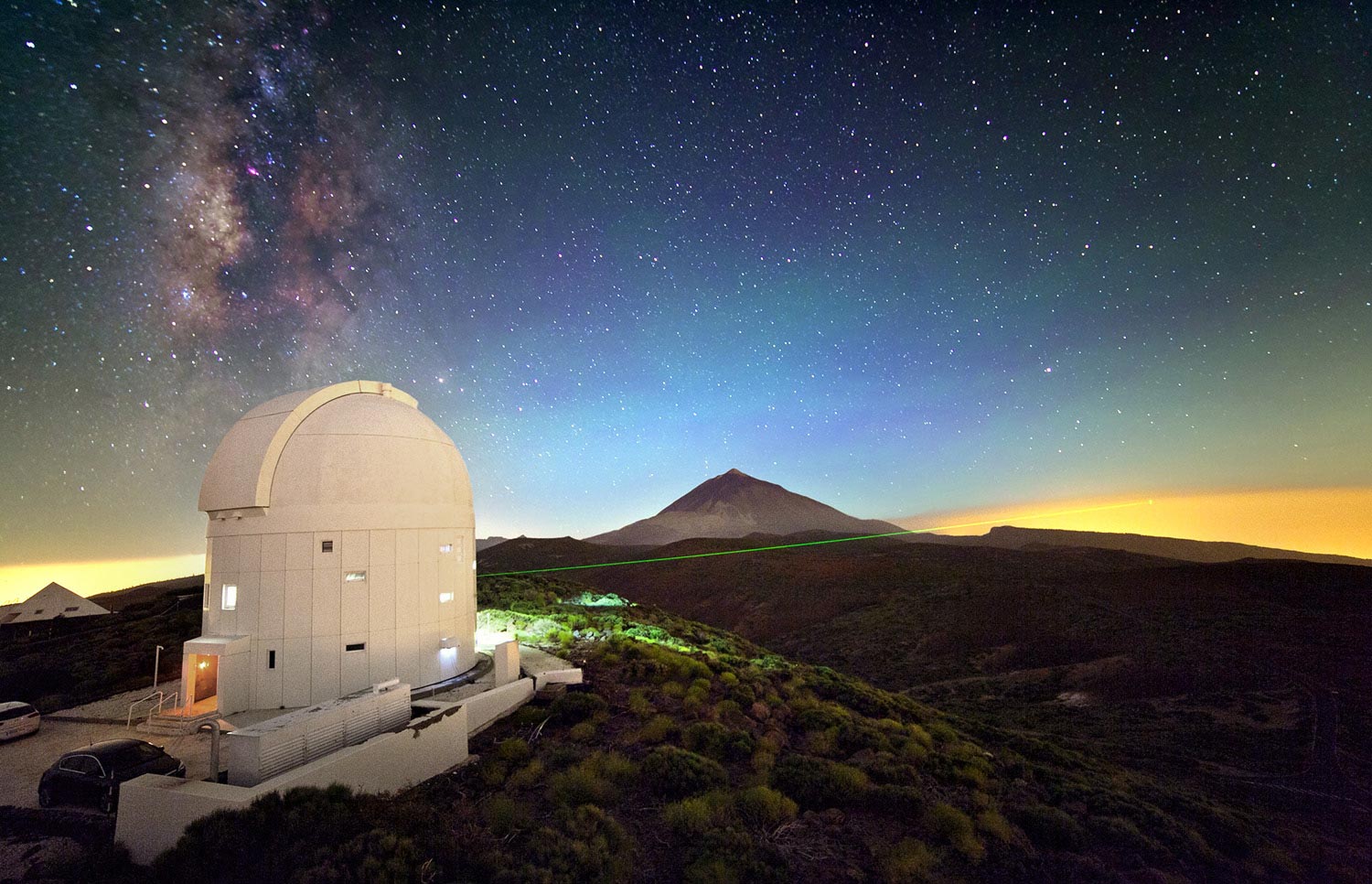
Detecting debris in daylight
During the recent tests, 40 different debris objects (and stars approximately 10 times fainter than what can be seen by the naked eye) were observed using the new technique, standing out against a blue sky, for the first time observed in the middle of the day – something that would not have been possible before.
“We expect that these results will significantly increase debris observation times in the near future,” explains Michael Steindorfer from the Austrian Academy of Sciences.
“Ultimately it means we will get to know the debris population better, allowing us to better protect Europe’s space infrastructure.”
Further development of such technologies is a core objective of ESA’s Space Safety program, including establishing a network of space debris laser ranging stations.
A new laser station next to ESA’s well-known Optical Ground Station in the Canary Islands is awaiting deployment, which will serve as a ‘test-bed’ for laser ranging technologies, as well as developing networking concepts.
Never miss a breakthrough: Join the SciTechDaily newsletter.
Follow us on Google and Google News.