
Close Menu
    Facebook X (Twitter) Instagram
    SciTechDaily
    • Biology
    • Chemistry
    • Earth
    • Health
    • Physics
    • Science
    • Space
    • Technology
    Facebook X (Twitter) Pinterest YouTube RSS
    SciTechDaily
    Home»Health»Oversensitive Sensory Neurons Can Cause Joint Deformities – But It Can Be Treated
    Health

    Oversensitive Sensory Neurons Can Cause Joint Deformities – But It Can Be Treated

    By American Association for the Advancement of Science (AAAS)February 20, 2023No Comments3 Mins Read
    Facebook Twitter Pinterest Telegram LinkedIn WhatsApp Email Reddit
    Share
    Facebook Twitter LinkedIn Pinterest Telegram Email Reddit
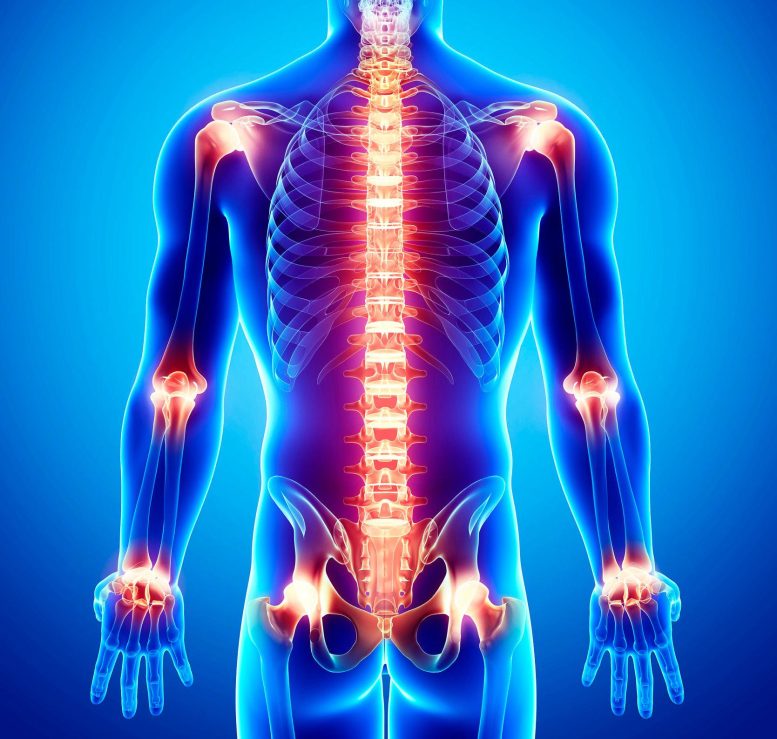
    Joint Pain Spine
    Arthrogryposis, also known as joint contractures, is a condition that results in multiple joint deformities. It is characterized by the inability to move a joint, resulting in a fixed, bent position. This can affect any joint in the body but is most commonly seen in the arms, legs, and spine.

    Excess mechanosensation in proprioceptive neurons causes joint deformities in DA. Early interventions, like Botox or fatty acid diets, show promise for non-invasive treatment during a critical developmental window.

    According to a recent study, an overabundance of mechanosensation in the neurons responsible for our sense of limb position in space can disrupt musculoskeletal development and cause joint deformities such as arthrogryposis.

    The research also demonstrates that it is possible to treat certain musculoskeletal conditions non-invasively by reducing this heightened sensory neuronal activity during a crucial age through the use of Botox or a specialized diet.

    Distal arthrogryposis (DA) is a disorder characterized by congenital joint deformities, or contractures, that often restrict movement in the hands and feet and is estimated to afflict roughly one in 3,000 individuals worldwide. Alleviating the symptoms often requires invasive surgeries.

    Although mutations in genes associated with muscle and joint function have been linked to DA, gain-of-function mutations in PIEZO2 – a principal mechanosensor in sensory neurons that underlies touch sensation, proprioception, and other mechanosensory processes – have been found in patients with DA subtype 5 (DA5).

    However, the mechanism by which PIEZO2 mutations cause DA is unknown. Using a mouse model, Shang Ma and colleagues found that over-expression of the mutant Piezo2 gain-of-function allele in proprioceptive neurons that enervate muscles and tendons during a critical postnatal period during development can cause joint contracture. These defects were not caused when the dysfunctional allele was expressed in skeletal muscles, cartilage, or tendons.

    Potential Non-Invasive Treatments

    According to Ma et al., Botox injection and a dietary fatty acid commonly found in fish reduced joint and tendon defects.

    “The study by Ma et al. provides exciting new insights into the mechanisms that cause DA,” writes Urich Müller in a related Perspective. “Finding that expression of the gain-of-function allele of Piezo2 in young adult mice does not cause DA symptoms is reassuring. It narrows down a time window for potential therapeutic intervention that could lead to lifelong improvement for the affected patients.”

    Reference: “Excessive mechanotransduction in sensory neurons causes joint contractures” by Shang Ma, Adrienne E. Dubin, Luis O. Romero, Meaghan Loud, Alexandra Salazar, Sarah Chu, Nikola Klier, Sameer Masri, Yunxiao Zhang, Yu Wang, Alex T. Chesler, Katherine A. Wilkinson, Valeria Vásquez, Kara L. Marshall and Ardem Patapoutian, 12 January 2023, Science.
    DOI: 10.1126/science.add3598

    Never miss a breakthrough: Join the SciTechDaily newsletter.
    Follow us on Google and Google News.

    Brain Diet Neuroscience
    Share. Facebook Twitter Pinterest LinkedIn Email Reddit

    Related Articles

    Just 4 Days of Junk Food Can Rewire Your Brain’s Memory Center

    Scientists Reveal Why You Still Have Room for Dessert Even When You’re Full

    This Simple Diet Tweak Could Help Protect Your Brain Against Dementia

    New Study Links Red Meat Consumption to Increased Dementia Risk

    Bacon Lovers Beware: Processed Red Meat Linked to Dementia Risk

    New Study Reveals How Palm Oil Triggers Neurodegeneration in MS – and How To Stop It

    Memory Block: How Saturated Fats May Hinder Memory Formation in the Aging Brain

    Scientists Identify Brain Aging “Sweet Spot”

    A Ketogenic Diet May Be Helpful With Brain Cancer

    Leave A Reply Cancel Reply

    • Facebook
    • Twitter
    • Pinterest
    • YouTube

    Don't Miss a Discovery

    Subscribe for the Latest in Science & Tech!

    Trending News

    Millions Take These IBS Drugs, But a New Study Finds Serious Risks

    Scientists Unlock Hidden Secrets of 2,300-Year-Old Mummies Using Cutting-Edge CT Scanner

    Bread Might Be Making You Gain Weight Even Without Eating More Calories

    Scientists Discover Massive Magma Reservoir Beneath Tuscany

    Europe’s Most Active Volcano Just Got Stranger – Here’s Why Scientists Are Rethinking It

    Alzheimer’s Symptoms May Start Outside the Brain, Study Finds

    Millions Take This Popular Supplement – Scientists Discover a Concerning Link to Heart Failure

    The Universe Is Expanding Too Fast and Scientists Can’t Explain Why

    Follow SciTechDaily
    • Facebook
    • Twitter
    • YouTube
    • Pinterest
    • Newsletter
    • RSS
    SciTech News
    • Biology News
    • Chemistry News
    • Earth News
    • Health News
    • Physics News
    • Science News
    • Space News
    • Technology News
    Recent Posts
    • Simple Blood Test May Predict Alzheimer’s Years Before Brain Scans Show Signs
    • Scientists Say Adding This Unusual Seafood to Your Diet Could Reverse Signs of Aging
    • U.S. Waste Holds $5.7 Billion Worth of Crop Nutrients
    • Scientists Say a Hidden Structure May Exist Inside Earth’s Core
    • Doctors Surprised by the Power of a Simple Drug Against Colon Cancer
    Copyright © 1998 - 2026 SciTechDaily. All Rights Reserved.
    • Science News
    • About
    • Contact
    • Editorial Board
    • Privacy Policy
    • Terms of Use

    Type above and press Enter to search. Press Esc to cancel.