
Close Menu
    Facebook X (Twitter) Instagram
    SciTechDaily
    • Biology
    • Chemistry
    • Earth
    • Health
    • Physics
    • Science
    • Space
    • Technology
    Facebook X (Twitter) Pinterest YouTube RSS
    SciTechDaily
    Home»Technology»Oxford Breakthrough Reveals the Secret Ingredient Inside Lithium-Ion Batteries
    Technology

    Oxford Breakthrough Reveals the Secret Ingredient Inside Lithium-Ion Batteries

    By University of OxfordFebruary 17, 2026No Comments6 Mins Read
    Facebook Twitter Pinterest Telegram LinkedIn WhatsApp Email Reddit
    Share
    Facebook Twitter LinkedIn Pinterest Telegram Email Reddit
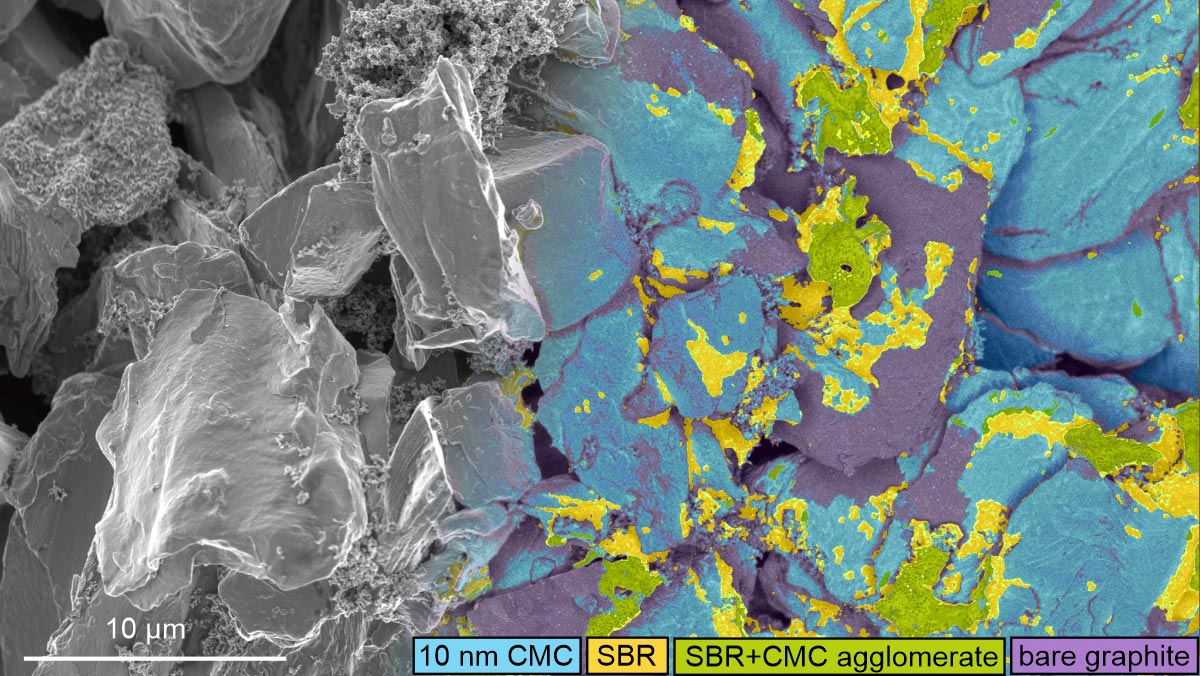
    Nanoscopic Carboxymethyl Cellulose Layers and Styrene Butadiene Rubber Agglomerates on Graphite Particles
    Nanoscopic carboxymethyl cellulose (CMC) layers and styrene butadiene rubber (SBR) agglomerates on graphite particles detected with energy-selective backscattered electron (EsB) imaging in a lab-made Li-ion anode after bromination. The difference in stability between brominated SBR and brominated CMC during electron imaging allows to distinguish both binders individually in the EsB image. The EsB image has been coloured for easier distinction of different binder phases. Credit: Stanislaw Zankowski

    Scientists can now see a hidden battery ingredient — and it could supercharge how fast and how long lithium-ion batteries last.

    Scientists at the University of Oxford have created an advanced technique that allows them to clearly see a crucial but previously hard-to-detect part of lithium-ion battery electrodes. The findings, published today (February 17) in Nature Communications, could improve how battery electrodes are manufactured and lead to faster charging and longer-lasting Li-ion batteries.

    The research centers on polymer binders used in the negative electrodes of lithium-ion batteries (anodes). Although these binders account for less than 5% of the electrode’s weight, they play an essential role in keeping the electrode intact. They influence mechanical strength, electrical and ionic conductivity, and overall battery lifespan. Because binders lack distinctive visual features and are present in such small amounts, scientists have struggled to track where they are located inside the electrode. That limitation has made it difficult to fine-tune battery performance, since binder placement directly affects conductivity, structural stability, and durability over time.

    Stanislaw Zankowski
    Lead author Dr. Stanislaw Zankowski using the world-class electron microscopy facilities at the David Cockayne Centre for Electron Microscopy, at Oxford University’s Department of Materials. Credit: Department of Materials, University of Oxford

    Patent Pending Staining Technique Makes Binders Visible

    To solve this long-standing challenge, the team developed a patent-pending staining method that attaches traceable silver and bromine markers to widely used cellulose- and latex-based binders in both graphite- and silicon-based anodes. Once tagged, the binders can be detected because they emit characteristic X-rays (measured with energy-dispersive X-ray spectroscopy) or reflect high-energy electrons from the surface (measured with energy-selective backscattered electron imaging). Under an electron microscope, these signals reveal detailed information about where elements are distributed and what the surface structure looks like.

    Lead author Dr. Stanislaw Zankowski (Department of Materials, University of Oxford) said: “This staining technique opens up an entirely new toolbox for understanding how modern binders behave during electrode manufacturing. For the first time, we can accurately see the distribution of these binders not only generally (i.e., their thickness throughout the electrode), but also locally, as nanoscale binder layers and clusters, and correlate them with anode performance.”

    The approach works not only for traditional graphite electrodes but also for more advanced materials such as silicon or SiOx. This makes the method useful for current lithium-ion batteries as well as next-generation designs.
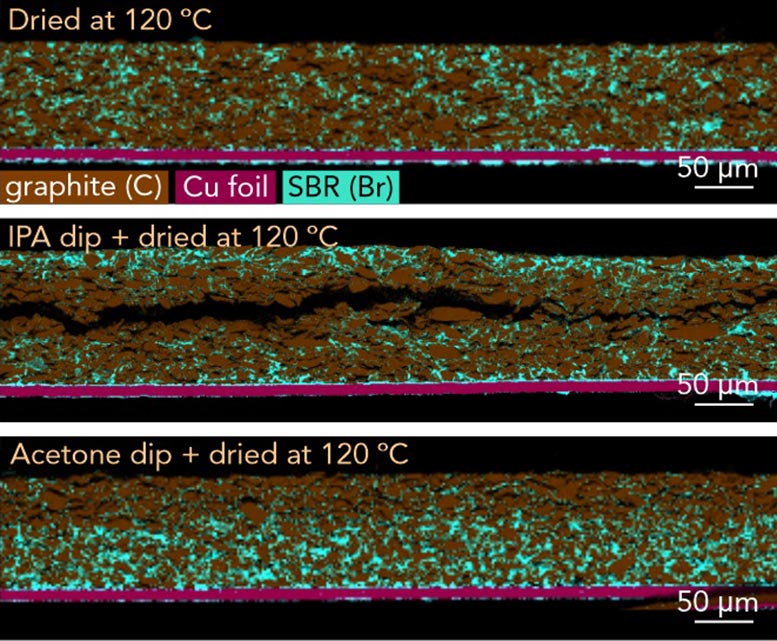
    Optimizing Fast Electrode Drying
    Using binder staining and cross-sectional energy-dispersive X-ray spectroscopy (EDX) to optimize fast electrode drying. The top electrode was dried at high temperature of 120 oC, which caused part of styrene butadiene rubber (SBR) (here, marked green) and carboxymethyl cellulose (CMC) (not shown) binders to migrate to the top electrode surface, making the electrode coating easily delaminating from the Cu current collector (marked magenta). The middle electrode was briefly dipped in isopropanol before drying at 120 oC, which amplified binder concentration at the top, leaving the middle part of the electrode binder-lean and prone to significant cracking. The bottom electrode was briefly dipped in acetone prior to 120 oC drying. The acetone dip prevented binder migration, concentrating binders close to the Cu collector and leaving more porosity in the upper electrode region for more efficient ionic transport. As a result, the acetone-dipped electrode had excellent adhesion to the current collector, and had 40% lower pore ionic resistance compared to the top (not-dipped) electrode. Credit: Stanislaw Zankowski

    Small Manufacturing Changes Cut Resistance by 40%

    Using this imaging technique, the researchers discovered that even slight differences in binder distribution can significantly influence charging speed and battery lifespan. By refining slurry mixing and drying steps during electrode production, they were able to lower the internal ionic resistance of test electrodes by as much as 40% – a major barrier to faster charging.

    The team also captured detailed images of extremely thin layers of carboxymethyl cellulose (CMC) binder coating graphite particles. The method allowed them to detect CMC films just 10 nm thick and observe structures spanning four orders of magnitude within a single image. These images showed that what begins as a uniform CMC coating can break apart into uneven, patchy fragments during processing, which may weaken battery performance and long-term stability.

    Co-author Professor Patrick Grant (Department of Materials, University of Oxford) said: “This multidisciplinary effort-spanning chemistry, electron microscopy, electrochemical testing, and modelling- has resulted in an innovative imaging approach that will help us to understand key surface processes that affect battery longevity and performance. This will drive forward advancements across a wide range of battery applications.”

    Detecting Different Binder Content in Bi Layered Electrodes
    Detecting different binder content in bi-layered electrodes using staining and energy-dispersive X-ray spectroscopy (EDX). The images show cross-sections of a bilayer electrode, which was made by first depositing binder-rich slurry (bottom electrode layer), followed by depositing binder-lean slurry (top electrode layer) – the bottom layer had 4× more amount of carboxymethyl cellulose (CMC) and of styrene butadiene rubber (SBR) compared to the top layer. Binders are invisible in conventional electron microscopy (left side of the images) but become visible in EDX mapping after Br and Ag staining (right side of the images). The EDX maps of Br and Ag reflect the differences in binder content between the lower and upper electrode layers with 80-97.5% accuracy. Credit: Stanislaw Zankowski

    Reference: “Chemical staining for fundamental studies and optimization of binders in Li-ion battery negative electrodes” by Stanislaw P. Zankowski, Samuel Wheeler, Thomas Barthelay, Wai Man Chan, Michael Metzler and Patrick S. Grant, 17 February 2026, Nature Communications.
    DOI: 10.1038/s41467-026-69002-1

    The work was supported by the Faraday Institution’s Nextrode project and has already drawn strong interest from industry, including major battery manufacturers and electric vehicle companies.

    Never miss a breakthrough: Join the SciTechDaily newsletter.
    Follow us on Google and Google News.

    Battery Technology Lithium-Ion Materials Science Microscopy University of Oxford
    Share. Facebook Twitter Pinterest LinkedIn Email Reddit

    Related Articles

    AI Just Found the Future of Batteries, And It’s Not Lithium

    Iontronics Breakthrough: Faster Thin Film Devices for Improved Batteries and Advanced Computing

    New Improved Lithium-Ion Batteries That Last Longer in Extreme Cold

    Bringing ‘Dead’ Batteries Back to Life – Researchers Extend Battery Lifetime by 30%

    Toward Solid-State Lithium-Ion Batteries That Pack Twice As Much Energy per Pound

    Using Carbon Filler to Improve High-Energy Lithium-Ion Batteries

    Flexible Electrolyte Sheet Breakthrough for Advanced Lithium Metal Batteries

    Solid-Oxide Fuel Cell That Converts Hydrogen Into Electricity Also Capable of Battery-Like Storage

    Spray Paint Battery Can be Painted on Virtually Any Surface

    Leave A Reply Cancel Reply

    • Facebook
    • Twitter
    • Pinterest
    • YouTube

    Don't Miss a Discovery

    Subscribe for the Latest in Science & Tech!

    Trending News

    First-of-Its-Kind Discovery: Homer’s Iliad Found Embedded in a 1,600-Year-Old Egyptian Mummy

    Beyond Inflammation: Scientists Uncover New Cause of Persistent Rheumatoid Arthritis

    A Simple Molecule Could Unlock Safer, Easier Weight Loss

    Scientists Just Built a Quantum Battery That Charges Almost Instantly

    Researchers Unveil Groundbreaking Sustainable Solution to Vitamin B12 Deficiency

    Millions of People Have Osteopenia Without Realizing It – Here’s What You Need To Know

    Researchers Discover Boosting a Single Protein Helps the Brain Fight Alzheimer’s

    World-First Study Reveals Human Hearts Can Regenerate After a Heart Attack

    Follow SciTechDaily
    • Facebook
    • Twitter
    • YouTube
    • Pinterest
    • Newsletter
    • RSS
    SciTech News
    • Biology News
    • Chemistry News
    • Earth News
    • Health News
    • Physics News
    • Science News
    • Space News
    • Technology News
    Recent Posts
    • Magnesium Magic: New Drug Melts Fat Even on a High-Fat, High-Sugar Diet
    • Weight-Loss Drugs Like Ozempic May Come With an Unexpected Cost
    • After Decades, MIT Researchers Capture the First 3D Atomic View of a Mysterious Material
    • Your Favorite Fishing Spot Is Turning Brown – and the Fish Are Changing
    • 380-Million-Year-Old Fish Fossil Reveals Secrets of Life’s First Steps Onto Land
    Copyright © 1998 - 2026 SciTechDaily. All Rights Reserved.
    • Science News
    • About
    • Contact
    • Editorial Board
    • Privacy Policy
    • Terms of Use

    Type above and press Enter to search. Press Esc to cancel.