
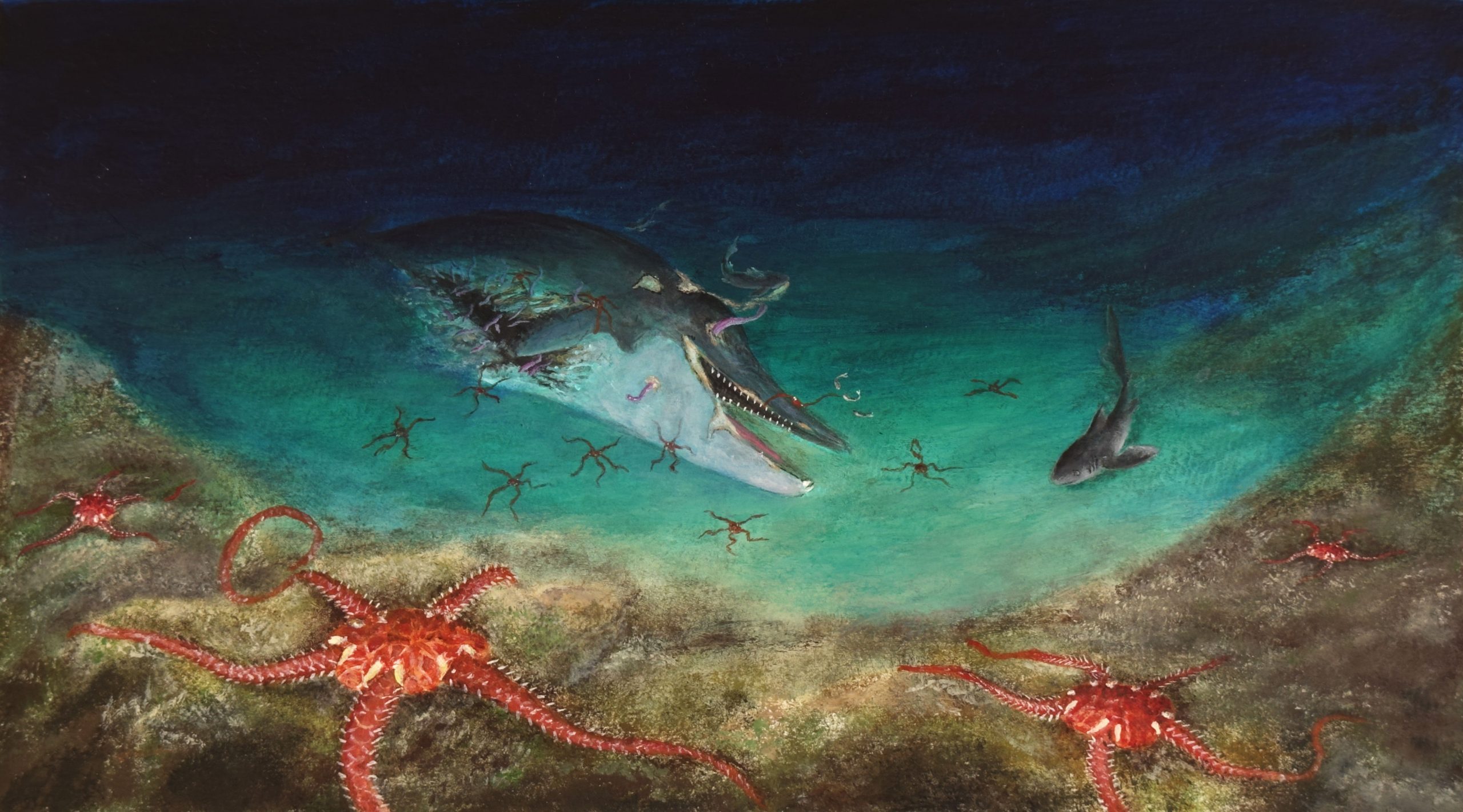
A 9.5-million-year-old fossil discovery suggests that an ecological relationship observed in modern oceans has ancient origins.
A whale that sank to the bottom of an ancient sea approximately 9.5 million years ago may have attracted a community of marine scavengers. Scientists excavating fossil deposits in southern Denmark have discovered microscopic skeletal plates that belong to a previously unknown species of brittle star, a marine invertebrate closely related to starfish.
Named Ophiura huebnerjenseni, the species may provide the earliest fossil evidence of brittle stars gathering around dead whales. Such carcasses create temporary ecosystems known as whale falls, supplying abundant food to organisms living on the seafloor. Brittle stars frequently inhabit these environments today, but their association with whale falls had never been documented in the fossil record.
Microscopic Fossils Reveal an Ancient Gathering
The remains were recovered from sediment collected during the 2018 excavation of a beaked whale’s lower jaw and several vertebrae at Denmark’s Gram Clay Pit. Researchers washed and sieved the sediment before examining individual microfossils using scanning electron microscopy. Subtle differences in the structure of the brittle stars’ skeletal plates allowed the team to identify a new species.
The distribution of the fossils suggested that their proximity to the whale was more than coincidental.
“Only three samples taken directly beside the whale bones contained brittle-star remains. Samples from the same layer farther from the skeleton, and other comparison samples, yielded none,” the lead author Ben Thuy explains.
Ruling Out Alternative Explanations
The researchers investigated whether ocean currents or favorable fossil preservation conditions could explain the unusual concentration of skeletal plates. Fragments of sea urchins, which have similar physical and chemical properties, provided a useful comparison.
“We considered whether currents had simply concentrated the plates around the bones, or whether local chemical conditions had helped preserve them. However, sea-urchin fragments of comparable size and mineral composition occurred in every sample studied. This makes a preservation-only explanation less likely and supports the interpretation that the brittle stars lived on or close to the whale carcass,” Thuy added.
The Gram Clay Pit preserves sediments deposited beneath the ancient North Sea during the Late Miocene. Although the site has yielded numerous whale skeletons, exceptionally large megalodon vertebrae, and a diverse collection of marine invertebrates, brittle stars had previously escaped detection.
How Dead Whales Supported Ancient Marine Life
A decomposing whale delivers a substantial supply of organic material to the seabed. In modern oceans, whale falls can support successive communities of scavengers, opportunistic invertebrates, and, particularly in deep water, organisms sustained by chemical processes associated with decomposition.
Although the fossils cannot establish what Ophiura huebnerjenseni ate or whether it depended on whale carcasses, researchers suspect it was a generalist species that normally occupied the surrounding seabed and congregated where food became abundant.
“We interpret the site as a shallow-water whale fall at a stage when enrichment from the carcass supported opportunistic animals,” said Mette Elstrup. “We found no evidence for the later sulfide-based community stages that can develop at deep-sea whale falls. The discovery therefore adds a rare fossil perspective on how animals responded to a large food source on an ancient shallow-water seabed,” Elstrup said.
An Unexpected Connection to Heavy Metal
The new species takes its name from Holger Hübner and Thomas Jensen, founders of Germany’s Wacken Open Air heavy metal festival. The connection extends beyond the scientific tribute, however, to the geological origins of the festival’s famously muddy grounds.
Researchers believe the dark gray mud encountered by festivalgoers probably originates from the same geological deposits that preserved the ancient brittle stars.
“The clay that accumulated on the bottom of the ancient North Sea not only preserved the remains of a 9.5-million-years old brittle star, it also turns Wacken Open Air into the muddy battlefield renowned by metalheads worldwide,” concludes Lea Numberger-Thuy.
Reference: “A new brittle star (Ophiuroidea, Ophiuridae) associated with a whale fall from the Miocene of Gram, Denmark” by Ben Thuy, Mette Elstrup, Lea D. Numberger-Thuy and Trine Sørensen, 19 October 2026, Neues Jahrbuch für Geologie und Paläontologie – Abhandlungen.
DOI: 10.1127/njgpa/2026/1335
Never miss a breakthrough: Join the SciTechDaily newsletter.
Follow us on Google and Google News.