

New fossil research shows that teeth originally evolved as sensory tissue embedded in the armored exoskeletons of ancient fish.
Anyone who has ever squirmed through a dental cleaning knows how sensitive teeth can be. This sensitivity provides important feedback about temperature, pressure, and pain as we bite and chew. However, the sensitive tissues inside hard enamel originally evolved for a very different purpose.
New research from the University of Chicago shows that dentine—the inner layer of teeth that transmits sensory information to the nerves in the pulp—first evolved as sensory tissue in the armored exoskeletons of ancient fish.
Paleontologists have long believed that teeth evolved from the bumpy structures found on this armor, but the purpose of those structures remained unclear. A new study, published in Nature, confirms that these features in an early vertebrate fish from the Ordovician period, about 465 million years ago, contained dentine and likely helped the animal detect conditions in the surrounding water.
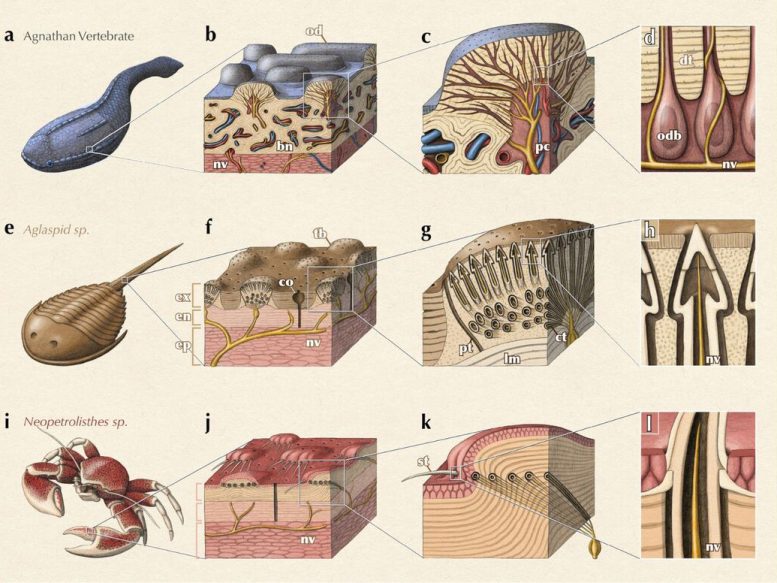
The research also revealed that structures previously identified as teeth in fossils from the Cambrian period (485 to 540 million years ago) closely resembled features in the armor of fossil invertebrates, as well as the sensory organs found in the shells of modern arthropods such as crabs and shrimp.
These similarities suggest that sensory organs in the armor of both vertebrates and invertebrates evolved independently to help animals perceive their environment.
“When you think about an early animal like this, swimming around with armor on it, it needs to sense the world. This was a pretty intense predatory environment and being able to sense the properties of the water around them would have been very important,” said Neil Shubin, PhD, Robert R. Bensley Distinguished Service Professor of Organismal Biology and Anatomy at UChicago and senior author of the new study. “So, here we see that invertebrates with armor like horseshoe crabs need to sense the world too, and it just so happens they hit on the same solution.”
Yara Haridy and Neil Shubin discuss their new study in Nature on the origins of sensitive teeth in vertebrates. Credit: Julian Romano
Night at the particle accelerator
Yara Haridy, PhD, a postdoctoral researcher in Shubin’s lab who led the study, did not set out to investigate the origins of teeth. Instead, she was focused on answering another long-standing question in paleontology: What is the earliest vertebrate in the fossil record?
To explore this, Haridy contacted museums across the country, requesting fossil specimens from the Cambrian period (485 to 540 million years ago) so she could CT scan them in search of signs that indicated vertebrate features.
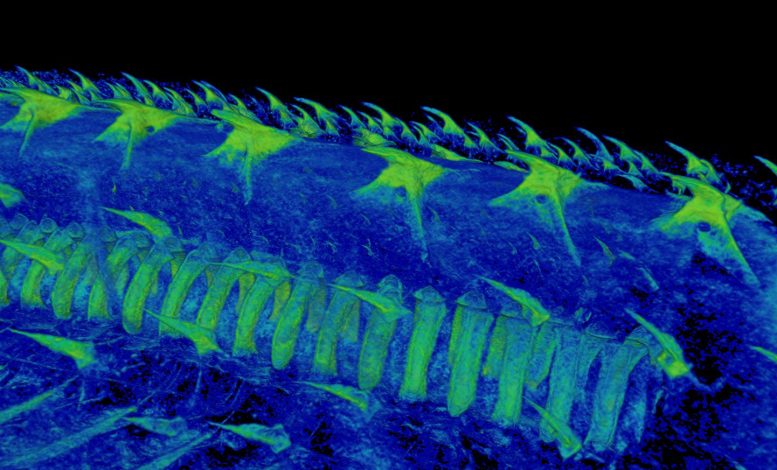
One of those signs, at least in later fish, is the presence of dentine inside the bumps on external armor, called odontodes. Haridy collected hundreds of specimens, some just tiny fragments that could fit on the end of a toothpick.
She then took them to Argonne National Laboratory for an all-night scanning session using the Advanced Photon Source, which captured extremely high-resolution CT images of the fossils. “It was a night at the particle accelerator; that was fun,” Haridy said.
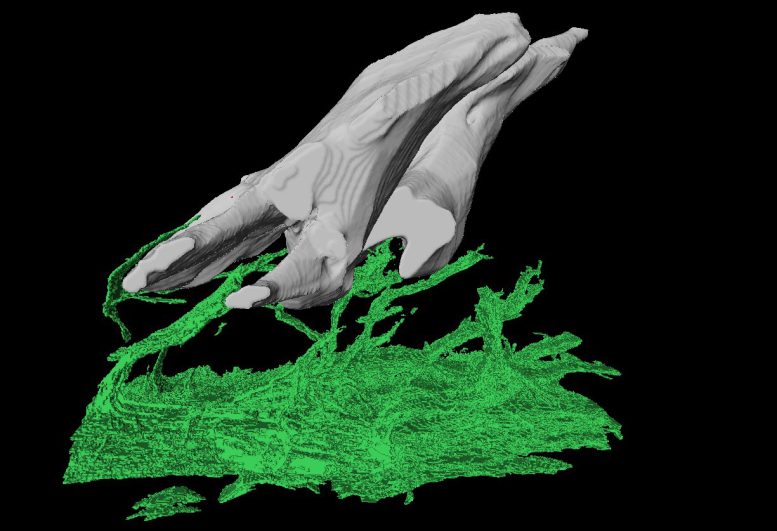
As they started seeing the images from the scans, one of the samples from a Cambrian fossil called Anatolepis looked like it showed the hallmarks of a vertebrate fish. It had a series of tubules, or pores underneath the odontodes, filled with material that bore the chemical signatures of dentine. If it truly was a vertebrate, this specimen would have extended the fossil record back by tens of millions of years.
“We were high fiving each other, like ‘oh my god, we finally did it,’” Haridy said. “That would have been the very first tooth-like structure in vertebrate tissues from the Cambrian. So, we were pretty excited when we saw the telltale signs of what looked like dentine.”
They had to confirm this, of course, so they began analyzing images of the other specimens Haridy scanned. This library of shells and skeletons included everything from other ancient fossils to modern crabs, snails, beetles, barnacles, sharks, and skates, plus miniature suckermouth catfish that Haridy raised herself in an aquarium.
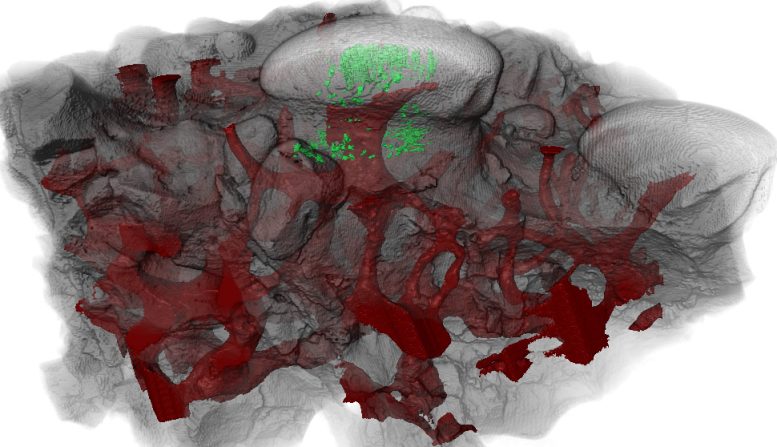
Once they compared the possible vertebrate Anatolepis to a known arthropod fossil from the Milwaukee Public Museum, they realized that what looked like dentine-lined tubules of a vertebrate were more like the sensory organs on the shells of crabs, called sensilla.
This means that Anatolepis, which was claimed to be a vertebrate in the pages of Nature in 1996, is an ancient invertebrate arthropod instead. The large tubules in another Ordovician vertebrate called Eriptychius were similar in structure to these sensilla, but did contain dentine.
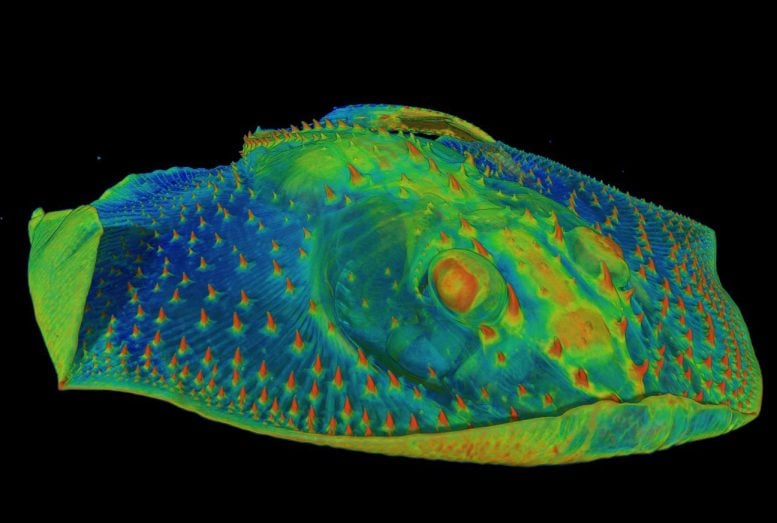
“This shows us that ‘teeth’ can also be sensory even when they’re not in the mouth,” Haridy said. “So, there’s sensitive armor in these fish. There’s sensitive armor in these arthropods. This explains the confusion with these early Cambrian animals. People thought that this was the earliest vertebrate, but it actually was an arthropod.”
Tooth-like structures scattered across the fossil record
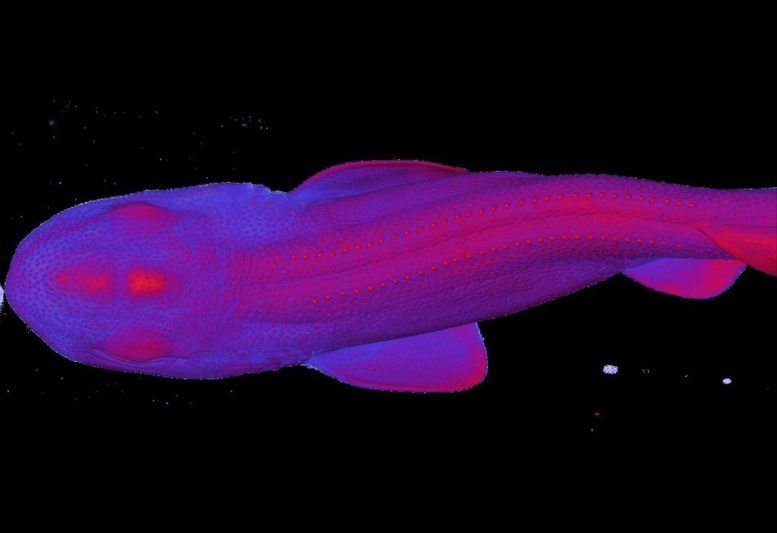
Sharks, skates, and catfish also have tooth-like structures called denticles that make their skin feel like sandpaper. When Haridy studied the tissues of her catfish, she saw that the denticles were connected to nerves, just like a tooth would be. She said the similarities to teeth, the ancient odontodes of armored fish, and the sensilla of arthropods was striking.
“We think that the earliest vertebrates, these big, armored fish, had very similar structures, at least morphologically. They look the same in ancient and modern arthropods, because they’re all making this mineralized layer that caps their soft tissue and helps them sense the environment,” she said.
There are two schools of thought about how these structures eventually became teeth. One, the “inside-out” hypothesis, says that teeth arose first, and were later adapted for exoskeletons. This paper would support the second, “outside-in” hypothesis, that says sensitive structures developed first on exoskeletons, and at some point, animals utilized the same genetic toolkit to produce sensitive teeth as well.
While they didn’t pin down the earliest vertebrate fish, Shubin said this discovery was more than worth the effort.
“For some of these fossils that were putative early vertebrates, we showed that they’re not. But that was a bit of misdirection,” Shubin said. “We didn’t find the earliest one, but in some ways, we found something way cooler.”
Reference: “The origin of vertebrate teeth and evolution of sensory exoskeletons” by Yara Haridy, Sam C. P. Norris, Matteo Fabbri, Karma Nanglu, Neelima Sharma, James F. Miller, Mark Rivers, Patrick La Riviere, Phillip Vargas, Javier Ortega-Hernández and Neil H. Shubin, 21 May 2025, Nature.
DOI: 10.1038/s41586-025-08944-w
Funding: U.S. National Science Foundation, DOE/US Department of Energy, Brinson Foundation
Never miss a breakthrough: Join the SciTechDaily newsletter.
Follow us on Google and Google News.
3 Comments
So, another case of exaptation (like feathers)?
I refuse to believe it. A science article in mainstream press that *doesn’t* read like it was written by a 3d grader testing out an AI program. Wonderful!
Yeah, and my fingernails were once part of unicorn horns too.