
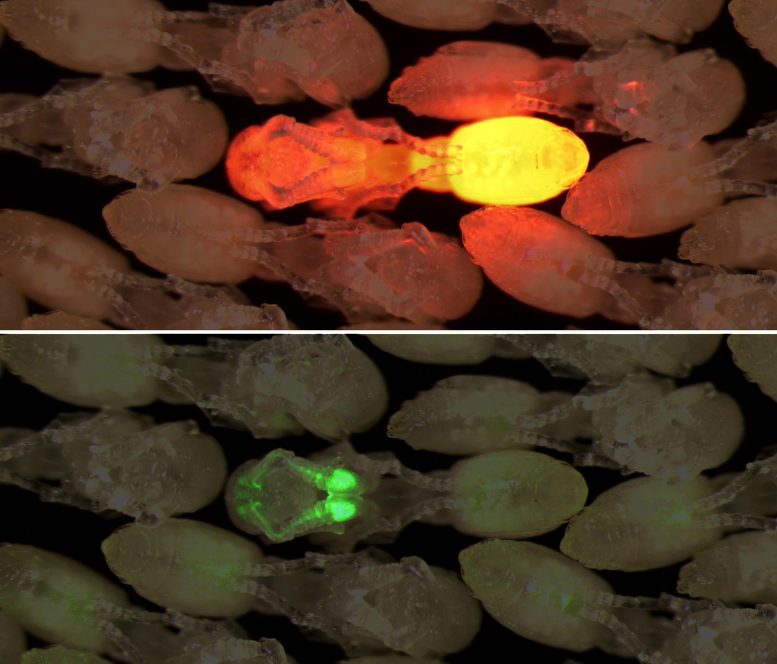
Ants have a specialized communication processing center that has not been found in other social insects.
A new study reveals that ants communicate danger through specific pheromones which activate a particular part of their brains, triggering complex responses like nest evacuation and offspring protection. The response varies depending on the colony size, and future research aims to delve into how different ant groups process the same signals.
Have you ever noticed an ant in your home, only to find that a week later the whole colony has moved in? The traps you set up catch only a few of these ants, but soon, the rest of the colony has mysteriously disappeared. Now, a study published in the journal Cell on June 14 explores how certain danger-signaling pheromones—the scent markers ants emit to communicate with each other—activate a specific part of the ants’ brains and can change the behavior of an entire nest.
The Complexity of Ant Communication
“Humans aren’t the only animals with complex societies and communication systems,” says lead author Taylor Hart of The Rockefeller University. “Over the course of evolution, ants have evolved extremely complex olfactory systems compared to other insects, which allows them to communicate using many different types of pheromones that can mean different things.”
This research suggests that ants have their own kind of communication center in their brains, similar to humans. This center can interpret alarm pheromones, or “danger signals,” from other ants. This section of their brain may be more advanced than that of some other insects such as honeybees, which prior work has suggested instead rely on many different parts of their brain to coordinate in response to a single pheromone.
“There seems to be a sensory hub in the ant brain that all the panic-inducing alarm pheromones feed into,” says corresponding author Daniel Kronauer of The Rockefeller University.
The researchers used an engineered protein called GCaMP to scan the brain activity of clonal raider ants that were exposed to danger signals. GCaMP works by attaching itself to calcium ions, which flare up with brain activity, and the resulting fluorescent chemical compound can be seen on high-resolution microscopes adapted to view them.
The “Panic Response” and Alarm Pheromones
When performing the scans, the researchers noticed that only a small section of the ants’ brains lit up in response to danger signals, but the ants still showed immediate and complex behaviors in response. These behaviors were named the “panic response” because they involved actions such as fleeing, evacuating the nest, and transporting their offspring from the nest toward a safer location.
Species of ants with different colony sizes also use different pheromones to communicate a variety of messages. “We think that in the wild, clonal raider ants usually have a colony size of just tens to hundreds of individuals, which is pretty small as far as ant colonies go,” says Hart. “Frequently, these small colonies tend to have panic responses as their alarm behavior because their main goal is to get away and survive. They can’t risk a lot of individuals. Army ants, the cousins of the clonal raider ants, have massive colonies—hundreds of thousands or millions of individuals—and they can be much more aggressive.”
Regardless of the species, ants within a colony divide themselves by caste and role, and ants within different castes and roles have slightly different anatomy. For the purpose of this study, researchers chose clonal raider ants as a species because they are easy to control. They used ants of one sex within one caste and role (female worker ants) to ensure consistency and therefore make it easier to observe widespread patterns. Once researchers have a clearer understanding of the neural differences between castes, sexes, and roles, they may better be able to comprehend exactly how different ant brains process the same signals.
“We can start to look at how these sensory representations are similar or different between ants,” says Hart. Kronauer says, “We’re looking at division of labor. Why do individuals that are genetically the same assume different tasks in the colony? How does this division of labor work?”
For more on this research, see World’s First Transgenic Ants Reveal How Colonies Respond to an Alarm.
Reference: “Sparse and stereotyped encoding implicates a core glomerulus for ant alarm behavior” by Taylor Hart, Dominic D. Frank, Lindsey E. Lopes, Leonora Olivos-Cisneros, Kip D. Lacy, Waring Trible, Amelia Ritger, Stephany Valdés-Rodríguez and Daniel J.C. Kronauer, 14 June 2023, Cell.
DOI: 10.1016/j.cell.2023.05.025
This work was supported by the National Institute of General Medical Sciences of the National Institutes of Health, the National Institute of Neurological Disorders and Stroke, the Howard Hughes Medical Institute, the National Science Foundation, and the Kavli Neural Systems Institute.
Never miss a breakthrough: Join the SciTechDaily newsletter.
Follow us on Google and Google News.