

A new study showcases a catalyst made from lignin, a plant-based waste material, that dramatically improves a key step in water electrolysis.
Researchers have introduced a new type of catalyst made from renewable plant waste that could greatly speed up the production of clean hydrogen. The material is produced by embedding nickel oxide and iron oxide nanoparticles within carbon fibers derived from lignin. This design improves both the efficiency and stability of the oxygen evolution reaction, which is an essential step in water electrolysis.
According to the study published in Biochar X, the catalyst operates with a low overpotential of 250 mV at 10 mA cm² and continues to perform reliably for more than 50 hours at high current density. These findings point to a practical and affordable option that could replace the precious metal catalysts commonly used in industrial water splitting.
“Oxygen evolution is one of the biggest barriers to efficient hydrogen production,” said corresponding author Yanlin Qin of the Guangdong University of Technology. “Our work shows that a catalyst made from lignin, a low-value byproduct of the paper and biorefinery industries, can deliver high activity and exceptional durability. This provides a greener and more economical route to large-scale hydrogen generation.”
Structural Advantages of the NiO/Fe3O4@LCFs Catalyst
Lignin is one of the planet’s most abundant biopolymers, yet it is often burned for low-grade heat rather than used for higher-value applications. In this study, the researchers transformed lignin-based waste into carbon fibers through electrospinning and thermal treatment.
The resulting conductive framework helps hold and protect the active metal oxide particles. The final material, known as NiO/Fe3O4@LCFs, contains a network of nitrogen-doped carbon fibers that improves charge transfer, increases surface area, and provides strong mechanical stability.
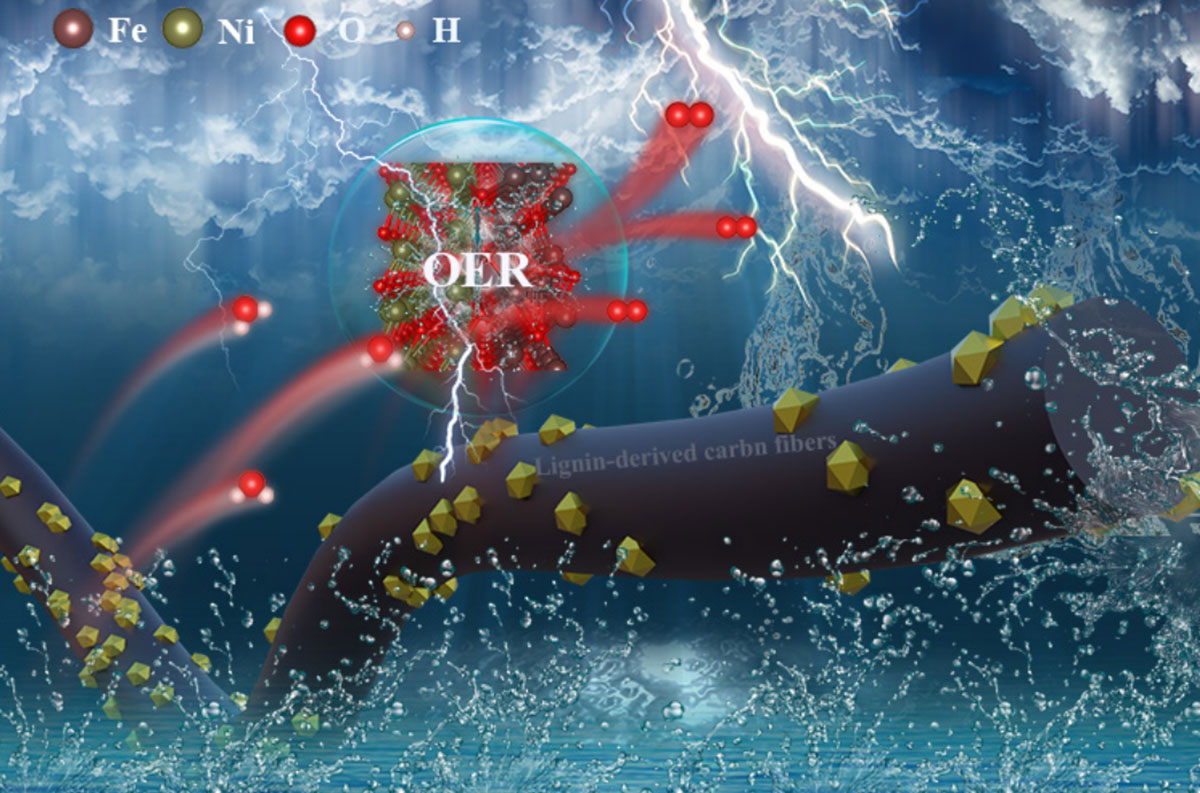
High-resolution microscopy revealed that the nickel and iron oxides form a nanoscale heterojunction inside the carbon fiber network. This interface plays a crucial role in accelerating oxygen evolution by promoting balanced adsorption and release of reaction intermediates. The combination of the metal oxides with the conductive carbon support enhances electron transport and suppresses particle agglomeration, two common limitations of traditional base metal catalysts.
Electrochemical Performance and Mechanistic Insights
Electrochemical tests confirmed that the catalyst outperforms single-metal versions, particularly at high current densities needed for practical water electrolysis. The material also shows a Tafel slope of only 138 mV per decade, indicating faster kinetics. In situ Raman measurements and density functional theory calculations support the proposed mechanism, revealing that the engineered interface facilitates key steps in the oxygen evolution pathway.
“Our goal was to develop a catalyst that not only performs well but is scalable and rooted in sustainable materials,” said co-corresponding author Xueqing Qiu. “Because lignin is produced in huge quantities worldwide, the approach offers a realistic path toward greener industrial hydrogen production technologies.”
The study highlights the growing potential of biomass-derived materials in energy conversion systems. By combining renewable carbon supports with rational engineering of metal oxide interfaces, the approach aligns with global efforts to develop low-cost and environmentally friendly solutions for clean energy.
The researchers believe that the strategy can be extended to other metal combinations and catalytic processes, opening new possibilities for designing next-generation electrocatalysts from abundant natural resources.
Reference: Lignin-derived carbon fibers loaded with NiO/Fe3O4 to promote oxygen evolution reaction” by Xuezhi Zeng1 Yutao Pan, Yi Qi, Yanlin Qin and Xueqing Qiu, 27 November 2025, Biochar X.
DOI: 10.48130/bchax-0025-0011
Never miss a breakthrough: Join the SciTechDaily newsletter.
Follow us on Google and Google News.
1 Comment
Could, but will it…?