
Close Menu
    Facebook X (Twitter) Instagram
    SciTechDaily
    • Biology
    • Chemistry
    • Earth
    • Health
    • Physics
    • Science
    • Space
    • Technology
    Facebook X (Twitter) Pinterest YouTube RSS
    SciTechDaily
    Home»Technology»Past the Breaking Point: Surprising Research May Help Prevent Damage to Industrial Parts
    Technology

    Past the Breaking Point: Surprising Research May Help Prevent Damage to Industrial Parts

    By Institute of Industrial Science, University of TokyoOctober 11, 2022No Comments3 Mins Read
    Facebook Twitter Pinterest Telegram LinkedIn WhatsApp Email Reddit
    Share
    Facebook Twitter LinkedIn Pinterest Telegram Email Reddit
    Past the Breaking Point
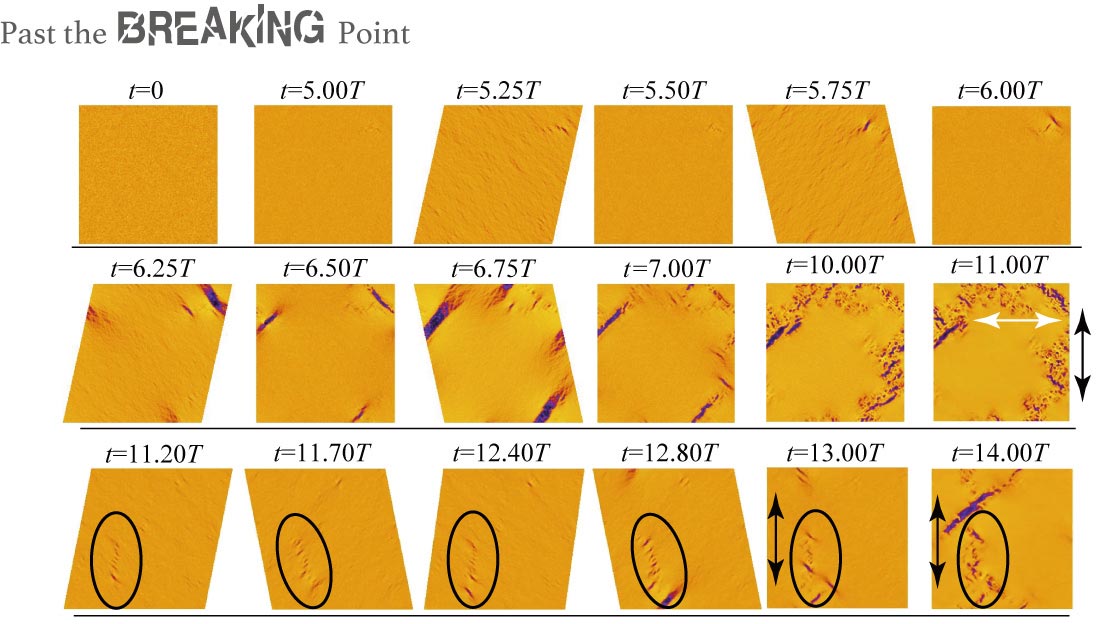
    Scientists simulated fractures in amorphous materials due to both cyclic fatigue and constant stress using course-grained dynamics, and demonstrated various failure modes, which can help improve the reliability of materials. Credit: Institute of Industrial Science, The University of Tokyo

    Breakthrough in Understanding Material Fatigue

    When industrial parts are damaged, it can be very expensive and result in delays. Plus, it could leave a plant unsafe for workers. Scientists from Japan have now simulated fracture initiated in materials that share a specific physical characteristic and are widely used across domestic, industrial, and scientific applications. Their work showed surprising results that may help prevent damage to industrial parts.

    If you’ve ever been bored in a meeting and tried playing with a metal paperclip to pass the time, you may have noticed something surprising. Although the paperclip starts flexible and returns to its original shape several times, after enough cycles it may suddenly snap. This is an example of “fatigue,” in which cracks and defects build up as an object is subjected to cyclic loading and unloading of stress.

    “Contrary to the common belief, we showed that the critical strain in disorder materials that corresponds with the onset of irreversible deformation is the same for both fatigue and monotonic fractures.” Yuji Kurotani

    Material fatigue is a significant concern in many industrial applications. It is especially crucial for machine or airplane parts that experience many cycles of stress, yet whose sudden failure could be catastrophic. As a result, obtaining a better understanding of the underlying process of material fatigue could have substantial benefits, especially for non-crystalline materials.

    Investigating Fracture Mechanics in Amorphous Materials

    Now, a group of scientists at the Institute of Industrial Science, The University of Tokyo, studied the physical mechanisms of low-cycle fatigue fracture in the case of amorphous solids, such as glass or plastics, using computer simulations. For crystalline materials, it has been shown that preexisting defects and grain boundaries can initiate a fracture because of fatigue. However, the corresponding mechanism in amorphous materials is not well understood. While it seems intuitive that the stress required for a fracture to occur is much smaller for cyclic stresses compared with constant stress, this was not what the scientists found.

    “Contrary to the common belief, we showed that the critical strain in disorder materials that corresponds with the onset of irreversible deformation is the same for both fatigue and monotonic fractures,” says co-author Yuji Kurotani.

    Density Fluctuations and Cavitation in Amorphous Systems

    This is because, for ordinary amorphous systems, higher density leads to more elasticity and slower dynamics. This density dependence of mechanical properties couples the shear deformation with density fluctuations. The cyclic shear can then amplify density fluctuations until the sample breaks via cavitation, in which voids are produced.

    “This situation is like a crowded train,” says co-author Hajime Tanaka. “Dynamic and elastic asymmetries with respect to density changes can lead to a link between shear deformation and density fluctuations.”

    According to the authors or the study, these results should be confirmed with experiments, which would also help material scientists better understand the initiation of fractures.

    Reference: “Fatigue fracture mechanism of amorphous materials from a density-based coarse-grained model” by Yuji Kurotani and Hajime Tanaka, 11 October 2022, Communications Materials.
    DOI: 10.1038/s43246-022-00293-9

    Never miss a breakthrough: Join the SciTechDaily newsletter.
    Follow us on Google and Google News.

    Industrial Engineering Materials Science University of Tokyo
    Share. Facebook Twitter Pinterest LinkedIn Email Reddit

    Related Articles

    Smart Glass Has a Bright Future: Daylight Steering Provide Huge Energy Savings

    Energy-Saving Gas Turbines Made by 3D Printer

    Polarized Photovoltaic Properties Emerge in 2D Materials – May Be Superior to Current Solar Cells

    An Organic Material for Next Generation Energy-Efficient HVAC Technologies

    Solution to Puzzling Phenomenon of Strangely Beautiful, Vortex-Like Structures May Improve Cold Spray Efficiency

    Scientists Invent New Glue That’s Activated by Magnetic Field – Saves on Energy, Time and Space

    Direct Solar Steam Generation: Harvesting the Sun’s Energy for Clean Drinking Water

    Progress Toward a Universal Theory of Glass Formation

    Plant-Based Nanowire Spray Could Be Used to Improve N95 Mask Filters, Energy Harvesters

    Leave A Reply Cancel Reply

    • Facebook
    • Twitter
    • Pinterest
    • YouTube

    Don't Miss a Discovery

    Subscribe for the Latest in Science & Tech!

    Trending News

    Largest-Ever Study Finds Medicinal Cannabis Ineffective for Anxiety, Depression, PTSD

    250-Million-Year-Old Egg Solves One of Evolution’s Biggest Mysteries

    Living With Roommates Might Be Changing Your Gut Microbiome Without You Knowing

    Century-Old Cleaning Chemical Linked to 500% Increased Risk of Parkinson’s Disease

    What if Your Memories Never Happened? Physicists Take a New Look at the Boltzmann Brain Paradox

    One of the Universe’s Largest Stars May Be Getting Ready To Explode

    Scientists Discover Enzyme That Could Supercharge Ozempic-Like Weight Loss Drugs

    Popular Sweetener Linked to DNA Damage – “It’s Something You Should Not Be Eating”

    Follow SciTechDaily
    • Facebook
    • Twitter
    • YouTube
    • Pinterest
    • Newsletter
    • RSS
    SciTech News
    • Biology News
    • Chemistry News
    • Earth News
    • Health News
    • Physics News
    • Science News
    • Space News
    • Technology News
    Recent Posts
    • Scientists Say This Overlooked Organ Could Hold the Key to Longer Life
    • Want Less Stress? Landmark Study Points to a Simple Habit
    • Scientists Reveal Eating Fruits and Vegetables May Increase Your Risk of Lung Cancer
    • AI Reveals Explosive Growth of Floating Algae Across the World’s Oceans
    • 5.5 Million Bees Discovered Living Beneath a New York Cemetery
    Copyright © 1998 - 2026 SciTechDaily. All Rights Reserved.
    • Science News
    • About
    • Contact
    • Editorial Board
    • Privacy Policy
    • Terms of Use

    Type above and press Enter to search. Press Esc to cancel.