
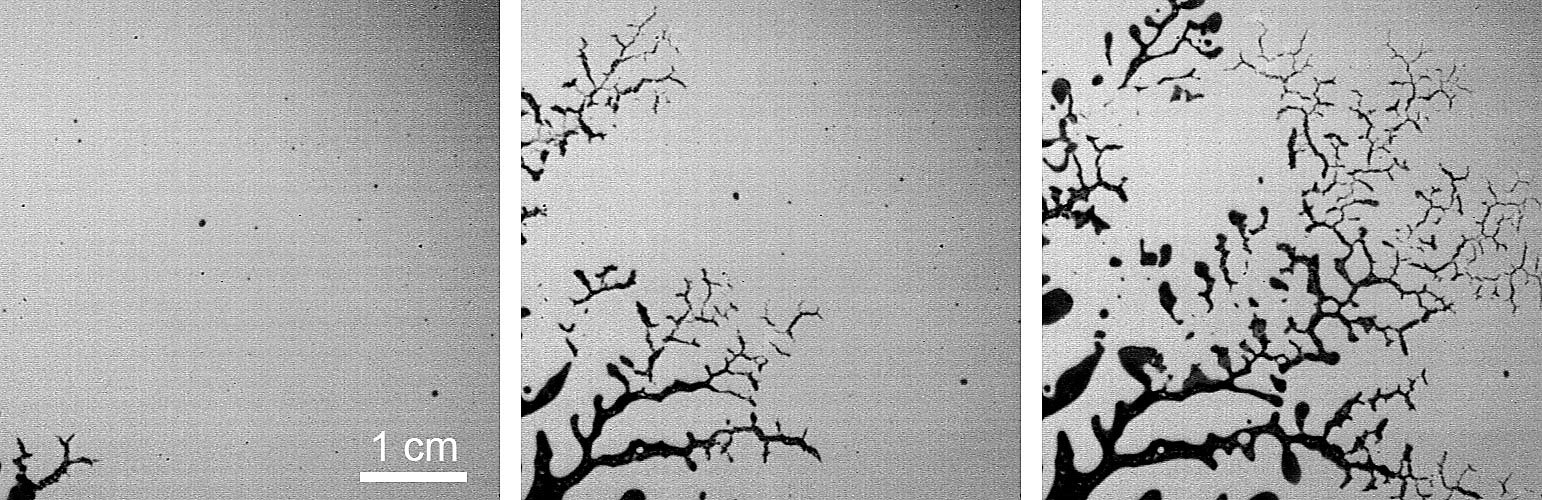
Swansea University researchers from the College of Engineering have captured the moments a fluid reacts like a solid through a new method of fluid observation under pressurized conditions.
The research comes from the Complex Flow Lab, based within the Institute for Innovative Materials, Processing, and Numerical Technologies (IMPACT). The lab studies the intricate flow patterns that often develop in granular materials, porous media, and complex fluids such as foams, gels, and pastes.
This latest study looks at fluids that have a solid-like response to stress, a phenomenon called Discontinuous Shear Thickening (DST). This is when liquid (in this case, a corn starch mixture) abruptly thickens and becomes solid when disturbed.
The tests involved a new method of observation involving a high-speed camera with results offering an innovative approach to future engineering practices.
Fluids that have a solid-like response to stress: a phenomenon called Discontinuous Shear Thickening (DST), captured by Swansea University researchers. This footage shows viscous fingering. When the concentration of cornflour and the pressure of air were both high enough to force a DST response, we observed the air invading through narrow branching fractures, indicating the fluid was behaving like a solid. This footage is filmed at 1000 frames per second but shown at 24 frames per second. So each second of displayed video is equivalent to 0.024 seconds of real time. Credit: IMPACT, Swansea University
Research author Dr. Deren Ozturk, who recently completed his Ph.D. in this area, comments:
“Our findings are of particular interest to the burgeoning DST field of research as it is a novel visual indication of DST behavior that could be used to calibrate future theoretical models. The DST phenomenon is being researched for unique engineering applications such as soft body armor, “smart” speed bumps, and food production.
The research team used regular kitchen corn starch mixed with water. This is then placed in a narrow cell; pressurized air is released into the corn starch-water fluid and forces its way through.
How the air escapes is filmed using a high-speed camera to visualize invasion patterns — which either present as fluid-like fingers or solid-like fractures depending on the concentration of corn starch and the pressure in the air.”
Dr. Ozturk continues:
“We used corn starch (as a model system for the wider class of shear thickening materials) as it is convenient, widely available and shows a dramatic shear thickening response. As this kind of invasion experiment (which we have a lot of experience with) had not been previously performed on a DST fluid, our main objective was to just try them in the hopes of seeing something interesting.
Our main hypothesis was that the fluid would “fracture” like a solid if given enough stress. This would be a great thing to see since a fluid ought to exhibit wide finger patterns. We were, therefore, delighted to see a narrow fracturing response as this meant we had developed a new kind of experiment to probe the conditions for which DST is observed.”

Co-author Dr. Bjornar Sandnes, head of the Complex Flow Lab, comments:
“What is particularly interesting about the corn starch studied here is that friction can be turned on or off like a switch.
When only gently disturbed, the grains repel each other and since they are not in contact there is no friction and the material flows like a liquid.
Disturb it more forcefully however, and the grains are pushed into contact such that friction stops the grains freely sliding. The material then behaves more like a solid, and that is when we observe fracturing in our experiments.”
The paper is published in Communications Physics. It is part of the project: Frictional flow patterns shaped by viscous and capillary forces (FriicFlow), funded by EPSRC – a study examining how friction between grains carried by a fluid changes the flow behavior of the fluid.
Reference: “Flow-to-fracture transition and pattern formation in a discontinuous shear thickening fluid” by Deren Ozturk, Miles L. Morgan and Bjørnar Sandnes, 3 July 2020, Communications Physics.
DOI: 10.1038/s42005-020-0382-7
It is a collaboration between Swansea University (IMPACT), University of Oxford and PoreLab Centre of Excellence in Norway.
The IMPACT operation is part-funded by the European Regional Development Fund through the Welsh Government and Swansea University.
Never miss a breakthrough: Join the SciTechDaily newsletter.
Follow us on Google and Google News.