
Close Menu
    Facebook X (Twitter) Instagram
    SciTechDaily
    • Biology
    • Chemistry
    • Earth
    • Health
    • Physics
    • Science
    • Space
    • Technology
    Facebook X (Twitter) Pinterest YouTube RSS
    SciTechDaily
    Home»Physics»COVID-19 Warning: Humid Air Can Extend Lifetime of Virus-Laden Aerosol Droplets
    Physics

    COVID-19 Warning: Humid Air Can Extend Lifetime of Virus-Laden Aerosol Droplets

    By American Institute of Physics,August 18, 20203 Comments3 Mins Read
    Facebook Twitter Pinterest Telegram LinkedIn WhatsApp Email Reddit
    Share
    Facebook Twitter LinkedIn Pinterest Telegram Email Reddit
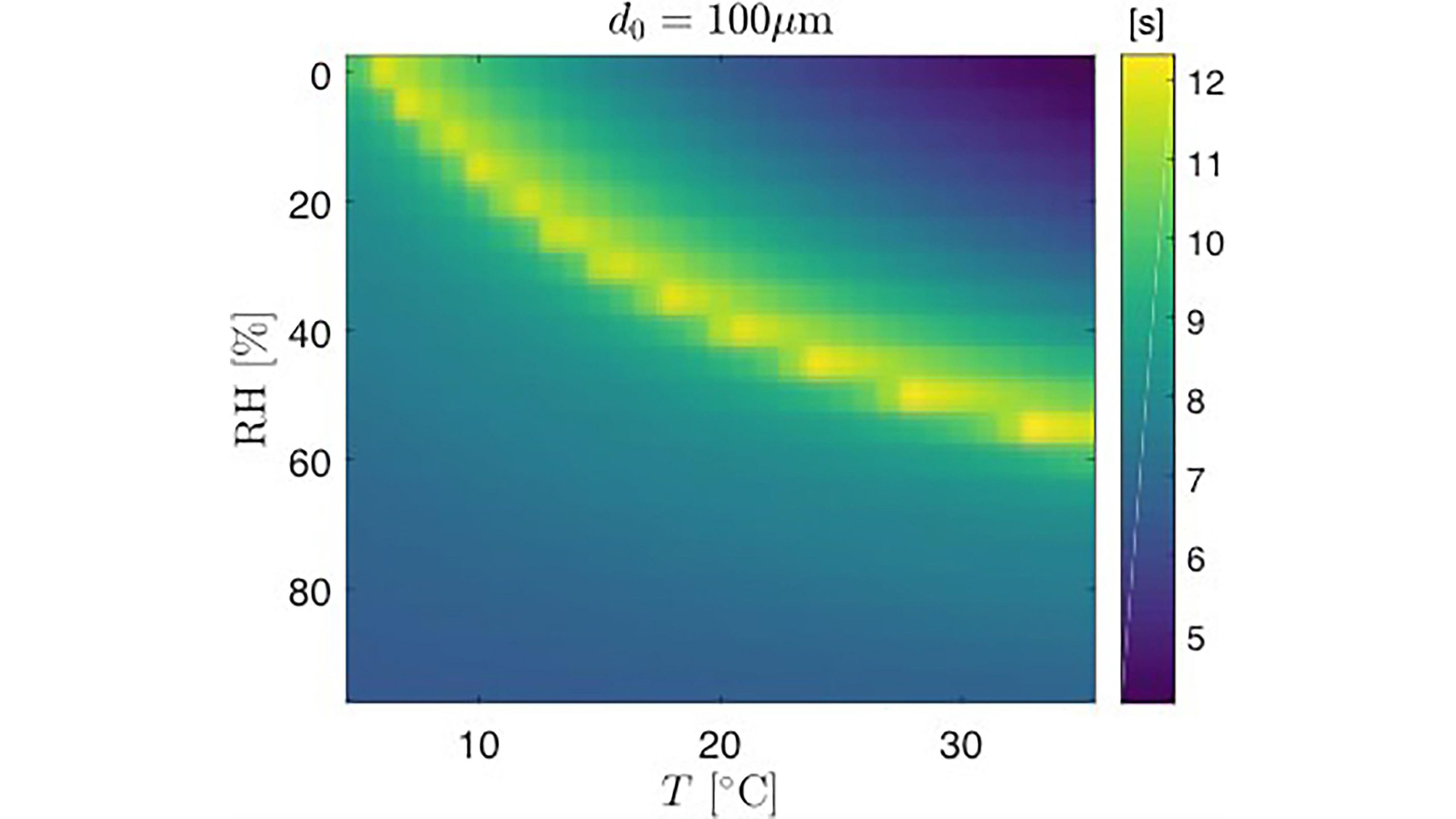
    Free-Falling 100-Micron Droplet Color Map
    Color map showing the amount of time a free-falling 100-micron droplet at an initial height of 1.6 meters is affected by temperature and humidity. For relative humidities (RH) and temperatures (T) below the yellow arc, the droplet will fall to the ground in the number of seconds indicated by the color scale; above the arc, the droplet will completely evaporate in air, never reaching the ground. Credit: Binbin Wang

    Scientists report a detailed model of aerosol transport through air, considering several environmental conditions, such as temperature, humidity and ambient flow.

    The novel coronavirus that causes COVID-19 is thought to spread through natural respiratory activities, such as breathing, talking, and coughing, but little is known about how the virus is transported through the air.

    University of Missouri scientists report, in Physics of Fluids, by AIP Publishing, on a study of how airflow and fluid flow affect exhaled droplets that can contain the virus. Their model includes a more accurate description of air turbulence that affects an exhaled droplet’s trajectory.

    Calculations with their model reveal, among other things, an important and surprising effect of humid air. The results show high humidity can extend the airborne lifetime of medium-sized droplets by as much as 23 times.

    Droplets exhaled in normal human breath come in a range of sizes, from about one-tenth of a micron to 1,000 microns. For comparison, a human hair has a diameter of about 70 microns, while a typical coronavirus particle is less than one-tenth of a micron. The most common exhaled droplets are about 50 to 100 microns in diameter.

    The droplets exhaled by an infectious individual contain virus particles as well as other substances, such as water, lipids, proteins, and salt. The research considered not just transport of droplets through the air but also their interaction with the surrounding environment, particularly through evaporation.

    The investigators used an improved description of air turbulence to account for natural fluctuations in air currents around the ejected droplet. They were able to compare their results to other modeling studies and to experimental data on particles similar in size to exhaled droplets. The model showed good agreement with data for corn pollen, which has a diameter of 87 microns, approximately the same size as most of the exhaled droplets.

    Humidity affects the fate of exhaled droplets, since dry air can accelerate natural evaporation. In air with 100% relative humidity, the simulations show larger droplets that are 100 microns in diameter fall to the ground approximately 6 feet from the source of exhalation. Smaller droplets of 50 microns in diameter can travel further, as much as 5 meters, or about 16 feet, in very humid air.

    Less humid air can slow the spread. At a relative humidity of 50%, none of the 50-micron droplets traveled beyond 3.5 meters.

    The investigators also looked at a pulsating jet model to mimic coughing.

    “If the virus load associated with the droplets is proportional to the volume, almost 70% of the virus would be deposited on the ground during a cough,” said author Binbin Wang. “Maintaining physical distance would significantly remediate the spread of this disease through reducing deposition of droplets onto people and through reducing the probability of inhalation of aerosols near the infectious source.”

    Reference: “Transport and fate of human expiratory droplets – a modeling approach” by Binbin Wang, Huijie Wu and Xiu-Feng Wan, 18 August 2020, Physics of Fluids.
    DOI: 10.1063/5.0021280

    Never miss a breakthrough: Join the SciTechDaily newsletter.
    Follow us on Google and Google News.

    American Institute of Physics Biomechanics Biophysics Popular Virology
    Share. Facebook Twitter Pinterest LinkedIn Email Reddit

    Related Articles

    Deactivating COVID-19 Virus Cough Droplets With UV-C Lamps

    SARS vs. COVID-19: Why Some Coronavirus Strains Are More Infectious Than Others

    New Fastener With Microscopic Mushroom Shapes Could Be an Improved Version of Velcro

    Egg Experiment Reveals Scrambling of the Brain on Impact to Find Answers About Concussions

    New Testing Shows Masks Not Enough to Stop COVID-19’s Spread Without Social Distancing

    COVID Face Shields No Match for Sneeze Vortex Rings

    COVID-19 Warning: Flushing Public Restroom Toilets Can Spew Clouds of Particles Carrying Viruses

    Yikes! Flushing Toilets Create Long-Lasting Clouds of Virus-Containing Particles

    Yikes! Saliva Droplets From Mild Cough Travel Up to 18 Feet

    3 Comments

    1. james moore on August 19, 2020 6:52 am

      Should we have a dehumidifier in every classroom?

      Reply
    2. kay iversen on December 15, 2020 12:45 pm

      Regarding the study on viral droplets traveling farther in humid air than in dry air – then isn’t the advice to open as many doors & windows as possible counter productive, especially in wet weather?Because that definitely increases humidity indoors.

      Reply
    3. KJ on December 16, 2020 7:11 am

      No where, in these articles, does it say how long these ‘infectious’ COVID particles are ‘infectious’ for ??

      Reply
    Leave A Reply Cancel Reply

    • Facebook
    • Twitter
    • Pinterest
    • YouTube

    Don't Miss a Discovery

    Subscribe for the Latest in Science & Tech!

    Trending News

    289-Million-Year-Old Reptile Mummy Reveals Origin of Human Breathing System

    New Brain Discovery Challenges Long-Held Theory of Teenage Brain Development

    Scientists Discover Plants “Scream” – We Just Couldn’t Hear Them Until Now

    Scientists Discover a Surprising Reason Intermittent Fasting Extends Life

    This Simple Fruit Wash Could Make Produce Safer and Last Days Longer

    Scientists Say Adding This Unusual Seafood to Your Diet Could Reverse Signs of Aging

    Scientists Say a Hidden Structure May Exist Inside Earth’s Core

    Doctors Surprised by the Power of a Simple Drug Against Colon Cancer

    Follow SciTechDaily
    • Facebook
    • Twitter
    • YouTube
    • Pinterest
    • Newsletter
    • RSS
    SciTech News
    • Biology News
    • Chemistry News
    • Earth News
    • Health News
    • Physics News
    • Science News
    • Space News
    • Technology News
    Recent Posts
    • Missing Medieval Relic of Legendary English King Found After Being Missing for 40 Years
    • New Study Challenges Long-Held Assumptions About Cancer and Aging
    • Major Review Finds Alzheimer’s Amyloid Drugs Offer No Real Benefit
    • Could This New Weight-Loss Pill Disrupt the Entire Market? Here’s What You Should Know About Orforglipron
    • Nearly 1 in 5 Gray Whales That Enter San Francisco Bay Die There
    Copyright © 1998 - 2026 SciTechDaily. All Rights Reserved.
    • Science News
    • About
    • Contact
    • Editorial Board
    • Privacy Policy
    • Terms of Use

    Type above and press Enter to search. Press Esc to cancel.