
Close Menu
    Facebook X (Twitter) Instagram
    SciTechDaily
    • Biology
    • Chemistry
    • Earth
    • Health
    • Physics
    • Science
    • Space
    • Technology
    Facebook X (Twitter) Pinterest YouTube RSS
    SciTechDaily
    Home»Science»A Lurking Threat: Beating the “Billion-Dollar Bug” Is a Shared Burden
    Science

    A Lurking Threat: Beating the “Billion-Dollar Bug” Is a Shared Burden

    By Ecological Society of AmericaJanuary 16, 20211 Comment3 Mins Read
    Facebook Twitter Pinterest Telegram LinkedIn WhatsApp Email Reddit
    Share
    Facebook Twitter LinkedIn Pinterest Telegram Email Reddit
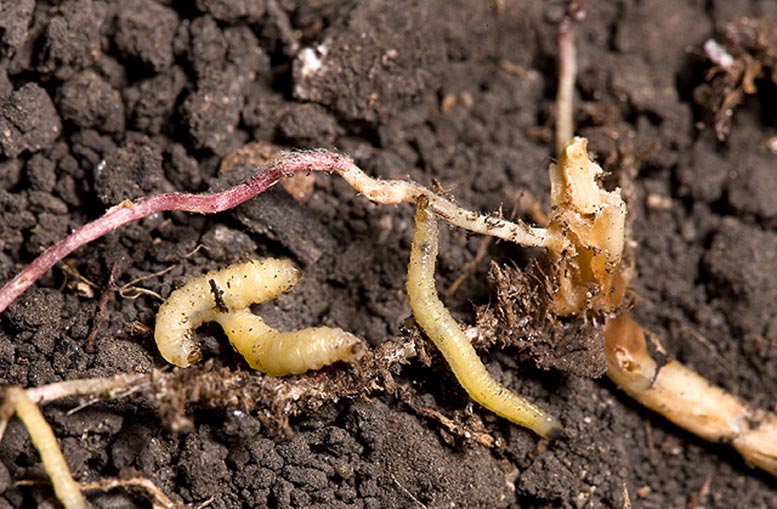
    Western Corn Rootworm Larvae
    Larvae of western corn rootworm, Diabrotica virgifera virgifera, feeding on corn roots. Credit: Photo by Stephen Ausmus, USDA Agricultural Research Service

    Study shows how individual farming practices associated with greater corn rootworm damage can have farther-reaching effects.

    A lurking threat that has stymied US corn growers for decades is now returning to the forefront: western corn rootworm. Sometimes referred to as the “billion-dollar bug,” the species’ tiny larvae chew through the roots of corn plants, causing devastating yield losses. In 2003, farmers began planting a genetically engineered variety of corn known as “Bt,” which produces a protein toxic to the pest species – but by 2009, the billion-dollar bug had already evolved adaptations for resistance to the toxin.

    A new study suggests that slowing the resurgence of western corn rootworm may require a larger-scale strategy than previously thought. The findings, which were published in the Ecological Society of America’s journal Ecological Applications, show that when farmers do not follow best management practices for mitigating corn rootworm within a field, they also jeopardize surrounding fields.

    Iowa Corn Field
    Corn rows as far as the eye can see in Buchanan County, Iowa. Credit: Original image from Carol M. Highsmith’s America, Library of Congress collection. Digitally enhanced by rawpixel.

    Primary author Coy St. Clair and his colleague Aaron Gassmann pinpointed 64 “problem fields” across Iowa, where western corn rootworm had caused greater-than-expected levels of injury to corn between 2009 and 2013 in two varieties of Bt maize: Cry3Bb1 and mCry3A. Compared to fields where rootworm had not damaged Bt maize, the problem fields had higher levels of continuous maize cultivation in surrounding buffer areas.

    Crop Rotation: A Proven Yet Underused Tool

    Regular crop rotation is a key strategy for interfering with rootworm’s life cycle: when rootworm eggs hatch in a field without corn, the larvae starve before they have a chance to mature and lay eggs. However, continuous planting of corn tends to be more profitable in the short term, leaving corn growers with difficult decisions about how to manage risks.

    St. Clair, now a research entomologist for Genective (Champaign, Ill.) who conducted the research as a Ph.D. student at Iowa State University, says that the story of western corn rootworm resistance to Bt illustrates that pest mitigation is a shared responsibility. “If the pest remains susceptible, everyone benefits. If resistance develops, everyone suffers.”

    Continuous maize cultivation gives nascent rootworm populations a chance to evolve resistance to the Bt toxin – and for those newly resistant offspring to travel to other fields.

    Best Practices Protect Everyone

    “The takeaway here is that a farmer who is employing best management practices – such as frequent crop rotation, or planting of non-Bt maize – will effectively manage rootworm and delay resistance in their own field firstly, while simultaneously helping to delay resistance development in surrounding populations secondly,” explained St. Clair. “Conversely, a farmer who is planting multiple years of the same trait will risk resistance in their own field, while contributing to the depletion of the shared resource of trait susceptibility.”

    As of 2020, agronomists have confirmed that populations of western corn rootworm resistant to the two Bt traits examined in the study are present across the US corn belt, along with two additional Bt traits.  

    Reference: “Linking land use patterns and pest outbreaks in Bt maize” by Coy R. St. Clair and Aaron J. Gassmann, 11 January 2021, Ecological Applications.
    DOI: 10.1002/eap.2295

    Never miss a breakthrough: Join the SciTechDaily newsletter.
    Follow us on Google and Google News.

    Agriculture Ecology Entomology
    Share. Facebook Twitter Pinterest LinkedIn Email Reddit

    Related Articles

    Feeding Cattle a Bit of Seaweed Reduces Their Greenhouse Gas Emissions 82%

    Prolonged Exposure to Weedkiller Roundup Can Cause Significant Harm to Keystone Species

    Keeping California a Powerhouse of Almond Production While Improving Environmental Quality

    Better Health – For People and the Planet – Grows on Tropical Fruit Trees

    Scientists Predict Potential Spread of Invasive Asian Giant “Murder” Hornet Through United States and Globally

    Natural Pest Control: Biological Control of Insect Pests Is Saving Farmers Billions of Dollars

    Deadly Virus Turns Honey Bees Into Trojan Horses, Rapidly Spreading the Infection to Healthy Hives

    Herbicide Overuse Costs UK Economy £400 Million per Year

    Helpful Insects and Their Response to Agricultural Landscape Changes

    1 Comment

    1. stephen schaffer on January 17, 2021 8:31 am

      “or planting of non-Bt maize” This was a weird phrase. No where in the article was their an implication that the bug exclusively fed on BT corn.

      Reply
    Leave A Reply Cancel Reply

    • Facebook
    • Twitter
    • Pinterest
    • YouTube

    Don't Miss a Discovery

    Subscribe for the Latest in Science & Tech!

    Trending News

    One of the Universe’s Largest Stars May Be Getting Ready To Explode

    Scientists Discover Enzyme That Could Supercharge Ozempic-Like Weight Loss Drugs

    Popular Sweetener Linked to DNA Damage – “It’s Something You Should Not Be Eating”

    Ancient “Rock” Microbes May Reveal How Complex Life Began

    Researchers Capture Quantum Interference in One of Nature’s Rarest Atoms

    “A Plague Is Upon Us”: The Mass Death That Changed an Ancient City Forever

    Scientists Discover Game-Changing New Way To Treat High Cholesterol

    This Small Change to Your Exercise Routine Could Be the Secret to Living Longer

    Follow SciTechDaily
    • Facebook
    • Twitter
    • YouTube
    • Pinterest
    • Newsletter
    • RSS
    SciTech News
    • Biology News
    • Chemistry News
    • Earth News
    • Health News
    • Physics News
    • Science News
    • Space News
    • Technology News
    Recent Posts
    • Scientists Prove There Are Just Six Degrees of Separation in a Social Network
    • Bee Bacteria Could Fix a Major Flaw in Plant-Based Milk
    • Scientists Discover a Surprising Way To Make Bread Healthier and More Nutritious
    • Natural Compounds Boost Bone Implant Success While Killing Bacteria and Cancer Cells
    • After 60 Years, Scientists Uncover Unexpected Brain Effects of Popular Diabetes Drug Metformin
    Copyright © 1998 - 2026 SciTechDaily. All Rights Reserved.
    • Science News
    • About
    • Contact
    • Editorial Board
    • Privacy Policy
    • Terms of Use

    Type above and press Enter to search. Press Esc to cancel.