
Close Menu
    Facebook X (Twitter) Instagram
    SciTechDaily
    • Biology
    • Chemistry
    • Earth
    • Health
    • Physics
    • Science
    • Space
    • Technology
    Facebook X (Twitter) Pinterest YouTube RSS
    SciTechDaily
    Home»Space»Philae Lander Makes Historic First Landing on Comet 67P
    Space

    Philae Lander Makes Historic First Landing on Comet 67P

    By DC Agle/Guy Webster, Jet Propulsion LaboratoryNovember 13, 2014No Comments3 Mins Read
    Facebook Twitter Pinterest Telegram LinkedIn WhatsApp Email Reddit
    Share
    Facebook Twitter LinkedIn Pinterest Telegram Email Reddit
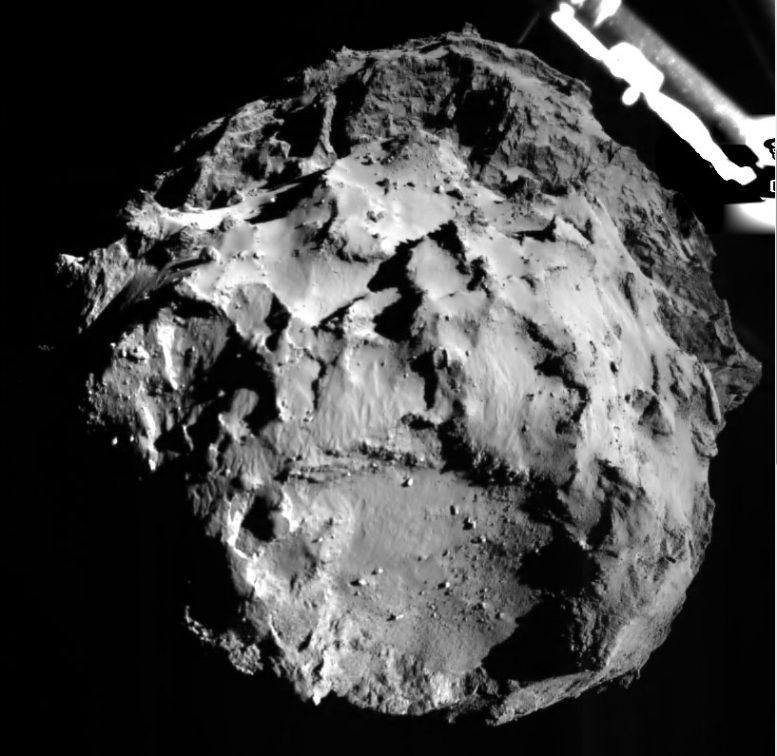
    Philae Makes Historic First Landing on a Comet
    This image of comet 67P/Churyumov–Gerasimenko was taken by the Philae lander of the European Space Agency’s Rosetta mission during Philae’s descent toward the comet on November 12, 2014. Philae’s ROLIS camera took the image from a distance of approximately two miles (three kilometers) from the surface. Credit: ESA/Rosetta/Philae/DLR

    After more than a decade in space, ESA’s Philae lander has made the first-ever soft landing of a spacecraft on a comet.

    Mission controllers at ESA’s mission operations center in Darmstadt, Germany, received a signal confirming that the Philae lander had touched down on comet 67P/Churyumov-Gerasimenko on Wednesday, November 12, just after 8 a.m. PST/11 a.m. EST.

    The following statement is from John Grunsfeld, astronaut and associate administrator for NASA’s Science Mission Directorate in Washington, about the successful comet landing by the European Space Agency’s Rosetta spacecraft:

    “We congratulate ESA on their successful landing on a comet today. This achievement represents a breakthrough moment in the exploration of our solar system and a milestone for international cooperation. We are proud to be a part of this historic day and look forward to receiving valuable data from the three NASA instruments on board Rosetta that will map the comet’s nucleus and examine it for signs of water.

    “The data collected by Rosetta will provide the scientific community, and the world, with a treasure-trove of data. Small bodies in our solar system like comets and asteroids help us understand how the solar system formed and provide opportunities to advance exploration. We look forward to building on Rosetta’s success exploring our solar system through our studies of near-Earth asteroids and NASA’s upcoming asteroid sample return mission OSIRIS-REx. It’s a great day for space exploration.”

    The lander is expected to send images from its landing site, named Agilkia. These will be the first images ever taken from a comet’s surface. Philae will also drill into the surface to study the composition, and witness close up how a comet changes as its exposure to the sun varies. With its primary battery, Philae will remain active on the surface for about two-and-a-half days. Philae’s mothership, the Rosetta spacecraft, will remain in orbit around the comet through 2015. The orbiter will continue detailed studies as the comet approaches the sun and then moves away.

    In addition to their well-deserved reputation as beautiful cosmic objects, comets hold vital clues about our solar system’s history. They are considered primitive building blocks of the solar system that are literally frozen in time. Comets may have played a part in “seeding” Earth with water and, possibly, the basic ingredients for life.

    NASA provided three of the 16 instruments on board the Rosetta orbiter. The NASA instruments are: the Microwave Instrument for Rosetta Orbiter (MIRO); Alice, an ultraviolet spectrometer; and the Ion and Electron Sensor (IES), which is part of a suite of five instruments. For more information on the U.S. instruments aboard Rosetta, visit: http://rosetta.jpl.nasa.gov

    Rosetta is a European Space Agency mission with contributions from its member states and NASA. Rosetta’s Philae lander is provided by a consortium led by the German Aerospace Center, Cologne; Max Planck Institute for Solar System Research, Gottingen; National Center of Space Studies of France (CNES), Paris; and the Italian Space Agency, Rome. NASA’s Jet Propulsion Laboratory in Pasadena, California, a division of the California Institute of Technology, Pasadena, manages the U.S. participation in the Rosetta mission for NASA’s Science Mission Directorate in Washington.

    Never miss a breakthrough: Join the SciTechDaily newsletter.
    Follow us on Google and Google News.

    Astronomy Comet European Space Agency Rosetta Spacecraft
    Share. Facebook Twitter Pinterest LinkedIn Email Reddit

    Related Articles

    Rosetta Views Comet 67P Making Its Closest Approach to the Sun

    Rosetta Spacecraft Views an Outburst from Comet 67P

    Rosetta Monitors Active Pits on Comet 67P

    Rosetta and Philae Reveal That Comet 67P is Not Magnetized

    Philae Lander Makes Soft Landing on Comet 67P

    Rosetta Spacecraft Picks Up a Mysterious “Song” From Comet 67P

    How to Land on a Comet Moving 40 Times Faster Than a Speeding Bullet

    Rosetta Orbiter Delivers First Batch of Science Data

    ESA Identifies Five Candidate Landing Sites on Comet 67P

    Leave A Reply Cancel Reply

    • Facebook
    • Twitter
    • Pinterest
    • YouTube

    Don't Miss a Discovery

    Subscribe for the Latest in Science & Tech!

    Trending News

    Doctors May Need To Rethink Calcium and Vitamin D Recommendations After Major Review

    Scientists Discover a Hidden Cause of Cellular Aging That Can Be Reversed

    Archaeologists Have Found Something Unexpected Inside a 1,600-Year-Old Egyptian Mummy

    Scientists May Have Found a Completely New Way To Treat Depression

    New 7-Dimensional Theory May Finally Solve the Black Hole Information Paradox

    Scientists Made Older Mice Biologically Younger Using Gut Microbes

    Scientists Finally Uncover Why Ozempic Stops Working for Some People

    Wasp Colonies Explode Into Violence After Losing Their Queen

    Follow SciTechDaily
    • Facebook
    • Twitter
    • YouTube
    • Pinterest
    • Newsletter
    • RSS
    SciTech News
    • Biology News
    • Chemistry News
    • Earth News
    • Health News
    • Physics News
    • Science News
    • Space News
    • Technology News
    Recent Posts
    • Researchers Measured Alien Planet Spins and Discovered a Surprising Pattern
    • NASA’s Roman Telescope Will Search 100 Million Stars for New Worlds
    • A Cannibal Star Finally Solves One of Astronomy’s Biggest Mysteries
    • Researchers Solve the Mystery Behind a Billion-Dollar Dental Implant Disease
    • Scientists Finally Uncover How a “Forever Chemical” Causes Birth Defects
    Copyright © 1998 - 2026 SciTechDaily. All Rights Reserved.
    • Science News
    • About
    • Contact
    • Editorial Board
    • Privacy Policy
    • Terms of Use

    Type above and press Enter to search. Press Esc to cancel.