
Close Menu
    Facebook X (Twitter) Instagram
    SciTechDaily
    • Biology
    • Chemistry
    • Earth
    • Health
    • Physics
    • Science
    • Space
    • Technology
    Facebook X (Twitter) Pinterest YouTube RSS
    SciTechDaily
    Home»Physics»Physicist’s 50-Year-Old Magnetic Structure Prediction Evidenced at Surprisingly Large Scales
    Physics

    Physicist’s 50-Year-Old Magnetic Structure Prediction Evidenced at Surprisingly Large Scales

    By Institut national de la recherche scientifique - INRSJune 25, 2020No Comments3 Mins Read
    Facebook Twitter Pinterest Telegram LinkedIn WhatsApp Email Reddit
    Share
    Facebook Twitter LinkedIn Pinterest Telegram Email Reddit
    Ion Radiography Weibel Instability
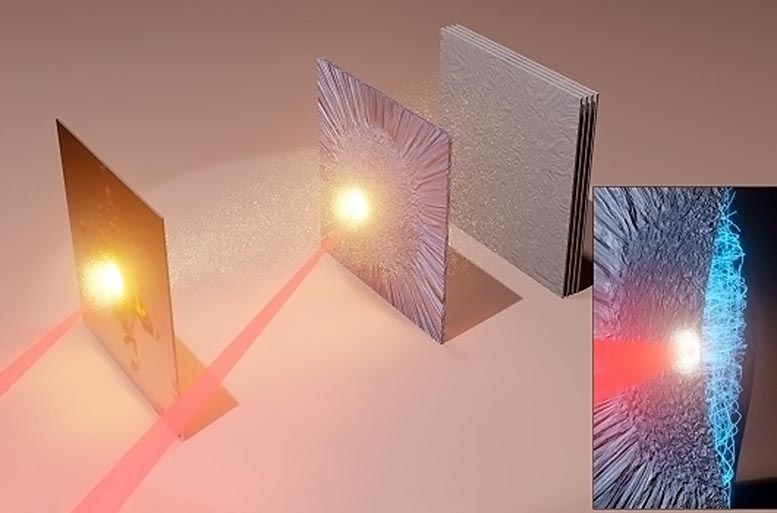
    Protons accelerated by laser-plasma interaction in a first target (left) pass through a second target, itself irradiated by another laser beam (middle and framed). The Weibel instability induced there by energetic electrons (blue trajectories) generates magnetic fluctuations that deflect the protons onto a series of sensitive films (right), producing an image of the resulting magnetic structures. Credit: David Tordeux

    Imaging Magnetic Instabilities Using Laser Accelerated Protons

    An international team of researchers highlighted two variants of Weibel’s instability.

    The magnetic structures resulting from a plasma instability predicted by the physicist Erich Weibel about 50 years ago has been evidenced at surprisingly large scales in a laser-driven plasma in the prestigious journal Nature Physics. This instability is also expected to operate in astrophysical settings where it is held responsible for the acceleration of cosmic rays and the emission of gamma photons in the famous “gamma-ray bursts.”

    Julien Fuchs, a graduate of the Institut national de la recherche scientifique (INRS) and a researcher at the Laboratoire pour l’utilisation des lasers intenses (LULI) in France, INRS Professor Patrizio Antici, a specialist in laser-driven particle acceleration, and INRS Professor Emeritus Henri Pépin have succeeded in measuring the magnetic fields produced by Weibel instabilities within a laser-driven plasma, an ionized gas. Their results were published on June 1, 2020, in the prestigious journal Nature Physics.

    The researchers used the proton radiography technique to visualize this extremely fast phenomenon. “Our protons accelerated by laser-plasma interaction are able to take a sequence of images of very fast electromagnetic phenomena, lasting a few picoseconds only and with a resolution of a few microns. This allows us to probe instabilities with precision unmatched by other imaging techniques” reports Patrizio Antici, who did his thesis under the supervision of Professor Fuchs, himself formerly under the direction of Professor Pépin.

    Patrizio Antici, INRS
    INRS Professor Patrizio Antici, a specialist in laser-driven particle acceleration. Credit: INRS

    These three generations of researchers recreated a “small-scale model” of astrophysical phenomena in the laboratory by irradiating a target with an intense laser. The magnetic fluctuations generated by the interaction can be probed by protons on a series of sensitive films, producing a sequence of images showing the temporal evolution of the magnetic structures.

    The interpretation and modeling of these structures were conducted by Laurent Gremillet and Charles Ruyer, physicists at the Commissariat à l’énergie atomique et aux énergies alternatives (CEA). After several years of hard work, combining theoretical modeling and advanced numerical simulations, they highlighted the growth of two variants of the Weibel instability according to the region of the plasma where they develop.

    With more powerful lasers, researchers will be able to reproduce and analyze even more extreme astrophysical phenomena with unrivaled resolution.

    Reference: “Growth of concomitant laser-driven collisionless and resistive electron filamentation instabilities over large spatiotemporal scales” by C. Ruyer, S. Bolaños, B. Albertazzi, S. N. Chen, P. Antici, J. Böker, V. Dervieux, L. Lancia, M. Nakatsutsumi, L. Romagnani, R. Shepherd, M. Swantusch, M. Borghesi, O. Willi, H. Pépin, M. Starodubtsev, M. Grech, C. Riconda, L. Gremillet and J. Fuchs, 1 June 2020, Nature Physics.
    DOI: 10.1038/s41567-020-0913-x

    Never miss a breakthrough: Join the SciTechDaily newsletter.
    Follow us on Google and Google News.

    Astrophysics INRS Optics Particle Physics Popular
    Share. Facebook Twitter Pinterest LinkedIn Email Reddit

    Related Articles

    Light-Speed Imager: World’s Fastest UV Camera Works at 500 Billion Frames per Second

    Breakthrough Towards Lasers Powerful Enough to Investigate a New Kind of Physics

    Radar and Ice Could Help Detect Mysterious Subatomic Particles That Pass Right Through Matter

    Using Light to Put a Twist on Electrons – Inducing Asymmetrical Patterns in Exotic Materials

    Groundbreaking Experiment: Physicists Grab Individual Atoms & Observe Complex Atomic Interactions

    Scientists Invent Way to See Fastest Motions of Electrons That Drive Chemistry for the First Time

    An Exotic Analysis Technique Places Another Piece in the Dark Matter Puzzle

    Black Holes Have Properties That Resemble the Dynamics of Solids and Liquids

    Fastest Laser Blast – 67 Quintillionths of a Second

    Leave A Reply Cancel Reply

    • Facebook
    • Twitter
    • Pinterest
    • YouTube

    Don't Miss a Discovery

    Subscribe for the Latest in Science & Tech!

    Trending News

    Scientists Discover How Coffee Impacts Memory, Mood, and Gut Health

    Why Did the Neanderthals Disappear? Scientists Reveal Humans Had a Hidden Advantage

    Physicists Propose Strange Experiment Where Time Goes Quantum

    Magnesium Magic: New Drug Melts Fat Even on a High-Fat, High-Sugar Diet

    Weight-Loss Drugs Like Ozempic May Come With an Unexpected Cost

    Mezcal “Worm” in a Bottle Mystery: DNA Testing Reveals a Surprise

    New Research Reveals That Your Morning Coffee Activates an Ancient Longevity Switch

    This Is What Makes You Irresistible to Mosquitoes

    Follow SciTechDaily
    • Facebook
    • Twitter
    • YouTube
    • Pinterest
    • Newsletter
    • RSS
    SciTech News
    • Biology News
    • Chemistry News
    • Earth News
    • Health News
    • Physics News
    • Science News
    • Space News
    • Technology News
    Recent Posts
    • Harvard Scientists Reveal Secret Structure Behind How You Smell
    • Scientists Just Discovered the Hidden Trick That Keeps Your Cells Alive
    • This Simple Movement Could Be Secretly Cleaning Your Brain
    • Male Birth Control Breakthrough: Scientists Find Way To Turn Sperm Production Off and Back On
    • A Common Vitamin Could Hold the Key to Treating Fatty Liver Disease
    Copyright © 1998 - 2026 SciTechDaily. All Rights Reserved.
    • Science News
    • About
    • Contact
    • Editorial Board
    • Privacy Policy
    • Terms of Use

    Type above and press Enter to search. Press Esc to cancel.