
Close Menu
    Facebook X (Twitter) Instagram
    SciTechDaily
    • Biology
    • Chemistry
    • Earth
    • Health
    • Physics
    • Science
    • Space
    • Technology
    Facebook X (Twitter) Pinterest YouTube RSS
    SciTechDaily
    Home»Physics»Physicists Create a Condensate of Erbium
    Physics

    Physicists Create a Condensate of Erbium

    By University of InnsbruckMay 22, 2012No Comments4 Mins Read
    Facebook Twitter Pinterest Telegram LinkedIn WhatsApp Email Reddit
    Share
    Facebook Twitter LinkedIn Pinterest Telegram Email Reddit
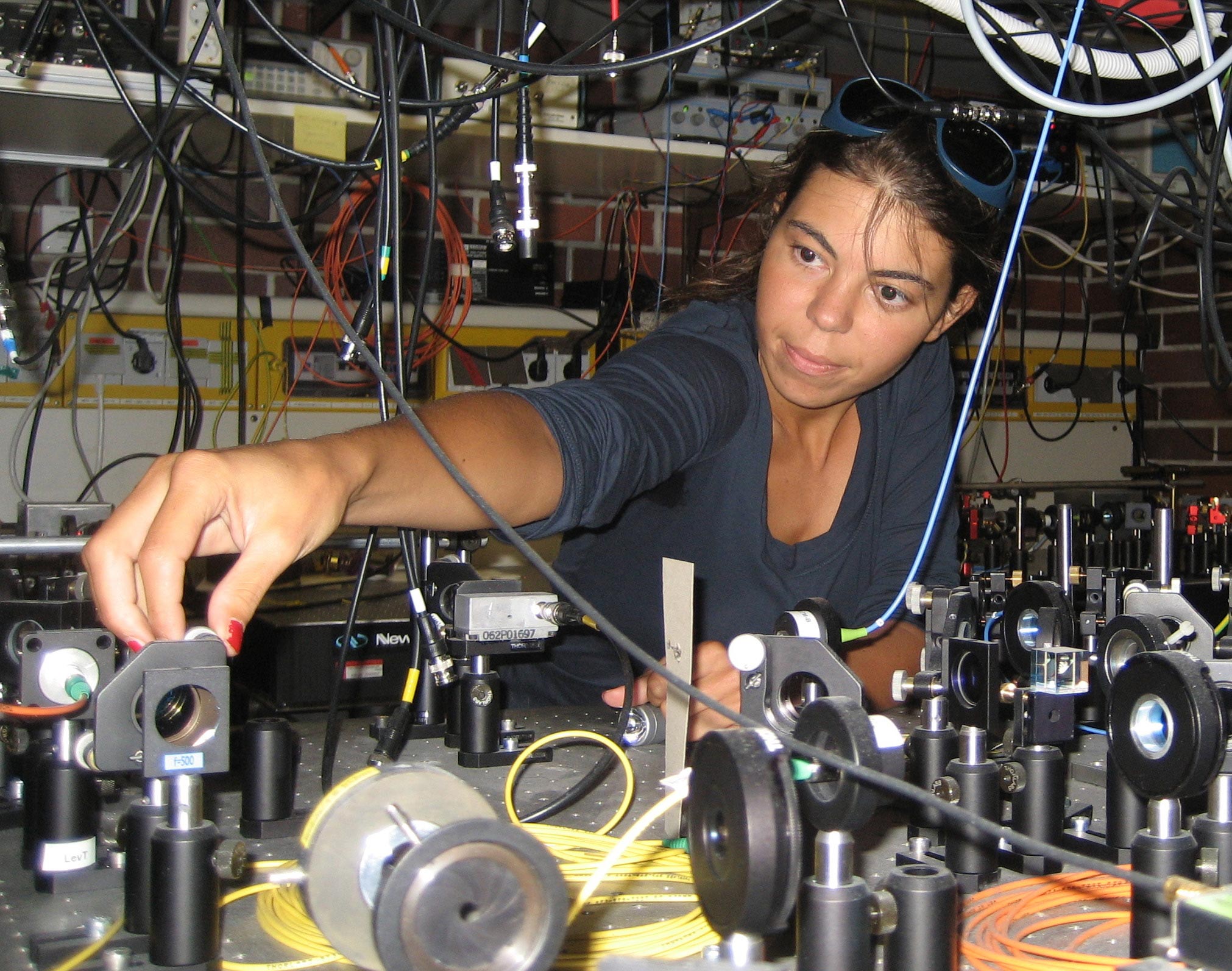
    Francesca Ferlaino
    Francesca Ferlaino in the lab. Francesca Ferlaino’s research team at the University of Innsbruck is the first to successfully create a condensate of the exotic element erbium. The Innsbruck experimental physicists hold the world record in attaining the first Bose-Einstein condensates of different chemical elements. Credit: University of Innsbruck

    A research team at the University of Innsbruck is the first to successfully create a condensate of the element erbium, making it the third chemical element that the physicists in Innsbruck have condensated successfully in the last few years.

    Ultracold quantum gases have exceptional properties and offer an ideal system to study basic physical phenomena. By choosing erbium, the research team led by Francesca Ferlaino from the Institute of Experimental Physics, University of Innsbruck, selected a very exotic element, which due to its particular properties offers new and fascinating possibilities to investigate fundamental questions in quantum physics.

    “Erbium is comparatively heavy and has a strongly magnetic character. These properties lead to an extreme dipolar behavior of quantum systems,” says Ferlaino. Together with her research group, she found a surprisingly simple way to deeply cool this complex element by means of laser and evaporative cooling techniques. At temperatures close to absolute zero, a cloud of about 70,000 erbium atoms forms a magnetic Bose-Einstein condensate.

    In a condensate, the particles lose their individual properties and synchronize their behavior. “Experiments with erbium enable us to gain new insights into the complex interaction processes of strongly correlated systems and, in particular, they offer new starting points to study quantum magnetism with cold atoms,” says Francesca Ferlaino. The young scientist was awarded the Austrian START prize in 2009 and she received an ERC (European Research Council) Starting Grant in 2010.
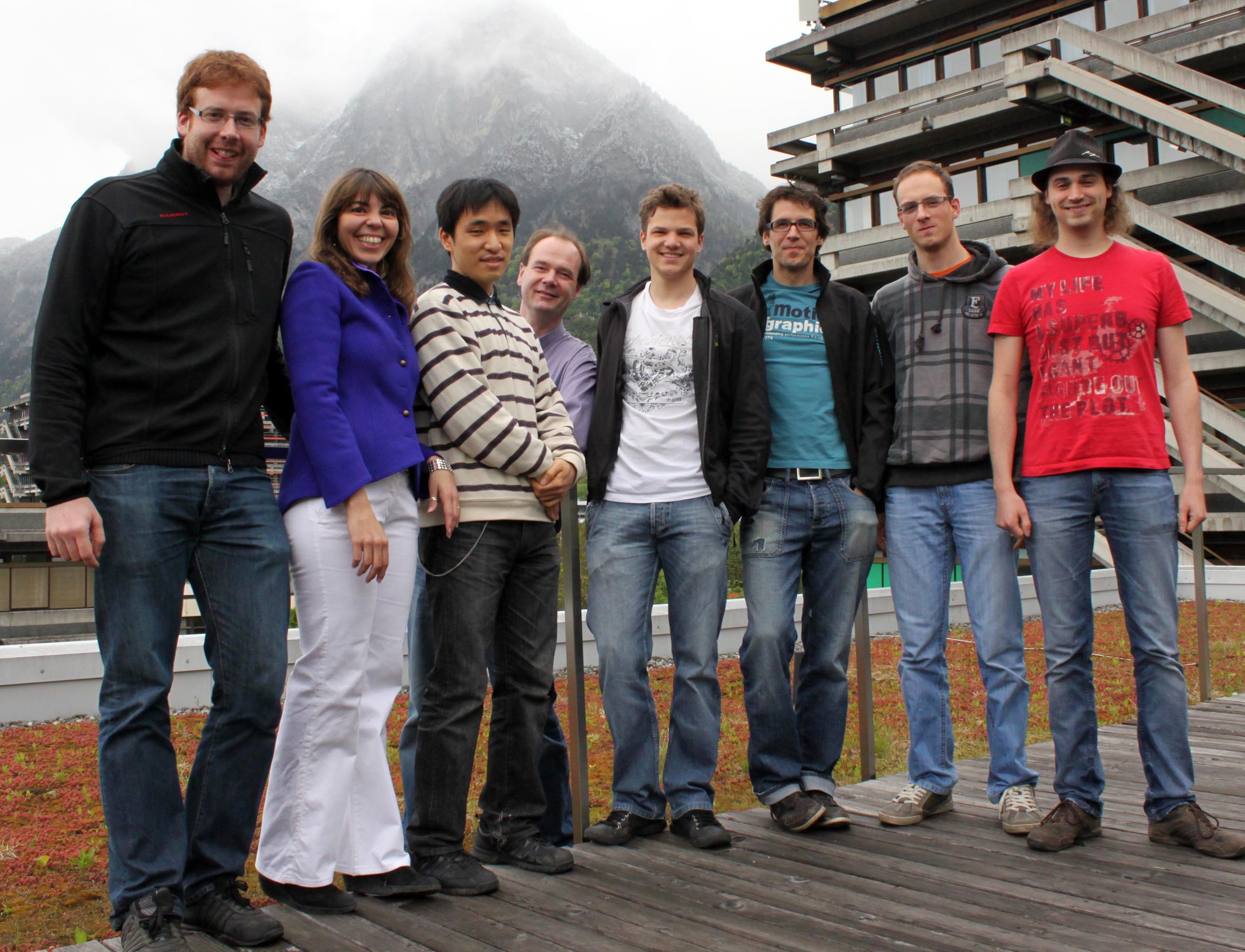
    Francesca Ferlaino and Team
    Francesca Ferlaino and her team at the University of Innsbruck. Credit: University of Innsbruck

    “With attaining the Bose-Einstein condensate barely a year after we started, we have already achieved one of the most important goals of the project,” says a proud Francesca Ferlaino.

    “This shows the importance of grants for young scientists and how crucial the support from the University of Innsbruck and the Institute for Experimental Physics has been for me and my team.” Also, Nobel laureate Eric Cornell congratulated the Innsbruck researchers: “Lovely new baby. Its parents must be very proud!”

    Quantum capital Innsbruck adds another superlative

    Cesium, strontium, and erbium are the three chemical elements that the physicists in Innsbruck have condensated successfully in the last few years. An important breakthrough was made by Rudolf Grimm and his research group in 2002 when they achieved condensation of cesium, which led to numerous scientific findings in the years to follow. START awardee Florian Schreck, a member of Rudolf Grimm’s research group, was the first to realize a condensate of strontium in 2009. And now Francesca Ferlaino accomplished this feat with the element erbium. Until now a total of 13 elements have been condensated worldwide.

    Ten of these condensates were created by ten different international research groups. In 2001 Eric Cornell, Wolfgang Ketterle, and Carl Wieman were awarded the Nobel Prize in physics for producing the first Bose-Einstein condensates. The new condensate of erbium, now produced for the first time in Innsbruck, is an excellent model system for miming fascinating effects arising from long-range interaction. This type of interaction is, for instance, at the basis of complex dynamics present in nature, such as occurring in geophysical vortices, in ferrofluids, or in proteins while folding.

    Reference: “Bose-Einstein Condensation of Erbium” by K. Aikawa, A. Frisch, M. Mark, S. Baier, A. Rietzler, R. Grimm and F. Ferlaino, 21 May 2012, Physical Review Letters.
    DOI: 10.1103/PhysRevLett.108.210401

    Never miss a breakthrough: Join the SciTechDaily newsletter.
    Follow us on Google and Google News.

    Quantum Physics Ultracold Atoms University of Innsbruck
    Share. Facebook Twitter Pinterest LinkedIn Email Reddit

    Related Articles

    New Protocol Identifies Fascinating Topological Quantum States

    Atoms Don’t Like Jumping Rope: Breakthrough in Using Nanooptical Traps for Quantum Technologies

    Physicists Develop Data Bus for Quantum Computers

    Physicists Demonstrate Probing Topology by “Heating”

    Physicists Encode One Qubit in Entangled States Distributed Over Several Particles

    Quantum Simulator Reveals Clues about How Ultracold Atoms Interact

    Spin-Velocity Correlation in an Ultracold, Dilute Gas of Atoms

    New System Converts Laser Beam Into Controlled Stream of Single Photons

    Physicists Realize New Quasiparticle in Ultracold Quantum Gas

    Leave A Reply Cancel Reply

    • Facebook
    • Twitter
    • Pinterest
    • YouTube

    Don't Miss a Discovery

    Subscribe for the Latest in Science & Tech!

    Trending News

    The Universe Is Expanding Too Fast and Scientists Can’t Explain Why

    “Like Liquid Metal”: Scientists Create Strange Shape-Shifting Material

    Early Warning Signals of Esophageal Cancer May Be Hiding in Plain Sight

    Common Blood Pressure Drug Shows Surprising Power Against Deadly Antibiotic-Resistant Superbug

    Scientists Uncover Dangerous Connection Between Serotonin and Heart Valve Disease

    Scientists Discover a “Protector” Protein That Could Help Reverse Hair Loss

    Bone-Strengthening Discovery Could Reverse Osteoporosis

    Scientists Uncover Hidden Trigger Behind Stem Cell Aging

    Follow SciTechDaily
    • Facebook
    • Twitter
    • YouTube
    • Pinterest
    • Newsletter
    • RSS
    SciTech News
    • Biology News
    • Chemistry News
    • Earth News
    • Health News
    • Physics News
    • Science News
    • Space News
    • Technology News
    Recent Posts
    • Drinking Alcohol To Cope in Your 20s Could Damage Your Brain for Life
    • Scientists Crack Alfalfa’s Chromosome Mystery After Decades of Debate
    • Ancient Ant-Plant Alliance Collapses As Predatory Wasps Move In
    • Scientists Discover Tiny New Spider That Hunts Prey 6x Its Size
    • Natural Component From Licorice Shows Promise for Treating Inflammatory Bowel Disease
    Copyright © 1998 - 2026 SciTechDaily. All Rights Reserved.
    • Science News
    • About
    • Contact
    • Editorial Board
    • Privacy Policy
    • Terms of Use

    Type above and press Enter to search. Press Esc to cancel.