
Researchers discovered that light pulses can carry angular momentum sideways, using donut-shaped beams called STOVs. This unexpected behavior could advance optical technologies and communication systems.
Spinning or rotating objects are commonplace, from toy tops and fidget spinners to spinning figure skaters. And from water circling a drain to far less welcome tornadoes and hurricanes.
In physics, there are two kinds of rotational motion, spin rotation and orbital rotation. Earth’s motion in our solar system nicely illustrates these: The daily 360-degree rotation of Earth around its own axis is a ‘spin’ rotation, while the Earth’s yearly trip around the sun is an ‘orbital’ rotation.
The quantity in physics defined to describe such rotational motion is “angular momentum” (AM). The important thing about AM is that it is a conserved quantity. Given an initial amount of it, it can be broken up and redistributed among particles (such as atoms, photons, pebbles, M&Ms) but the total AM must remain the same. Angular momentum is a vector. It is a quantity that has a direction, and this direction is perpendicular to the plane in which the rotational circulation occurs.
For the particles of light in laser beams — photons — these two kinds of AM are present. Photons have spin, but we can’t think of a photon as rotating on its own axis. Instead, the spin angular momentum (SAM) comes from the rotation of the photon’s electric field, and the SAM can only point forward or backward with respect to the beam direction. Photons in laser beams can also have orbital angular momentum (OAM). The simplest laser beam where the photons have OAM is the ‘donut beam’ — if you shine such a beam on the wall, it will look like a bright donut or ring with a dark center. In this case, the OAM vector also points forward or backward. The amazing fact, courtesy of quantum mechanics, is that the OAM is the same for every photon in the beam.
Flying Donuts
In a paper published on April 27, 2021, in the Journal Optica, Professor Howard Milchberg’s group (IREAP/ECE/Physics) demonstrates the surprising result that photons in a vacuum can have orbital angular momentum vectors pointing sideways — at 90 degrees to the direction of propagation — a result literally orthogonal to the many decades-long expectation that OAM vectors could only point forward or backward.
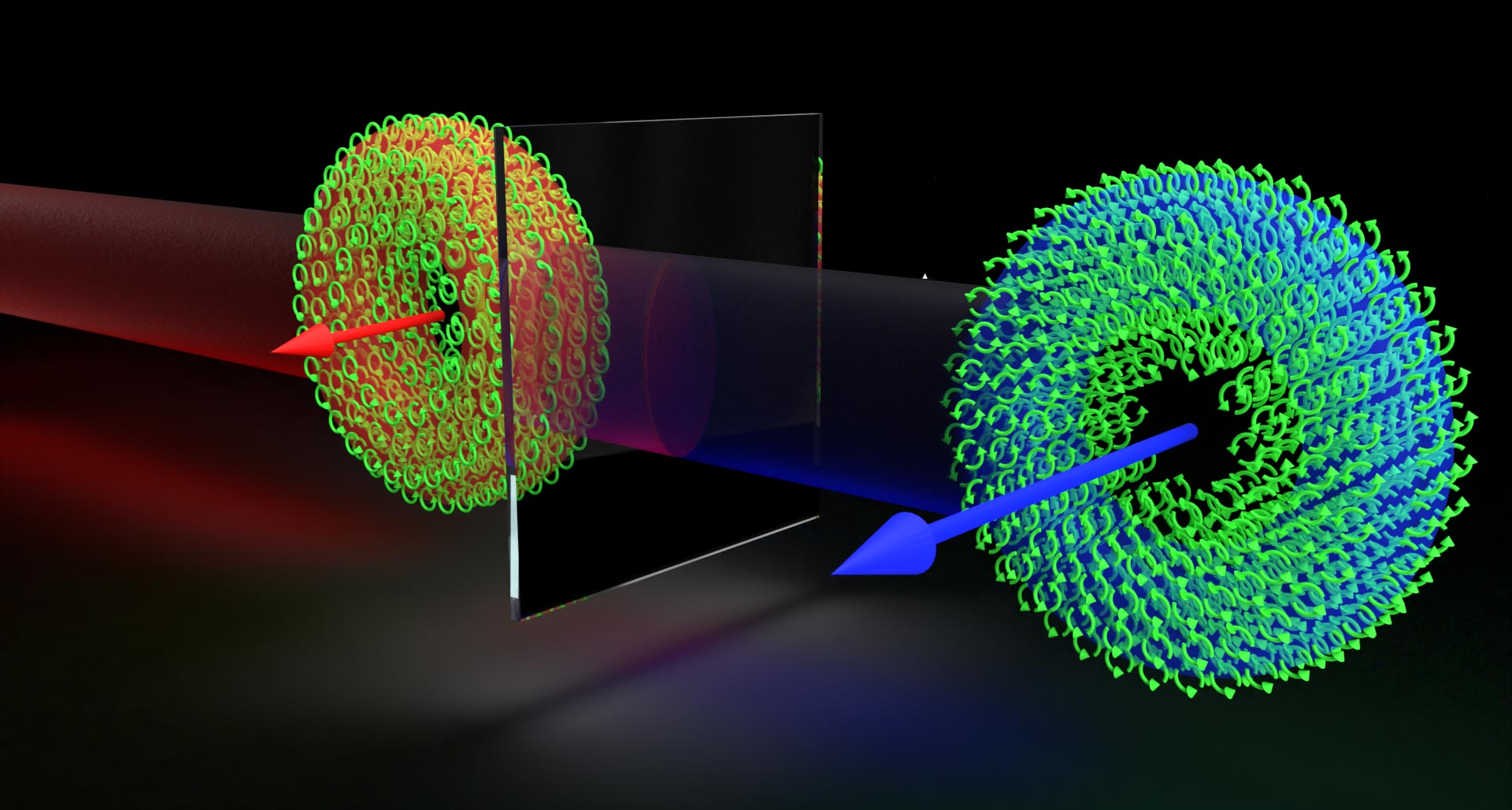
The research team, including graduate student and lead author Scott Hancock, postdoc Sina Zahedpour (EE Ph.D. ’17), and Milchberg, did this by generating a donut pulse they dub an “edge-first flying donut,” depicted in the diagram (its more technical name is “spatio-temporal optical vortex”—STOV). Here, the donut hole is oriented sideways, and because the rotational circulation now occurs around the ring, the angular momentum vector points at right angles to the plane containing the ring. To prove that this sideways-pointing OAM is associated with individual photons and not just the overall shape of the flying donut, the team sent the pulse through a nonlinear crystal (shown in the diagram) to undergo a well-known process called “second harmonic generation,” where 2 red photons are converted into a single blue photon with double the frequency. This reduces the number of photons by a factor of 2, which means each blue photon should have twice the sideways-pointing OAM — and this is exactly what the measurements showed. As seen in the diagram, the angular momentum of the flying donut (or STOV) — represented by the red and twice-longer blue arrows — is the composite effect of a swarm of photons somersaulting in lockstep.
Future Potential of STOV Beams
There are numerous potential applications of STOVs. For example, the angular momentum conservation embodied by somersaulting photons may make STOV beams resistant to breakup by atmospheric turbulence, with potential application to free-space optical communications. In addition, because STOV photons must occur in pulses of light, such pulses could be used to dynamically excite a wide range of materials or to probe them in ways that exploit the OAM and the donut hole. “STOV pulses could play a big role in nonlinear optics,” says Milchberg, “where beams can control the material they propagate in, enabling novel applications in beam focusing, steering, and switching.”
Reference: “Second-harmonic generation of spatiotemporal optical vortices and conservation of orbital angular momentum” by S. W. Hancock, S. Zahedpour and H. M. Milchberg, 27 April 2021, Optica.
DOI: 10.1364/OPTICA.422743
Never miss a breakthrough: Join the SciTechDaily newsletter.
Follow us on Google and Google News.