
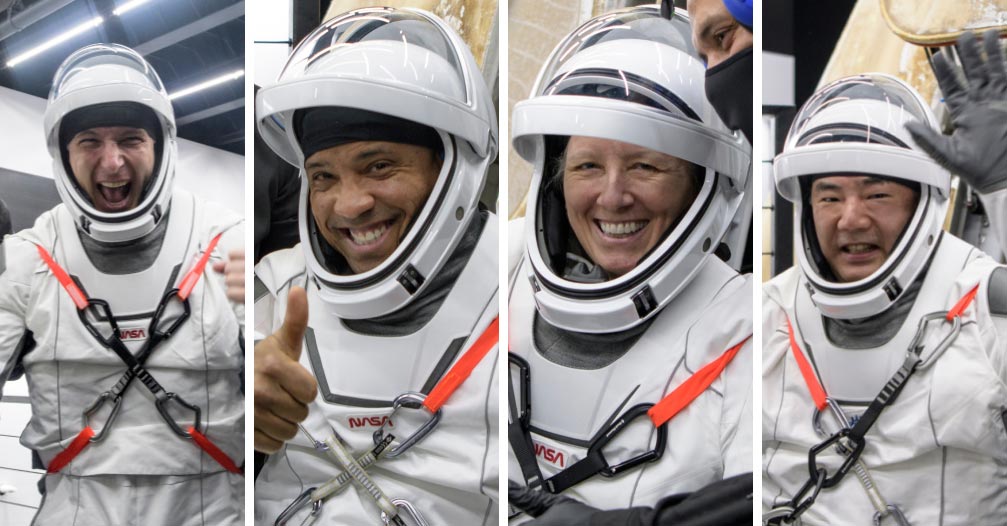
Crew-1 astronauts reflected on their historic mission aboard Crew Dragon, highlighting scientific milestones and spacewalks during their six-month stay on the ISS.
NASA astronauts Michael Hopkins, Victor Glover, and Shannon Walker, along with Japan Aerospace Exploration Agency (JAXA) astronaut Soichi Noguchi, participated in the first media event following their mission and splashdown, where they answered questions about their historic mission on the International Space Station and return to Earth.
SpaceX’s Crew Dragon, named Resilience, carrying Hopkins, Glover, Walker, and Noguchi, splashed down at 2:56 a.m. May 2 under parachutes in the Gulf of Mexico, off the coast of Panama City, Florida, and was successfully recovered by SpaceX. After returning to shore, the astronauts immediately flew back to Houston, where they were greeted by their families and colleagues.
NASA’s SpaceX Crew-1 astronauts answer questions about their historic mission on the International Space Station and their return to Earth. At around 14:15 Victor Glover discusses how it feels to be subjected to 4.5 Gs for over a minute on reentry after experiencing weightlessness for 167 days: “I felt really heavy!”
The successful launch of the agency’s SpaceX Crew-1 in November 2020 was the first flight of a NASA-certified commercial human spacecraft system in history. Crew-1 is the first of six crewed missions NASA and SpaceX will fly as part of the agency’s Commercial Crew Program, which worked with the U.S. aerospace industry to return launches with astronauts on American rockets and spacecraft from American soil.
Crew-1 astronauts worked on a number of experiments as part of Expedition 64 and Expedition 65 to the International Space Station, including tissue chips that mimic the structure and function of human organs to understand the role of microgravity on human health and diseases, and translate those findings to improve human health on Earth. Astronauts also grew radishes in different types of light and soils as part of ongoing efforts to produce food in space, and tested a new system to remove heat from spacesuits.
Michael Hopkins was commander of the Crew Dragon spacecraft and the Crew-1 mission. He was responsible for all phases of flight, from launch to re-entry. Selected as a NASA astronaut in 2009, Hopkins now has spent a total of 335 days in space during two spaceflights. He conducted three spacewalks during this mission for a total of five in his career totaling 32 hours and 1 minute. Born in Lebanon, Missouri, Hopkins grew up on a farm outside Richland, Missouri. He has a bachelor’s degree in aerospace engineering from the University of Illinois, and a master’s degree in aerospace engineering from Stanford University. Before joining NASA, Hopkins was a flight test engineer with the U.S. Air Force.
Victor Glover was the pilot of the Crew Dragon spacecraft and second-in-command for the mission. Glover was responsible for spacecraft systems and performance. Selected as an astronaut in 2013, this was his first spaceflight, during which he conducted four spacewalks totaling 26 hours, 7 minutes. The California native holds a Bachelor of Science degree in general engineering from California Polytechnic State University, a Master of Science degree in flight test engineering and a master’s degree in military operational art and science from Air University, as well as a Master of Science degree in systems engineering from the Naval Postgraduate School. Glover is a naval aviator and was a test pilot in the F/A‐18 Hornet, Super Hornet, and EA‐18G Growler aircraft.
Shannon Walker was a mission specialist for Crew-1. As a mission specialist, she worked closely with the commander and pilot to monitor the spacecraft during the dynamic launch and re-entry phases of flight. She also was responsible for monitoring timelines, telemetry, and consumables during the mission. Selected as a NASA astronaut in 2004, this was her second spaceflight, bringing her total time in space to 331 days. Walker first launched to the International Space Station aboard the Russian Soyuz TMA-19 spacecraft as the co-pilot, and spent 161 days aboard the orbiting laboratory. A Houston native, Walker received a Bachelor of Arts degree in physics from Rice University, as well as a Master of Science degree and a doctorate in space physics, both from Rice University, in 1992 and 1993, respectively.
Soichi Noguchi also was a mission specialist for Crew-1, working with the commander and pilot to monitor the spacecraft during the dynamic launch and re-entry phases of flight, and keeping watch on timelines, telemetry, and consumables. Noguchi was selected as an astronaut candidate by the National Space Development Agency of Japan (NASDA, currently the JAXA) in May 1996. Noguchi is now a veteran of three spaceflights and has spent a total of 345 days in space. During STS-114 in 2005, he became the first Japanese astronaut to perform a spacewalk outside the space station. He has performed a total of four spacewalks, accumulating 27 hours and 1 minute of spacewalking time. Noguchi launched aboard a Soyuz spacecraft in 2009, to return to the station as a long-duration crew member. The Crew Dragon is the third spacecraft Noguchi has flown to the orbiting laboratory.
Never miss a breakthrough: Join the SciTechDaily newsletter.
Follow us on Google and Google News.
1 Comment
I have mentioned that the possibility of a suit made from spandex that is tailored for each astronaut for the purpose of imitating gravitational pressure on the human body in space, the tension of the material would pull against the body simumulating the gravity and atmospheric pressure in addition to exercising muscles to alleviate degradation, rather than loose fitting clothes