
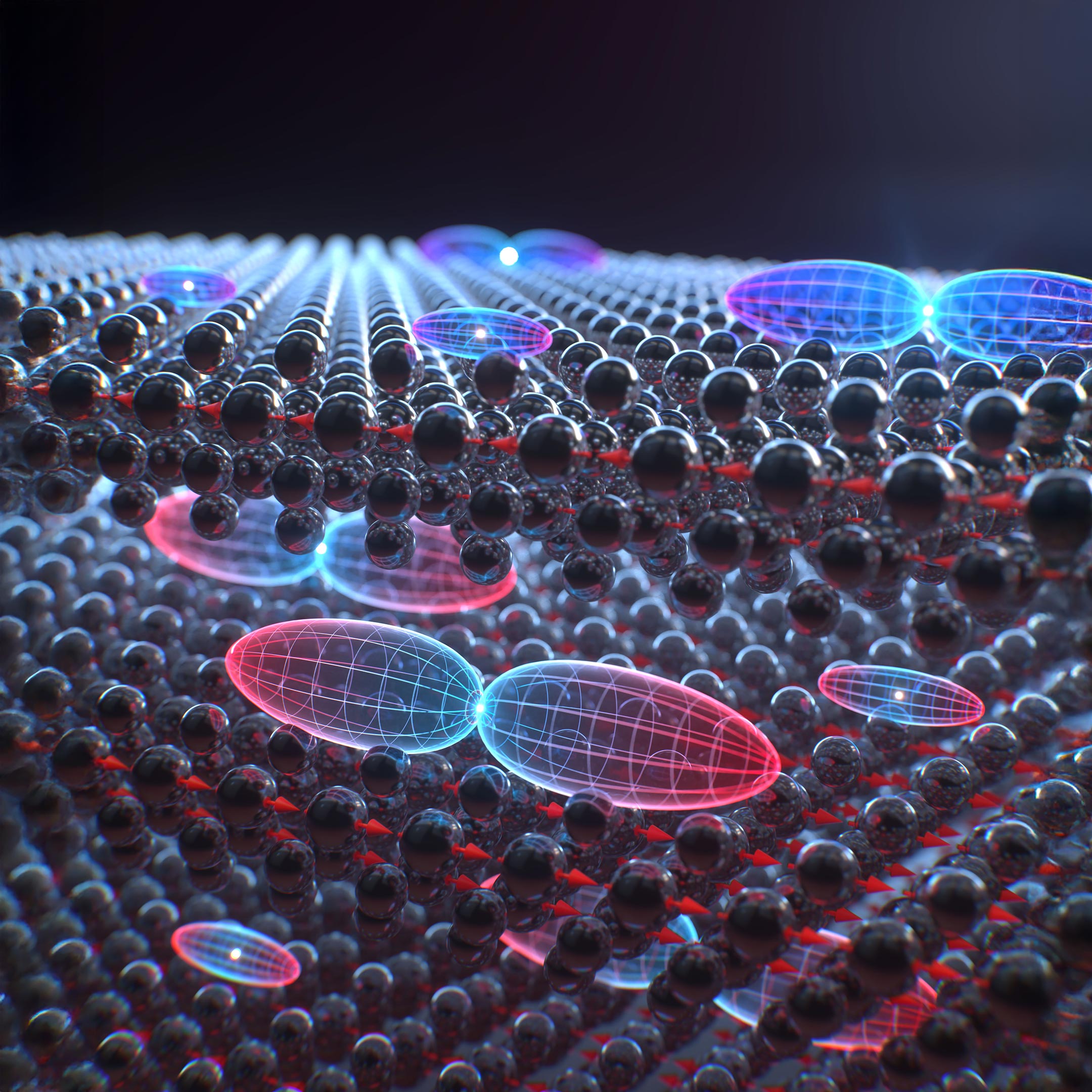
Scientists have found a new way to control quantum information using a special material, chromium sulfide bromide.
It can store and process data in multiple forms, but its magnetic properties are the real game-changer. By adjusting its magnetization, researchers can confine excitons—quantum particles that carry information—allowing for longer-lasting quantum states and new ways to process data.
Quantum “Miracle Material” Enables Magnetic Switching
A newly identified quantum “miracle material” may enable magnetic switching, according to researchers from the University of Regensburg and the University of Michigan.
This discovery could lead to advancements in quantum computing, sensing, and other technologies. Previous studies found that quantum particles called excitons can sometimes be restricted to a single line within the material, chromium sulfide bromide. The new research provides both theoretical and experimental evidence linking this confinement to the material’s magnetic properties.
Chromium sulfide bromide is particularly exciting for quantum research because it can encode information in multiple ways: through electric charge, light (photons), magnetism (electron spins), and vibrations (phonons).
“The long-term vision is, you could potentially build quantum machines or devices that use these three or even all four of these properties: photons to transfer information, electrons to process information through their interactions, magnetism to store information, and phonons to modulate and transduce information to new frequencies,” said Mackillo Kira, U-M professor of electrical and computer engineering.
Harnessing Excitons for Quantum Encoding
One of the ways chromium sulfide bromide could encode quantum information is in excitons. An exciton forms when an electron is moved out of its “ground” energy state in the semiconductor into a higher energy state, leaving behind a “hole.” The electron and hole are paired together, and that collective state is an exciton.
The excitons are trapped in single layers by chromium sulfide bromide’s unusual magnetic properties. The material is made up of layers just a few atoms thick, like molecular phyllo pastry. At low temperatures under 132 Kelvin (-222 Fahrenheit), the layers are magnetized—the spins of the electrons align with one another. The direction of the magnetic field switches to the opposite direction from one layer to the next. This is an antiferromagnetic structure.
Above 132 Kelvin, the material isn’t magnetized—the heat keeps the electron spins from staying aligned, so they point in random directions. In the unmagnetized state, the excitons aren’t trapped but extend over multiple atomic layers, making them three-dimensional. They can also move in any direction.
Quantum Confinement and Longevity of Information
When the antiferromagnetic structure confines excitons to a single atomic layer, the excitons are further restricted to a single line—a single dimension—because they can easily move along only one of the two axes of the plane. In a quantum device, this confinement helps quantum information last longer because the excitons are less likely to collide with one another and lose the information they carry.
“The magnetic order is a new tuning knob for shaping excitons and their interactions. This could be a game changer for future electronics and information technology,” said Rupert Huber, professor of physics at the University of Regensburg in Germany.
Excitons’ Fine Structure: A Surprising Discovery
The experimental team, led by Huber, produced excitons inside a sample of chromium sulfide bromide by hitting it with pulses of infrared light just 20 quadrillionths of a second long. Then, they used another infrared laser with less energetic pulses to nudge the excitons into slightly higher energy states. In this way, they discovered that there are two variations of the excitons with surprisingly different energies—when normally, they would have identical energies. This splitting of an energy state is known as fine structure.
The team also explored how the material varies in space by shooting those less energetic pulses along two different axes within the material to probe the inner structures of excitons. This approach revealed the highly direction-dependent excitons, which could either be confined to a line or expanded in three dimensions. These configurations can be adjusted based on the magnetic states, switchable through external magnetic fields or temperature changes.
A New Pathway for Quantum Information Processing
“Since the electronic, photonic, and spin degrees of freedom are strongly intertwined, switching between a magnetized and a nonmagnetized state could serve as an extremely fast way to convert photon and spin-based quantum information,” said Matthias Florian, U-M research investigator in electrical and computer engineering and co-first author with Marlene Liebich, a Ph.D. candidate in physics at the University of Regensburg.
The theory team, led by Kira, explained these results with quantum many-body calculations. The calculations used the structure of the material to systematically predict the exceptionally large fine-structure splitting in the magnetically ordered material and the transitions between the two exciton states when the material transitioned in and out of magnetic order. They also confirmed that the transition from one-dimensional to three-dimensional excitons accounted for the substantial changes observed in how long excitons could go without colliding, as the larger and more mobile excitons have more opportunities to collide.
Future Research: Converting Charge into Spin
One of the big questions the team plans to pursue is whether these excitons embodied in charge separation can be converted to magnetic excitations embodied in electron spins. If it can be done, it would provide a useful avenue for converting quantum information between the very different worlds of photons, excitons, and spins.
Reference: “Controlling Coulomb correlations and fine structure of quasi-one-dimensional excitons by magnetic order” by M. Liebich, M. Florian, N. Nilforoushan, F. Mooshammer, A. D. Koulouklidis, L. Wittmann, K. Mosina, Z. Sofer, F. Dirnberger, M. Kira and R. Huber, 19 February 2025, Nature Materials.
DOI: 10.1038/s41563-025-02120-1
The research was supported by the German Research Foundation, National Science Foundation, Air Force Office of Scientific Research and U-M’s Advanced Research Computing resources.
Researchers from the University of Chemistry and Technology Prague, in the Czech Republic, and Dresden University of Technology, in Germany, also contributed to the study.
Never miss a breakthrough: Join the SciTechDaily newsletter.
Follow us on Google and Google News.
1 Comment
It would provide a useful avenue for converting quantum information between the very different worlds of photons, excitons, and spins.
VERY GOOD!
Ask the physicists:
1. Are the photons related to spin?
2. Are the excitons related to spin?
3. Are the topological vortices related to spin?
Scientific research guided by correct theories can enable researchers to think more. Can you get an Interpretation of Quantum Theory within the Framework of Topological Vortex Theory (TVT)? (https://scitechdaily.com/microscope-spacecrafts-most-precise-test-of-key-component-of-the-theory-of-general-relativity/#comment-875168). Can you get an Interpretation of Einstein’s Relativity within the Framework of Topological Vortex Theory (TVT)? (https://scitechdaily.com/microscope-spacecrafts-most-precise-test-of-key-component-of-the-theory-of-general-relativity/#comment-875170).
A topological vortex is a concept in physics that describes the natural gravitational field or the fluid-body coupled system. A topological vortex is formed by the interaction and balance of vortex and anti-vortex field pairs, which can be set into resonance by the body motion and interaction.
Topological Vortex Theory (TVT) treats space as an ideal fluid, posits that the topological vortex gravitational field is fundamental to the structure of the universe, and emphasizes the importance of topological phase transitions in understanding mass, inertia, and energy.
According to the Topological Vortex Theory (TVT), spins create everything, spins shape the world. There are substantial distinctions between Topological Vortex Theory (TVT) and traditional physical theories. Grounded in the inviscid, incompressible, and isotropic spaces, TVT introduces the concept of topological phase transitions and employs topological principles to elucidate the formation and evolution of matter in the universe, as well as the impact of interactions between topological vortices and anti-vortices on spacetime dynamics and thermodynamics.
Within TVT, low-dimensional spacetime matter serves as the foundation for high-dimensional spacetime matter, and the hierarchical structure of matter and its interaction mechanisms challenge conventional macroscopic and microscopic interpretations. The conflict between Quantum Physics and Classical Physics can be attributed to their differing focuses: Quantum Physics emphasizes low-dimensional spacetime matter, whereas Classical Physics centers on high-dimensional spacetime matter.
Subatomic particles in the quantum world often defy the familiar rules of the physical world. The fact repeatedly suggests that the familiar rules of the physical world are pseudoscience. In the familiar rules of the physical world, two sets of cobalt-60 can form the mirror image of each other by rotating in opposite directions, and should receive the Nobel Prize for physics.
Please witness the grand performance of some so-called peer review publications (including PRL, PNAS, Nature, Science, etc.). https://scitechdaily.com/microscope-spacecrafts-most-precise-test-of-key-component-of-the-theory-of-general-relativity/#comment-854286. Some so-called academic publications (including PRL, PNAS, Nature, Science, etc.) are addicted to their own small circles and have deviated from science for a long time.
As the background of various material interactions and movements, space exhibits inviscid, absolutely incompressible and isotropic physical characteristics. It may form various forms of spacetime vortices through topological phase transitions. Hence, vortex phenomena are ubiquitous in cosmic space, from vortices of quantum particles and living cells to tornados and black holes. Stars and radioactive elements are one of the most active topological nodes in spacetime. Utilizing them is more valuable and meaningful than simulating them. Small or micro power topology intelligent batteries may be the direction of future energy research and development for human society.
Under the topological vortex architecture, science and pseudoscience are clear at a glance. Topological Vortex Theory (TVT) can play a crucial role in elucidating the foundations of physics, establishing its principles, and combating pseudoscience. Therefore, TVT has been strongly opposed and boycotted by traditional so-called peer review publications (such as PRL, PNAS, Nature, Science, etc.).
These so-called peer review publications (including PRL, PNAS, Nature, Science, etc.) mislead the direction of science and are known for their various absurdities and wonders. They collude together, reference each other, and use so-called Impact Factor (IF) or the Nobel Prize to deceive people around.
Ask the so-called peer review publications (including PRL, PNAS, Nature, Science, etc.):
1. What are your criteria for distinguishing science from pseudoscience?
2. Is your Impact Factor (IF) the standard for distinguishing science from pseudoscience?
3. Is the Nobel Prize the standard for distinguishing science from pseudoscience?
4. What is the most important aspect of academic publications?
5. Is the most important aspect of academic publications being flashy and impractical articles?
Pseudo academic publications (including PRL, PNAS, Nature, Science, etc.) are neither inclusivity nor openness, nor transparency and fairness, and have already had a serious negative impact on the progress of science and technology. Some so-called peer review publications (including PRL, PNAS, Nature, Science, etc.) are addicted to their own small circle and no longer know what science is. They hardly know what is dirty and ugly.
Publications that mislead the public under the guise of scholarship are more reprehensible than ordinary publications. The field of physics faces an ongoing challenge in maintaining scientific rigor and integrity in the face of pervasive pseudoscientific claims. Fighting against rampant pseudoscience, physics still has a long way to go.
While my comments may be lengthy, they are necessary to combat the proliferation of rampant pseudoscience and to promote the advancement of science and technology, and also is all I can do.
Appreciate the SciTechDaily for its inclusivity, openness, transparency, and fairness. If the researchers are truly interested in cosmic matter, please read: A Brief History of the Evolution of Cosmic Matter (https://scitechdaily.com/microscope-spacecrafts-most-precise-test-of-key-component-of-the-theory-of-general-relativity/#comment-873523).