
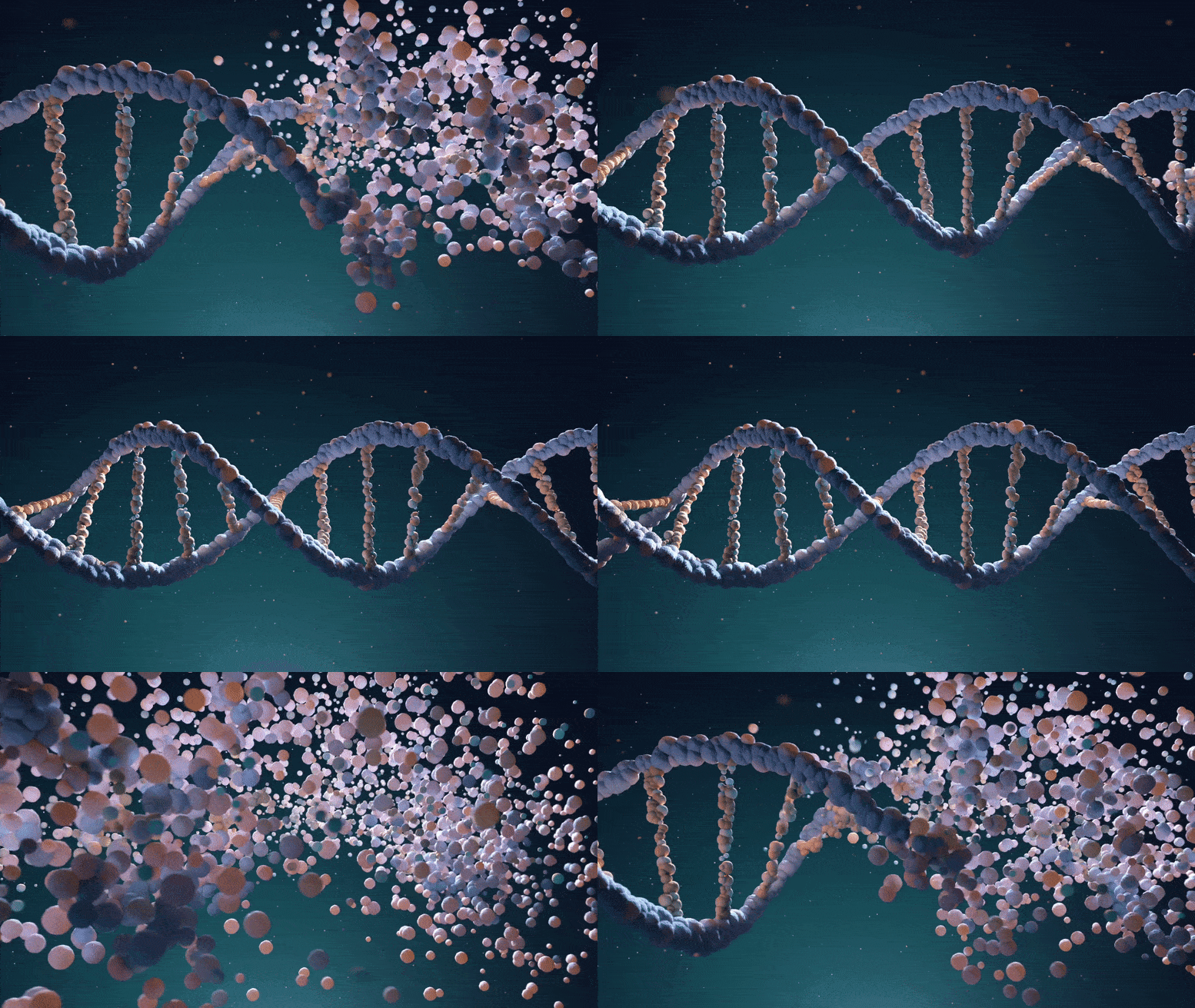
DNA linkers can program particles to assemble into tailored, reversible structures—opening doors to smart, customizable materials.
A team of physicists has discovered how DNA molecules self-organize into adhesive patches between particles in response to assembly instructions. Its findings offer a “proof of concept” for an innovative way to produce materials with a well-defined connectivity between the particles.
The work is reported in Proceedings of the National Academy of Sciences.
“We show that one can program particles to make tailored structures with customized properties,” explains Jasna Brujic, a professor in New York University’s Department of Physics and one of the researchers. “While cranes, drills, and hammers must be controlled by humans in constructing buildings, this work reveals how one can use physics to make smart materials that ‘know’ how to assemble themselves.”
Scientists have long sought a means for molecules to self-assemble and have achieved breakthroughs on many fronts. However, less developed are measures in which these tiny particles self-assemble with a preprogrammed number of bonds.
The video shows that a blue particle initially binds to three red particles, satisfying its valence at room temperature. Upon heating, those bonds are broken, but upon cooling, the particle finds three red partners again, showing that the particle ‘chooses’ the number of bonds it makes. Their result implies that the DNA bonds between particles are reversible and rearrange on the particle surface to optimize valence. Credit: Courtesy of Angus McMullen/NYU’s Department of Physics
Microscopic Experiments with DNA Linkers
To address this, Brujic and her colleagues, Angus McMullen, a postdoctoral researcher in NYU’s Department of Physics, and Sascha Hilgenfeldt, a professor of mechanical science and engineering at the University of Illinois, Urbana-Champaign, ran a series of experiments to capture–and manipulate–the behavior of DNA molecules on particle surfaces.
Operating at a micron level–with particles 1/25th the size of a speck of dust–they submerged tiny droplets into a liquid solution. Attached to these droplets were “DNA linkers”–molecular tools possessing “sticky ends” that allow for mixing and matching to form an array of structures desired by the researchers.
“The beauty of this procedure is we can program the properties of a specific material, such that it could be elastic or brittle, or even have self-healing powers once broken, since the bonds can be made and broken reversibly,” observes Brujic. “Creators could decide to put in five particles that stick to only one other one, 10 that stick to two, and 20 that stick to three, or any other combination. This would allow you to build materials with specific topologies or architectures.”
Reference: “DNA self-organization controls valence in programmable colloid design” by Angus McMullen, Sascha Hilgenfeldt and Jasna Brujic, 8 November 2021, Proceedings of the National Academy of Sciences.
DOI: 10.1073/pnas.2112604118
The work was supported by the Materials Research Science and Engineering Center (MRSEC) program of the National Science Foundation (NSF DMR-1420073, NSF PHY17-48958, and NSF DMR-1710163).
Never miss a breakthrough: Join the SciTechDaily newsletter.
Follow us on Google and Google News.
5 Comments
… almost as a small code…
So whats new, this has been known about for decades.
Once again, scientists discover the mechanism that physical reality displays in its atrangement of material, but fail to acknowledge that organization implies pre existing intelligence and design. Whether replication or self atrangement, secular scienyism is still just moving the goalposts in their conception of the physical reality of the universe, while ignoring the metaphysical laws, forces and logic that undermine it all.
I want to self assemble a Jessica Alba’s lips,face, and throat from 2004.
how natural physics controls smart materials to know how to self assemble themselves with a preprogrammed number of bonds
micron level 1/25th the size of a speck of dust topologies and architectures
and they are all moving in a 2 d plane
north east south and west
12—–3—–6———-9 oclock on the dial
notice how some approach the north 12 oclock and stick
notice how some approach the east 3 oclock and stick
notice how some approach the south 6 oclock and stick
what dont they do the reverse whats controlling their proper brownian motion in a liquid flow
so are you allowing tradesmen to enter by a certain door
but the beauty and truth of physics is
one could stick north and one material is made
one could stick south and another material is made
one could stick east and west
and whilst you use three
physics would get five all around the blue ball centre disc circle 1/25 speck of dust
but why are you floating them in a water liquid allowing them blue balls to attract all around
what about above its head and below its feet
physics could probably make 14 stick at a easy working pace
bring in the engineer and then the architect and then the builder and tighter still maybe 25 28 could hang out in this space 1/25 of a dust speck wide x 25 = 25 squared a perfect cube arrangement cubic wise
do you want physics to go on with its permutations and combinations its been at it for 13,700,000,000 years its knows what it is doing all that time
how long have you been trying