
Warm seas provide fuel for extreme storms, and can then be cooled by them.
Even though tropical cyclones are atmospheric phenomena, much of their fearsome power actually comes from the ocean. The seas are plentiful sources of moisture to feed growing storm clouds. Just as critically, they are also massive repositories of thermal energy that can move from the sea to the sky.
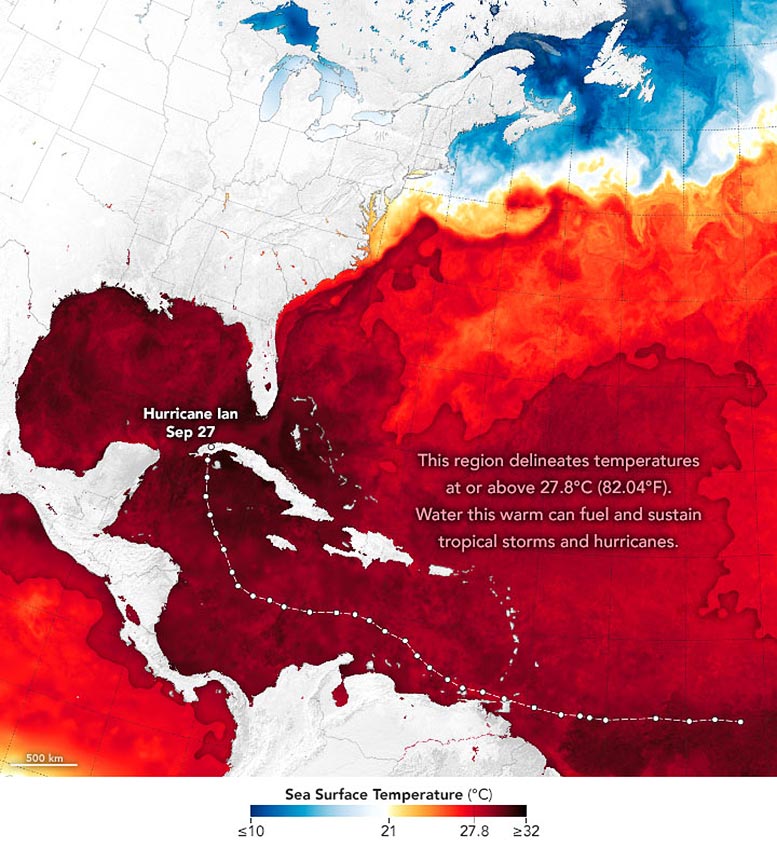
On September 27, 2022, as Hurricane Ian lashed western Cuba and headed for the west coast of Florida it moved over a vast fuel source in the Gulf of Mexico. While sea surface temperatures are just one of the significant factors influencing hurricanes, they are a fair predictor of the readiness of the ocean to sustain them.
The map above shows sea surface temperatures (SSTs) as measured on September 26 by a combination of satellite and ocean instruments and processed by NASA scientists. Meteorologists generally agree that SSTs should be above 82.04° Fahrenheit (27.8° Celsius) to sustain and intensify hurricanes, cyclones, and typhoons. Surface waters above that threshold are represented in red on the map.
Evidence for the transfer of energy between the ocean and atmosphere often shows up in the wake of a storm, literally. As a hurricane or typhoon passes through a parcel of ocean, it can cool the local sea surface for several days.
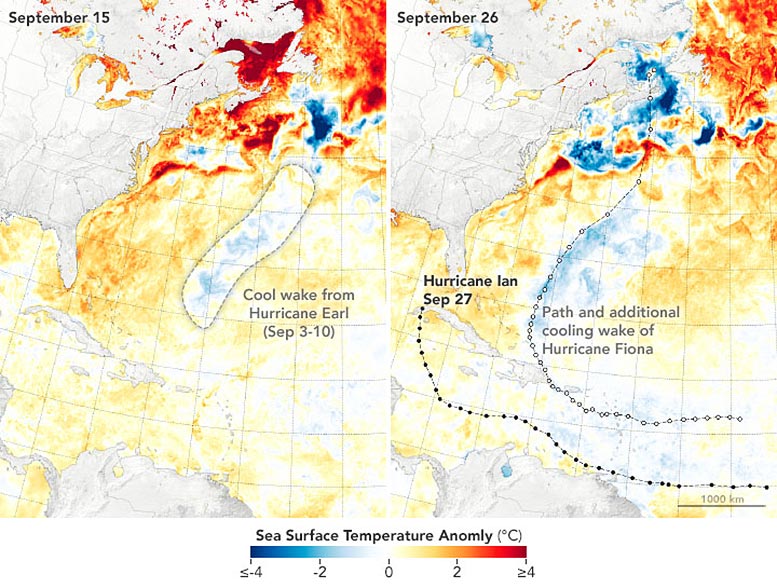
The maps above depict sea surface temperature anomalies on September 15 (left) and September 26 (right). They show how much the surface layer was above or below the long-term average temperature for this time of year. Between September 3 and 10, the storm that developed into Hurricane Earl traveled through the northwest Atlantic, leaving a trail of cooler water in its wake. Next, Hurricane Fiona—which traced a path of destruction across Puerto Rico, the Dominican Republic, Bermuda, and Newfoundland—also left a cool patch in its wake as it moved north between September 15-26.
Water vapor naturally cools as it rises through the atmosphere and then falls back onto the sea as rainwater. Having given up much of its heat to the atmosphere, the rain cools the sea surface a bit. Simultaneously, the winds and waves of a hurricane disperse warm surface water and bring up cooler water from the ocean depths.
In theory, the cooler water rising to the surface should make it less likely for a new storm to develop or intensify in the same area in the following days. However, the waters of the North Atlantic were not necessarily cool after Earl and Fiona, just at a lower temperature compared to before.
The data for all of these maps come from the MUR Global Foundation Sea Surface Temperature Analysis, produced at NASA’s Jet Propulsion Laboratory. The system combines observations from several satellite instruments, including the NASA Advanced Microwave Scanning Radiometer-EOS (AMSR-E), the Moderate Resolution Imaging Spectroradiometer (MODIS) on the NASA Aqua and Terra platforms, the U.S. Navy microwave WindSat radiometer, the Advanced Very High Resolution Radiometer (AVHRR) on several NOAA satellites, and from in situ observations from NOAA.
Editor’s Note: NOAA and other federal and state agencies lead the forecasting of and response to hurricanes in the United States, with NASA playing a supporting role in developing experimental tools and providing key data to those agencies. NASA also works to streamline the flow of information and support foreign scientific institutions, governments, and international groups as they generate data products from freely available NASA data. The NASA Disasters program contributes with high-value or unique products to complement the actions of operational agencies and regional governments to support decision-making during crises and also in disaster risk reduction.
NASA Earth Observatory images by Joshua Stevens, using data from the Multiscale Ultrahigh Resolution (MUR) project and information from the National Hurricane Center.
Never miss a breakthrough: Join the SciTechDaily newsletter.
Follow us on Google and Google News.