
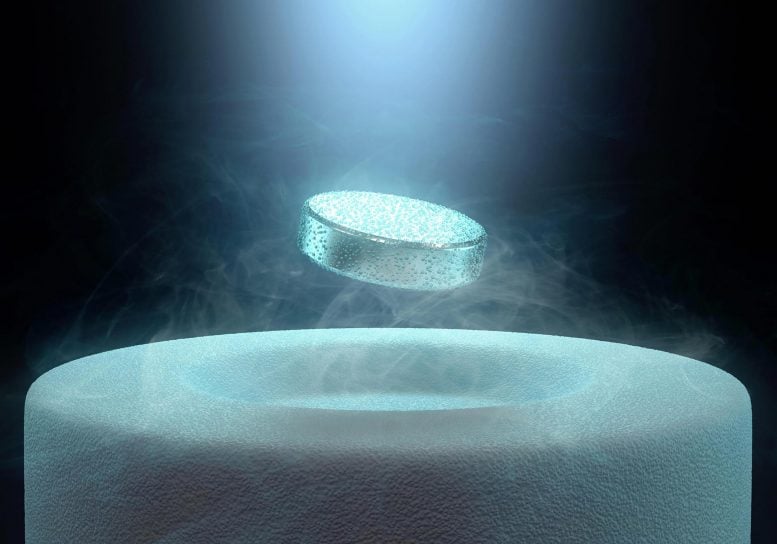
Researchers Published a New Theoretical Framework
Physicists have pinpointed a mechanism responsible for the creation of oscillating superconductivity, termed pair-density waves. The findings, which shed light on an atypical high-temperature superconductive state observed in specific materials like high-temperature superconductors, were published in Physical Review Letters.
“We discovered that structures known as Van Hove singularities can produce modulating, oscillating states of superconductivity,” says Luiz Santos, assistant professor of physics at Emory University and senior author of the study. “Our work provides a new theoretical framework for understanding the emergence of this behavior, a phenomenon that is not well understood.”
The first author of the study is Pedro Castro, an Emory physics graduate student. Co-authors include Daniel Shaffer, a postdoctoral fellow in the Santos group, and Yi-Ming Wu from Stanford University.
Santos is a theorist who specializes in condensed matter physics. He studies the interactions of quantum materials — tiny things such as atoms, photons, and electrons — that don’t behave according to the laws of classical physics.
A Century-Old Discovery With Modern Implications
Superconductivity, or the ability of certain materials to conduct electricity without energy loss when cooled to a super-low temperature, is one example of intriguing quantum behavior. The phenomenon was discovered in 1911 when Dutch physicist Heike Kamerlingh Onnes showed that mercury lost its electrical resistance when cooled to 4 Kelvin or minus 371 degrees Fahrenheit. That’s about the temperature of Uranus, the coldest planet in the solar system.
It took scientists until 1957 to come up with an explanation for how and why superconductivity occurs. At normal temperatures, electrons roam more or less independently. They bump into other particles, causing them to shift speed and direction and dissipate energy. At low temperatures, however, electrons can organize into a new state of matter.
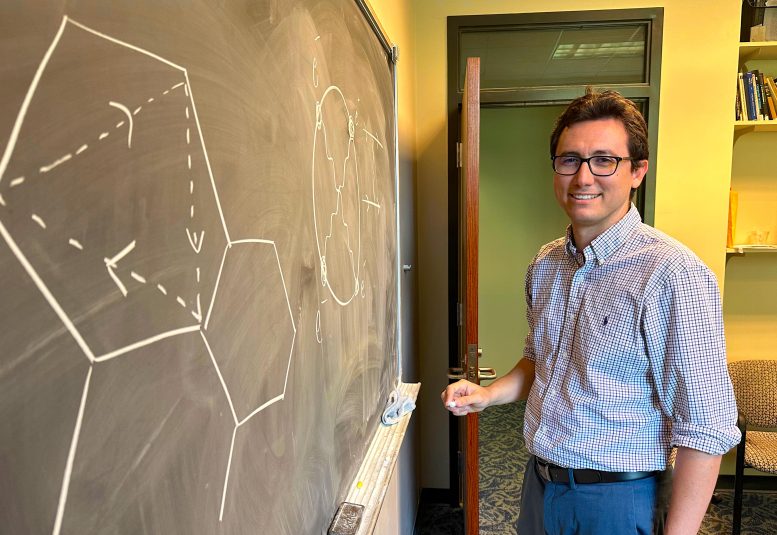
Electron Pairing: The Secret Behind Superconductivity
“They form pairs that are bound together into a collective state that behaves like a single entity,” Santos explains. “You can think of them like soldiers in an army. If they are moving in isolation they are easier to deflect. But when they are marching together in lockstep it’s much harder to destabilize them. This collective state carries current in a robust way.”
Superconductivity holds huge potential. In theory, it could allow for electric current to move through wires without heating them up or losing energy. These wires could then carry far more electricity, far more efficiently.
“One of the holy grails of physics is room-temperature superconductivity that is practical enough for everyday-living applications,” Santos says. “That breakthrough could change the shape of civilization.”
Many physicists and engineers are working on this frontline to revolutionize how electricity gets transferred.
Meanwhile, superconductivity has already found applications. Superconducting coils power electromagnets used in magnetic resonance imaging (MRI) machines for medical diagnostics. A handful of magnetic levitation trains are now operating in the world, built on superconducting magnets that are 10 times stronger than ordinary electromagnets. The magnets repel each other when the matching poles face each other, generating a magnetic field capable of levitating and propelling a train.
The Large Hadron Collider, a particle accelerator that scientists are using to research the fundamental structure of the universe, is another example of technology that runs through superconductivity.
Superconductivity continues to be discovered in more materials, including many that are superconductive at higher temperatures.
Beyond Traditional Superconductivity: Investigating Oscillating States
One focus of Santos’ research is how interactions between electrons can lead to forms of superconductivity that cannot be explained by the 1957 description of superconductivity. An example of this so-called exotic phenomenon is oscillating superconductivity, when the paired electrons dance in waves, changing amplitude.
In an unrelated project, Santos asked Castro to investigate specific properties of Van Hove singularities, structures where many electronic states become close in energy. Castro’s project revealed that the singularities appeared to have the right kind of physics to seed oscillating superconductivity.
That sparked Santos and his collaborators to delve deeper. They uncovered a mechanism that would allow these dancing-wave states of superconductivity to arise from Van Hove singularities.
“As theoretical physicists, we want to be able to predict and classify behavior to understand how nature works,” Santos says. “Then we can start to ask questions with technological relevance.”
Some high-temperature superconductors — which function at temperatures about three times as cold as a household freezer — have this dancing-wave behavior. The discovery of how this behavior can emerge from Van Hove singularities provides a foundation for experimentalists to explore the realm of possibilities it presents.
“I doubt that Kamerlingh Onnes was thinking about levitation or particle accelerators when he discovered superconductivity,” Santos says. “But everything we learn about the world has potential applications.”
Reference: “Emergence of the Chern Supermetal and Pair-Density Wave through Higher-Order Van Hove Singularities in the Haldane-Hubbard Model” by Pedro Castro, Daniel Shaffer, Yi-Ming Wu and Luiz H. Santos, 11 July 2023, Physical Review Letters.
DOI: 10.1103/PhysRevLett.131.026601
The work was funded by the U.S. Department of Energy’s Office of Basic Energy Sciences.
Never miss a breakthrough: Join the SciTechDaily newsletter.
Follow us on Google and Google News.
2 Comments
“They form pairs that are bound together into a collective state that behaves like a single entity,” Santos explains. “You can think of them like soldiers in an army. If they are moving in isolation they are easier to deflect. But when they are marching together in lockstep it’s much harder to destabilize them. This collective state carries current in a robust way.” Your understanding can go further.
According to topological vortex gravitational field theory, no particle can move independently of the outside world. Have you ever asked yourself why Electron spin? Scientific research guided by correct theories can help people avoid detours and failures. Understanding these phenomena within the framework of topological vortex gravitational field will broaden your thinking.
Which is from chaos to order via synchronization.