

Close Menu
    Facebook X (Twitter) Instagram
    SciTechDaily
    • Biology
    • Chemistry
    • Earth
    • Health
    • Physics
    • Science
    • Space
    • Technology
    Facebook X (Twitter) Pinterest YouTube RSS
    SciTechDaily
    Home»Physics»Physicists Successfully Create a New Type of Quasiparticle
    Physics

    Physicists Successfully Create a New Type of Quasiparticle

    By City College of New YorkOctober 8, 20221 Comment2 Mins Read
    Facebook Twitter Pinterest Telegram LinkedIn WhatsApp Email Reddit
    Share
    Facebook Twitter LinkedIn Pinterest Telegram Email Reddit
    Abstract Sphere Energy Particle Physics
    A quasiparticle refers to a physics concept in which highly stimulated states of matter are viewed as elementary quantum particles in their own right.

    City College of New York Physicists Have Created a New Magnetic Quasiparticle

    The City College of New York’s Center for Discovery and Innovation and the Physics Department have announced the creation of a new type of magnetic quasiparticle generated by coupling light to a stack of ultrathin two-dimensional magnets. This breakthrough, the result of a collaboration with the University of Texas at Austin, lays the foundation for an emerging strategy to artificially design materials by ensuring their strong interaction with light.

    “Implementing our approach with magnetic materials is a promising path towards efficient magneto-optical effects,” said CCNY physicist Vinod M. Menon, whose group led the study. “Achieving this goal can enable their use for applications in everyday devices like lasers, or for digital data storage.”
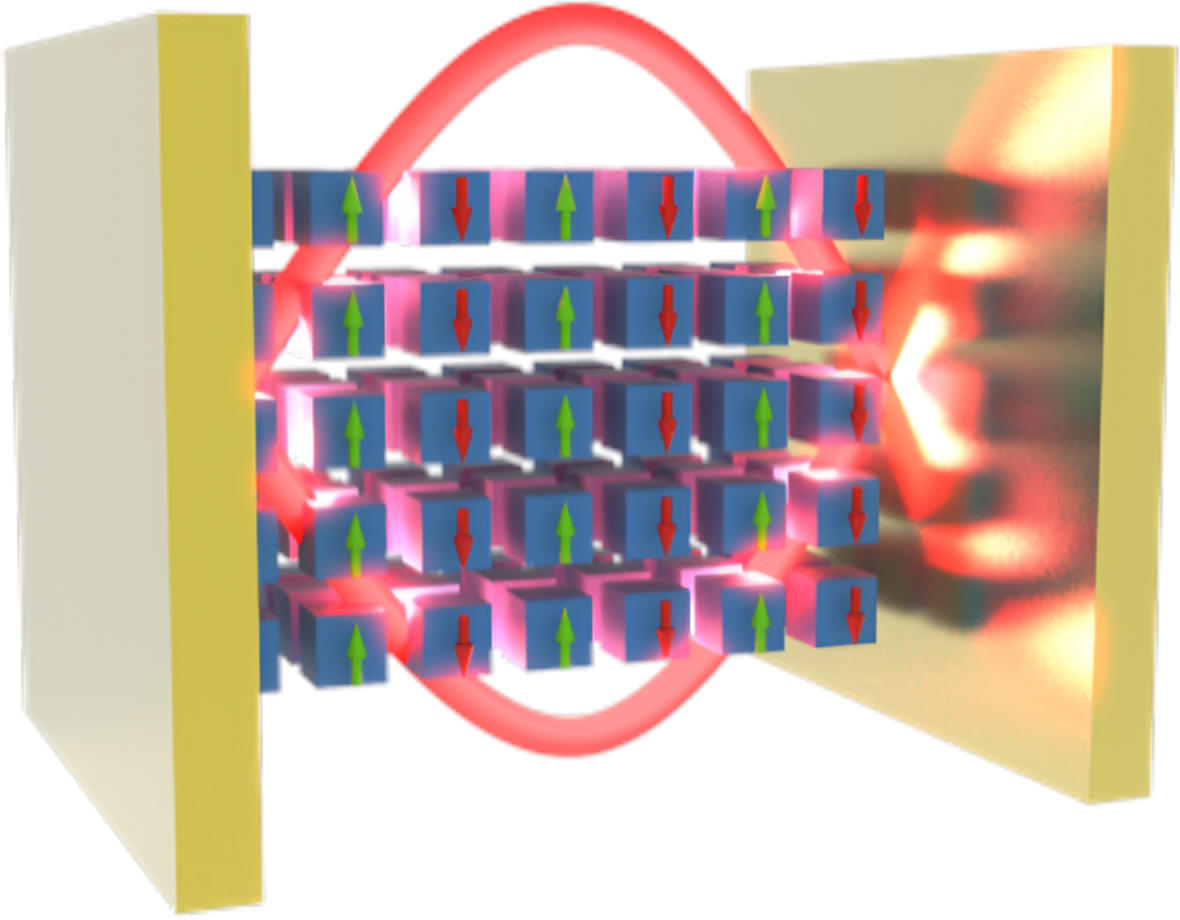
    Enhanced Coupling of Photons and Spin Correlated Excitations
    Optical resonator enhanced photons and spin-correlated excitations coupling in a van der Waals magnetic crystal. Credit: Rezlind Bushati.

    Dr. Florian Dirnberger, the study’s lead author, believes that their work exposed a largely unexplored realm of strong interactions between light and magnetic crystals. “Research in recent years brought forth a number of atomically flat magnets that are exceptionally well-suited to be studied by our approach,” he noted.

    Looking ahead, the team plans to extend these investigations to understand the role of the quantum electrodynamical vacuum when quantum materials are placed into optical cavities. “Our work paves the way for the stabilization of novel quantum phases of matter that have no counterpart in thermodynamic equilibrium,” commented Edoardo Baldini, assistant professor at The University of Texas at Austin.

    Reference: “Spin-correlated exciton–polaritons in a van der Waals magnet” by Florian Dirnberger, Rezlind Bushati, Biswajit Datta, Ajesh Kumar, Allan H. MacDonald, Edoardo Baldini and Vinod M. Menon, 12 September 2022, Nature Nanotechnology.
    DOI: 10.1038/s41565-022-01204-2

    The study was funded by the National Science Foundation, the Army Research Office, and the CREST-IDEALS Center at CCNY.

    Never miss a breakthrough: Join the SciTechDaily newsletter.
    Follow us on Google and Google News.

    City College of New York Magnets Nanotechnology Quasiparticles University of Texas at Austin
    Share. Facebook Twitter Pinterest LinkedIn Email Reddit

    Related Articles

    Physicists Discover Magnetic Mechanism That Challenges a 300-Year-Old Law of Friction

    Hydrogen Ions Are Revolutionizing Quantum Tech – Here’s How

    DNA Origami Nanoturbine: Pioneering the Nanomotor Revolution

    Optical Tweezer Technology Breakthrough Overcomes Dangers of Heat

    Single Photon Switch Advance: “Rydberg States” in Solid State Materials

    Photonics Breakthrough: Half-Light Half-Matter Quasiparticle Based LED

    Electron-Electron Interactions are Critical to Graphene’s Extraordinary Properties

    Researchers Create Electron Vortex Beams Inside Electron Microscopes

    Two-Dimensional Polymers Created for the First Time

    1 Comment

    1. xABBAAA on October 8, 2022 8:55 am

      … and nothing changes, I listen to “Lana Del Rey – Chemtrails Over The Country Club”, because opposition has a meeting against the legally elected political candidate. However, it is not Americas favorite… So, the democracy needs to be enforced to the common ones! …

      Reply
    Leave A Reply Cancel Reply

    • Facebook
    • Twitter
    • Pinterest
    • YouTube

    Don't Miss a Discovery

    Subscribe for the Latest in Science & Tech!

    Trending News

    Just a Few Breathless Minutes a Day Could Slash Your Risk of 8 Major Diseases

    This Simple Habit Could Cut Your Risk of Dementia by 30%

    Scientists Debunk Rattlesnake Myth That Fooled Hikers and Doctors for Decades

    Scientists Discover Plants Can “Count” – and May Be Smarter Than We Thought

    New Research Reveals Ancient Mars May Have Been Warm, Wet – and Possibly Alive

    This Surprising Daily Habit Could Cut Dementia Risk by 35%

    Just 10 Minutes a Day: Scientists Say This Ancient Chinese Practice Shows Powerful Blood Pressure Benefits

    Scientists Say This Popular Food Could Help Your Body Get Rid of Microplastics

    Follow SciTechDaily
    • Facebook
    • Twitter
    • YouTube
    • Pinterest
    • Newsletter
    • RSS
    SciTech News
    • Biology News
    • Chemistry News
    • Earth News
    • Health News
    • Physics News
    • Science News
    • Space News
    • Technology News
    Recent Posts
    • What Causes Chronic Pain? Scientists Identify Key Culprit in the Brain
    • Semaglutide Shows Surprising Mental Health Benefits in Massive 100,000-Person Study
    • This Little-Known Japanese Fruit Could Help Stop Lung Cancer Before It Starts
    • Scientists Uncover Giant Lava Fields From an Active Underwater Volcano
    • Baffling Geologists for 150 Years: New Study Finally Solves Green River Mystery
    Copyright © 1998 - 2026 SciTechDaily. All Rights Reserved.
    • Science News
    • About
    • Contact
    • Editorial Board
    • Privacy Policy
    • Terms of Use

    Type above and press Enter to search. Press Esc to cancel.